
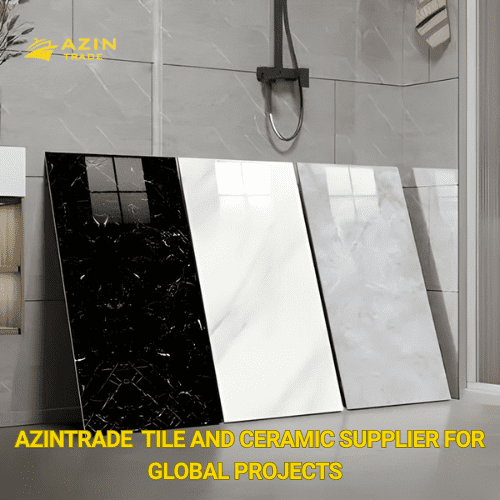
Tile and Ceramic Supplier for International Construction Projects | Bulk Export – Azintrade
Tile and Ceramic Supplier for Global Construction and Commercial Projects
Azintrade is a tile and ceramic supplier for international construction projects, delivering bulk export solutions for commercial, residential, and industrial developments worldwide. The global demand for tile and ceramic materials continues to expand as construction standards evolve and architectural expectations rise. From high-rise commercial buildings to industrial facilities, tile and ceramic products remain essential finishing components in modern construction.
The global demand for tile and ceramic products continues to expand as construction standards evolve and architectural expectations rise. From high-rise commercial buildings to industrial facilities and residential developments, tile and ceramic materials remain essential finishing components in modern construction.
As a professional tile and ceramic supplier, Azintrade provides bulk solutions tailored for international construction projects. Our supply network focuses on performance-driven ceramic tiles, porcelain tiles, and architectural surface materials designed to meet industrial standards rather than retail trends.
Tile and ceramic products are widely used in flooring systems, wall cladding, sanitary environments, hospitality projects, and heavy-traffic commercial areas. Their durability, controlled water absorption rate, and surface resistance make them suitable for demanding structural applications where performance consistency is critical.
The global construction materials market increasingly prioritizes durability, safety ratings, and compliance with international standards. A reliable tile and ceramic supplier must therefore offer not only product availability but also technical transparency, export logistics expertise, and consistent quality inspection protocols. Azintrade operates within this performance-first framework.
Types of Tile and Ceramic for Construction Projects
Understanding the differences between ceramic tiles and porcelain tiles is essential when selecting materials for international projects.
Porcelain Tiles
Porcelain tiles are manufactured at higher firing temperatures, resulting in a denser body structure and extremely low water absorption rates (typically below 0.5%). This makes porcelain tiles suitable for exterior environments, high-traffic commercial flooring, and frost-exposed installations.
Because of their compact structure, porcelain tiles demonstrate high load resistance and improved mechanical strength. Rectified edge porcelain tiles allow minimal grout lines, enhancing structural uniformity in large-format applications.
Glazed Ceramic Tiles
Glazed ceramic tiles offer controlled surface finishes, including matte, polished, and textured options. While ceramic tiles generally have higher water absorption compared to porcelain, they remain ideal for interior wall cladding, residential flooring, and decorative architectural surfaces.
Unglazed and Industrial Tiles
Unglazed tile and ceramic products are often used in industrial settings where slip resistance and durability are critical. These tiles typically feature anti-slip surface treatments and higher breaking strength ratings to withstand mechanical stress.
Heavy-Duty Construction Tiles
Industrial tile and ceramic solutions for warehouses, public infrastructure, and commercial centers require enhanced PEI ratings, surface hardness, and thickness standards ranging from 10mm to 12mm. These specifications directly impact long-term performance.
Azintrade supplies multiple grades of tile and ceramic products based on project load requirements, surface usage, and environmental exposure conditions.
Technical Specifications of Industrial Tile and Ceramic
Technical transparency defines a serious tile and ceramic supplier. For international construction projects, specifications determine suitability.
Water Absorption Classification
Water absorption levels directly affect frost resistance and structural stability. Porcelain tiles and industrial-grade tiles with <0.5% absorption meet strict performance classifications, while standard ceramic tiles may range higher depending on intended use.
PEI Rating (Abrasion Resistance)
PEI ratings (I to V) classify tile durability under foot traffic:
-
PEI I–II: Light residential use
-
PEI III–IV: Commercial environments
-
PEI V: Heavy industrial traffic
Selecting the correct tile and ceramic grade ensures lifecycle durability.
Slip Resistance (R9–R13)
Slip resistance ratings are critical in hospitality, public, and industrial flooring systems. R11–R13 ratings are recommended for high-risk or wet environments.
Breaking Strength and Thickness
Industrial tile and ceramic products typically range from 8mm to 12mm thickness, with higher thickness providing improved load distribution and mechanical durability.
Compliance Standards
International standards such as ISO 13006 and EN 14411 define classification criteria for ceramic tiles and porcelain products. Compliance with these standards ensures consistent performance across global construction markets.
Azintrade coordinates supply based on these technical parameters, aligning tile and ceramic specifications with project engineering requirements.
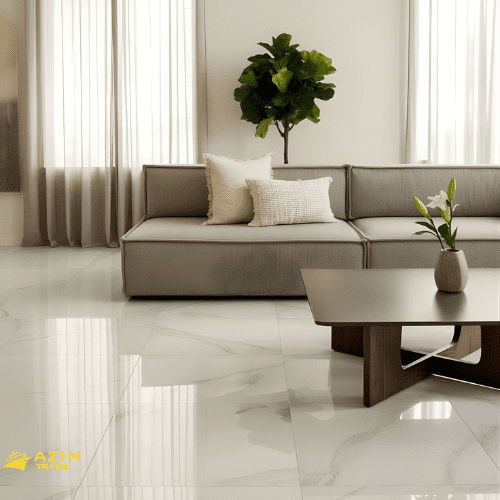
Performance Comparison of Tile and Ceramic Materials
| Specification | Standard Ceramic Tiles | Porcelain Tiles | Industrial Heavy-Duty Tiles |
|---|---|---|---|
| Water Absorption Rate | 3% – 10% | < 0.5% | < 0.5% |
| PEI Rating | II – IV | III – V | IV – V |
| Slip Resistance | R9 – R11 | R10 – R12 | R11 – R13 |
| Thickness Range | 8mm – 10mm | 8mm – 12mm | 10mm – 12mm |
| Breaking Strength | Moderate | High | Very High |
| Frost Resistance | Limited | High | High |
| Recommended Application | Interior Walls & Light Flooring | Commercial & Exterior Flooring | Industrial & High-Traffic Areas |
Interpretation: Porcelain tiles and industrial-grade tiles demonstrate superior density, mechanical strength, and long-term performance, making them ideal for demanding construction projects.
Mini Case Study: International Commercial Project
A recent commercial project in Dubai required 10,000 m² of porcelain tiles and 5,000 m² of ceramic wall tiles. Azintrade supplied:
| Material | Quantity | PEI Rating | Slip Resistance | Delivery Time |
|---|---|---|---|---|
| Porcelain Floor Tiles | 10,000 m² | V | R12 | 21 Days |
| Ceramic Wall Tiles | 5,000 m² | III | R10 | 18 Days |
Outcome: Installation met project timeline, with zero material failure. Customer feedback highlighted consistency in tile thickness and uniform color, crucial for large-scale commercial applications.
Container Loading Capacity for Export
| Container Type | Tile Type | Pallet Count | Total m² per Container |
|---|---|---|---|
| 20ft | Ceramic | 24 | 1,500 – 1,800 m² |
| 20ft | Porcelain | 22 | 1,300 – 1,600 m² |
| 40ft | Industrial Heavy-Duty | 44 | 3,000 – 3,200 m² |
Moisture-controlled packaging and secure pallet configuration minimize breakage risk during international shipping.
Global Market Statistics
| Region | Annual Tile Consumption (m²) | Growth Rate (YoY) | Popular Tile Type |
|---|---|---|---|
| Europe | 3,500,000 | 4% | Porcelain |
| Middle East | 1,800,000 | 6% | Ceramic & Porcelain |
| North America | 2,200,000 | 3.5% | Ceramic |
| Asia-Pacific | 5,000,000 | 7% | Porcelain & Glazed Tiles |
Source: Global Construction Materials Report 2026
These statistics highlight where bulk tile and ceramic suppliers like Azintrade are most competitive and demonstrate export potential in high-demand markets.
Tile and Ceramic Applications in Construction
Residential Projects
Interior flooring, bathrooms, kitchens, and balconies rely on ceramic tiles and porcelain tiles for moisture resistance and aesthetic uniformity.
Commercial Buildings
Shopping centers, office complexes, and public facilities demand tile and ceramic solutions with high PEI ratings and anti-slip surfaces for continuous foot traffic.
Hospitality Sector
Hotels and resorts require architectural surfaces that combine visual consistency with safety standards, including slip-resistant porcelain tiles.
Industrial Flooring
Warehouses and manufacturing facilities require heavy-duty tile and ceramic installations with high breaking strength and chemical resistance.
Outdoor Areas
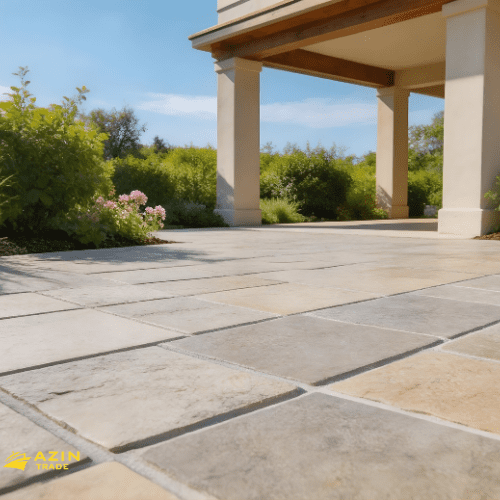
Exterior applications require frost-resistant porcelain tiles with minimal water absorption to prevent structural damage.
Why Azintrade as Your Tile and Ceramic Supplier
Azintrade functions within a global supply network designed for construction-scale orders rather than small retail transactions. Our approach emphasizes:
-
Project-specific sourcing
-
Quality inspection before shipment
-
Industrial packaging standards
-
Bulk order coordination
-
International logistics management
By focusing on construction materials supply, Azintrade integrates tile and ceramic distribution with complementary building materials, supporting contractors and developers across multiple regions.
Frequently Asked Questions
What is the difference between porcelain and ceramic tiles?
Porcelain tiles are denser and have lower water absorption than standard ceramic tiles, making them more suitable for heavy traffic and exterior applications.
Which tile is best for commercial flooring?
Commercial flooring typically requires porcelain tiles with PEI IV or V ratings and appropriate slip resistance classification.
What is PEI rating in ceramic tiles?
PEI rating measures abrasion resistance and indicates suitability for different traffic levels.
How many square meters fit in a 20ft container?
Container capacity depends on tile thickness and pallet configuration, but industrial loading optimization ensures maximum safe volume.
Are porcelain tiles waterproof?
Porcelain tiles are highly water-resistant due to their low absorption rate, though proper installation and grouting remain essential.
What standards define tile quality?
Standards such as ISO 13006 and EN 14411 define technical classification and performance criteria.