
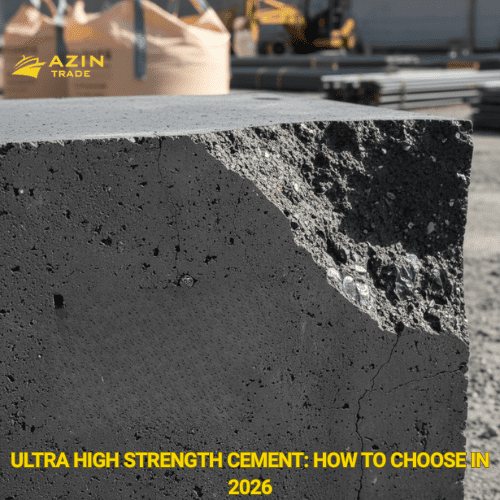
Ultra High Strength Cement: How to Choose the Strongest Option in 2026
Introduction
Ultra high strength cement is a critical material in modern construction, especially as buildings grow taller, structures become heavier, and engineering tolerances tighten. In 2026, relying on conventional cement is no longer sufficient for many structural applications where safety, durability, and long service life are non-negotiable.
This advanced cement category is now widely used in high-rise buildings, bridges, precast systems, industrial floors, and marine structures. Selecting the right ultra high strength cement directly affects structural performance, construction efficiency, lifecycle cost, and long-term durability.
This guide explains what defines ultra high strength cement, how it differs from ordinary cement, the technical factors that matter most, and how to choose the strongest and most reliable option in 2026.
What Defines Ultra High Strength Cement?
Ultra high strength cement refers to engineered cementitious materials capable of achieving compressive strengths far beyond traditional cement. While ordinary Portland cement typically supports concrete strengths of 30–50 MPa, ultra high strength cement enables strengths above 80 MPa and can reach 120–150 MPa in optimized systems.
This exceptional performance is achieved through precise clinker chemistry, controlled mineral phases, advanced grinding technology, and the strategic use of supplementary cementitious materials. As a result, ultra high strength cement often forms the backbone of ultra high performance concrete (UHPC) used in demanding structural environments.
Ultra High Strength Cement vs Ordinary Cement
The difference between ultra high strength cement and ordinary cement goes far beyond compressive strength.
Ultra high strength cement provides lower permeability, superior abrasion resistance, and enhanced durability in aggressive conditions such as marine exposure, chemical attack, and heavy cyclic loading. Ordinary cement, while suitable for residential and light commercial construction, lacks the resilience required for long-span structures and extreme environments.
Using ordinary cement in high-demand projects often leads to thicker sections, higher material consumption, increased maintenance, and a reduced service life.
Key Technical Factors That Affect Ultra High Strength Cement Performance
Clinker Quality in Ultra High Strength Cement
Clinker quality is the foundation of ultra high strength cement. High alite (C3S) content, controlled belite (C2S), minimal free lime, and stable mineral phases ensure predictable strength development and long-term durability. Poor clinker quality limits achievable performance regardless of later processing.
Cement Fineness and Particle Size Control
Ultra high strength cement requires precise grinding. Finer particles accelerate hydration and improve early strength, but excessive fineness increases water demand and reduces workability. Leading manufacturers carefully optimize particle size distribution to balance strength and practicality.
Additives and Supplementary Materials in Ultra High Strength Cement
Silica fume, slag, fly ash, and limestone fillers play a critical role in enhancing strength and durability. When correctly proportioned, these materials reduce porosity, improve bonding, and enhance long-term performance rather than simply reducing cost.
Manufacturing Precision and Quality Testing
True ultra high strength cement comes from controlled kiln operation, continuous laboratory testing, and multi-stage strength verification. Consistent quality separates engineered high-performance cement from products driven mainly by marketing claims.
Where Ultra High Strength Cement Is Used
Ultra high strength cement is essential in projects where structural failure is not an option, including:
-
High-rise and super-tall buildings
-
Bridges, tunnels, and heavy infrastructure
-
Precast and prestressed concrete elements
-
Industrial floors and heavy-load slabs
-
Marine and offshore structures
-
Defense and security-related facilities
In these applications, cement selection becomes a strategic engineering decision rather than a simple procurement choice.
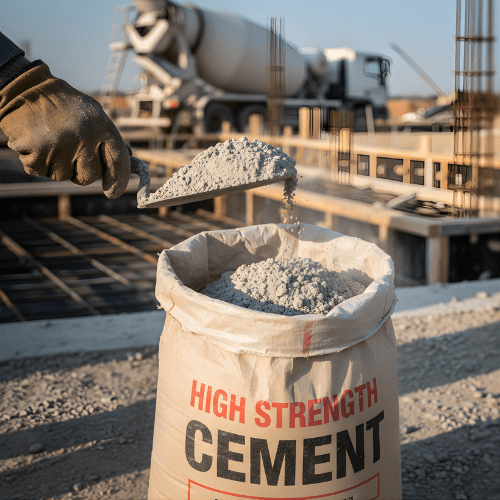
How to Choose the Right Ultra High Strength Cement
Verify Certified Strength Data
Always review certified test results based on ASTM or EN standards. Reliable suppliers provide documented 7-day, 28-day, and long-term strength data.
Ensure Consistency and Supply Stability
Strength consistency across production batches is critical. Variability increases structural risk, causes construction delays, and raises overall project cost.
Test Compatibility With Mix Components
Ultra high strength cement must be compatible with admixtures and aggregates. Pre-project testing prevents workability problems, delayed setting, and unexpected strength loss.
Evaluate Durability Beyond Strength
High compressive strength alone does not guarantee durability. Resistance to chloride penetration, sulfate attack, freeze-thaw cycles, and chemical exposure is equally important.
Choose Technically Supportive Suppliers
Experienced suppliers provide mix design guidance, technical documentation, and on-site support, significantly reducing execution risk.
Ultra High Strength Cement Market Trends in 2026
Infrastructure-Driven Demand Growth
Major infrastructure investments across Asia, the Middle East, and emerging markets continue to drive demand for ultra high strength cement solutions.
Shift Toward Low-Carbon Ultra High Strength Cement
Manufacturers increasingly reduce CO₂ emissions through optimized clinker ratios, alternative binders, and energy-efficient production without sacrificing strength.
Growth of Precast and Modular Construction
Precast producers rely on ultra high strength cement to achieve faster curing, slimmer structural elements, and improved factory productivity.
Digital Quality Control and Automation
Advanced cement plants now use real-time monitoring and automated testing to maintain consistent quality across global supply chains.
Common Risks When Using Ultra High Strength Cement
Despite its advantages, improper use can create challenges. Over-specification increases costs unnecessarily, while poor curing limits achievable strength. Incompatibility with admixtures and unstable supply chains also pose significant risks.
Early testing, careful supplier selection, and structured quality control planning effectively mitigate these issues.
Conclusion
Ultra high strength cement plays a central role in modern high-performance construction. In 2026, choosing the strongest option requires more than chasing the highest MPa value.
Successful projects evaluate verified strength, clinker quality, durability, environmental resistance, and supplier expertise. A structured selection approach improves safety, controls lifecycle costs, and delivers long-term structural value.
(FAQ)
What is ultra high strength cement?
Ultra high strength cement is an engineered cement designed to enable concrete strengths above 80 MPa for demanding structural applications.
Is ultra high strength cement suitable for all projects?
No. It is best suited for projects where high loads, durability requirements, or reduced structural dimensions justify the higher material cost.
Does higher strength always mean better durability?
Not necessarily. Durability also depends on permeability, curing quality, mix design, and material compatibility.
Is ultra high strength cement more expensive than ordinary cement?
Yes, but it often reduces total project cost by allowing thinner sections and lowering long-term maintenance needs.
Can ultra high strength cement reduce structural dimensions?
Yes. Higher strength enables slimmer designs without compromising safety or performance.
Related Technical Guides :