
Azintrade Iran Exporter: The Complete Guide to Cement, Clinker, Gypsum, and Tile Exports
If you’re researching Azintrade as a potential Iran exporter, you’re probably comparing it against a handful of other trading companies that all sound similar on the surface. This guide breaks down what Azintrade actually offers, product by product, with direct links to the specifics — not just a sales pitch.
Who Is Azintrade and Why Buyers Search for This Iran Exporter
Most Iranian export companies pick one lane and stay in it. Azintrade didn’t.
Azintrade operates as a multi-category exporter of construction and industrial materials from Iran, covering cement, clinker, gypsum, ceramics and tiles, and natural stone. According to the company’s About Us page, the business focuses specifically on export and import of high-quality construction materials, with cement, gypsum, clinker, and ceramics named as its core categories. That range matters more than it might sound. A buyer sourcing cement for one project and gypsum board for another usually has to deal with two separate suppliers — Azintrade positions itself to handle both from a single point of contact.
This kind of research usually comes up at a specific moment: a buyer has a shortlist of two or three Iranian exporters, each with a website that says roughly the same thing about quality and reliability, and no easy way to tell them apart without digging into the actual product pages. That’s the gap this guide is meant to close. Rather than repeating Azintrade’s own marketing language, it walks through what’s actually documented on the company’s site — product by product, with the trade data and certifications that back each claim — so you can compare it against other options on substance rather than tone.
What Makes Azintrade Different From Other Iran Cement and Clinker Exporters
Most competing Iranian export companies specialize narrowly, and that narrowness is worth understanding before comparing prices.
A lot of Iran-based exporters in this space focus almost entirely on one product — white cement, or clinker, or gypsum — and build their entire pitch around that single category. That’s not a criticism; specialization has real advantages for buyers who only need one thing. But for a buyer managing a larger project, or a trading company that resells multiple materials, working with a single-category supplier means juggling separate contracts, separate shipping schedules, and separate quality checks across different vendors. Azintrade’s structure — spanning cement, gypsum stone and powder, and ceramic tiles under one company — is built around consolidating that into fewer relationships.
Azintrade Iran Exporter: Cement and Clinker Export Capabilities
Cement and clinker sit at the center of Azintrade’s product range, and this is where the company’s export documentation gets the most specific.
Cement Types: OPC, SRC, and White Cement
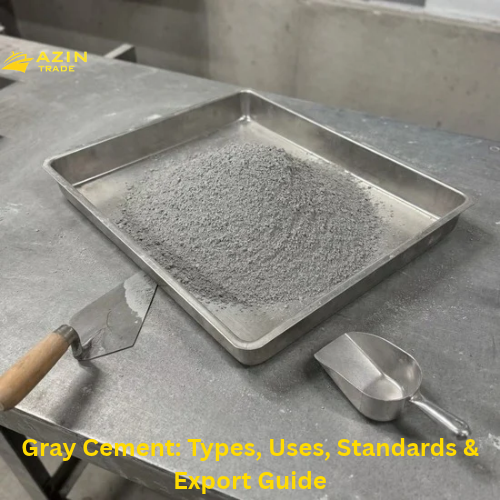
Azintrade’s cement lineup covers Ordinary Portland Cement (OPC) and Sulphate Resistant Cement (SRC) for standard construction use, alongside White Cement for architectural and decorative applications. This range matches what most import markets actually order — general construction accounts for the bulk of demand, with white cement serving a smaller but higher-margin decorative segment.
Clinker: OPC Clinker, Type 5, and White Cement Clinker
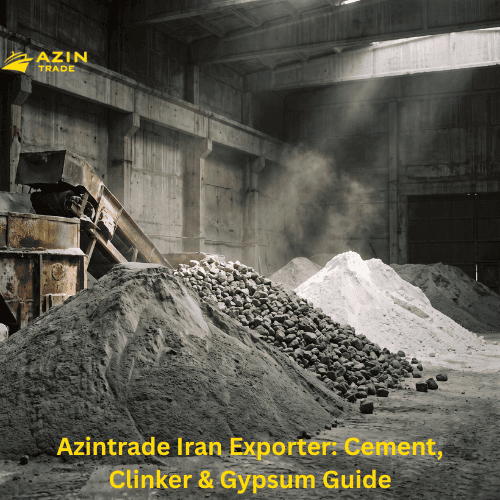
On the clinker export side, Azintrade states its clinker meets ASTM and EN international standards, with quality control backed by laboratory-tested specifications before shipment. The company also maintains a dedicated clinker supplier page covering regional demand trends, noting that countries like Iraq, Kuwait, Qatar, Bahrain, and Oman increasingly source clinker internationally to meet construction needs — a trend Iran has positioned itself to serve directly.
This matters in context. Iran ranked sixth among the world’s largest cement-producing countries in 2023, producing 65 million metric tons of cement with a clinker production capacity of 81 million metric tons, according to data reported by PressTV. More recent figures from Global Cement’s 2026 industry report show Iran’s clinker production held stable at 43.0 million tons in the first seven months of 2025, even as domestic cement consumption dipped — meaning a meaningful share of that clinker output is available for export rather than tied up in domestic use.
That gap between production and domestic consumption is worth sitting with for a moment, because it’s the actual economic reason Iranian clinker shows up so consistently across Gulf and South Asian import markets. When a country’s cement plants are running at capacity but domestic demand softens, as the Global Cement figures suggest happened through mid-2025, exporters have both the incentive and the surplus volume to compete aggressively on price into neighboring markets. That’s the environment Azintrade’s clinker documentation is operating in — not a niche export activity, but a structural feature of how Iran’s cement industry currently balances supply against a domestic market that isn’t absorbing everything the plants can produce.
Azintrade Iran Exporter: Gypsum Stone and Powder Products
Gypsum is where Azintrade’s export data gets genuinely specific, and it’s worth looking at the actual numbers rather than taking the category on faith.
The company’s gypsum stone page reports that Iran’s raw gypsum rock exports reached $70 million in 2025, a 40% increase from 2020, while gypsum powder exports more than doubled over the same period to reach $34 million. Iraq, Kuwait, the UAE, Oman, India, Pakistan, and Afghanistan all appear as consistent destination markets. Azintrade’s separate coverage of gypsum export to India and its broader piece on gypsum’s growing global demand both reinforce the same pattern: this isn’t a side product for the company, it’s a category with its own dedicated export infrastructure.
The shift the company documents — powder exports growing faster than raw stone exports — reflects something happening across the Iranian gypsum sector more broadly, not just at Azintrade. Processing raw rock into calcined powder domestically before export captures more value per shipment than sending unprocessed stone abroad, and it’s a trend worth watching if you’re comparing suppliers: an exporter investing in powder-grade processing capacity is generally positioning for longer-term growth rather than treating gypsum as a low-margin bulk commodity.
Azintrade’s Ceramic and Tile Export Division
Construction materials buyers don’t always think to check whether their cement supplier also handles finishing materials, but for this Iran exporter, tiles are a full product line rather than an afterthought.
The company’s tile and ceramic supplier page covers both ordinary and porcelain tile categories for bulk export. Azintrade has also published specific regional coverage, including its analysis of ceramic tile export growth to the Middle East and a broader look at leading global ceramic exporters that positions Iranian manufacturing within that wider competitive landscape.
This matters for a specific reason: buyers importing cement or clinker for a construction project frequently need interior and exterior finishing materials for the same project a few months later. A supplier who only handles structural materials forces that buyer to start a second sourcing process from scratch once the project reaches the finishing stage. Azintrade’s tile catalog, sitting alongside its cement and gypsum lines, is built to capture that second phase of the same project rather than losing the relationship to a separate ceramic-specific exporter.
Azintrade’s Reach Into Natural Stone and Regional Markets
Beyond manufactured materials, this Iran exporter’s activity extends into natural stone, which says something about how the company scopes its regional strategy.
The company’s coverage of building stone exports to Uzbekistan shows a deliberate push into Central Asian markets specifically, rather than treating every export destination the same way. That regional specificity — tailoring product focus and market analysis to individual countries instead of publishing generic “we ship worldwide” claims — is a pattern that shows up consistently across Azintrade’s product coverage, and it’s part of what separates a genuine export operation from a directory listing.
What to Verify Before Committing to Any Iran Exporter (Azintrade Included)
None of this is specific to Azintrade — it’s the same due diligence that applies to any Iranian export relationship, and it’s worth stating plainly rather than assuming buyers already know it.
- Ask for a sample or trial shipment first. A supplier confident in their product quality won’t push back hard on a smaller initial order.
- Confirm the actual production source. Trading companies that source from multiple manufacturers should be able to name which plant is supplying your specific order, especially for cement and clinker where plant-level quality can vary.
- Get freight and FOB pricing broken out separately. A single bundled quote makes it harder to compare against other suppliers or to catch inflated freight markups.
- Clarify payment terms in writing before any deposit moves. Given banking restrictions that affect some Iranian trade routes, confirm exactly how funds will transfer between your bank and theirs.
- Check whether the company publishes region-specific detail or only generic claims. Azintrade’s dedicated pages on Uzbekistan stone exports and India gypsum trade, for instance, are a useful signal — they suggest real shipping experience on those specific routes rather than a boilerplate “we ship worldwide” statement.
Running through this list takes maybe twenty minutes and will tell you more about a supplier’s reliability than any amount of website copy.
Certifications and Quality Standards Azintrade References
Certifications are where buyers should slow down and actually check claims rather than take a supplier’s word for it.
Azintrade’s clinker export documentation references compliance with ASTM and EN international standards, paired with what the company describes as laboratory-tested specifications ahead of shipment. For any Iran exporter — Azintrade included — the reasonable next step for a serious buyer is requesting the actual certificate of analysis for a specific order, not just a general statement of compliance on a webpage. A supplier that hands this over without hesitation is telling you more than any marketing copy could.
What Affects Pricing Across Azintrade’s Product Lines
Price comparisons between exporters only mean something once you know what’s actually driving the number, and this holds true whether you’re buying clinker, gypsum, or tile from this or any other Iran exporter.
Across all of Azintrade’s categories, a handful of factors consistently move the final delivered cost:
- Product grade and specification — white cement and porcelain tile carry higher per-unit costs than standard OPC or ordinary ceramic tile, reflecting the more demanding production process behind each.
- Order volume — bulk clinker or cement orders unlock better per-ton pricing than smaller trial shipments, and the same logic applies to jumbo-bag gypsum orders versus retail-sized bags.
- Shipping mode and destination — overland routes into neighboring countries like Iraq, Afghanistan, or Central Asian markets typically land cheaper than sea-freight destinations further afield, simply because of shorter transit distances.
- Currency movements — since most Iranian export contracts settle in US dollars, exchange rate shifts on either side of a deal affect the final landed price regardless of the product category.
A transparent exporter should be willing to break these factors apart on request rather than folding everything into a single flat number. That transparency is arguably a better signal of reliability than the headline price itself.
Regions This Iran Exporter Ships To
Product range matters less if the shipping routes don’t match your location, so it’s worth mapping where Azintrade’s stated coverage actually lands.
Based on the company’s published regional coverage, Azintrade’s export activity spans:
- Middle East — Iraq, Kuwait, Qatar, Bahrain, Oman, and the wider Gulf region for cement, clinker, and gypsum. This region benefits from Iran’s proximity across the Persian Gulf and established shipping lanes out of southern Iranian ports.
- South Asia — India, Pakistan, and Afghanistan, particularly for gypsum and clinker. Overland routes into Afghanistan and Pakistan give Iranian exporters a cost advantage over sea-freight competitors serving the same markets.
- Central Asia — Uzbekistan and neighboring markets for natural stone and construction materials, an area where Azintrade has published specific market analysis rather than treating it as a generic export destination.
- Broader international markets — general cement and ceramic tile distribution referenced across the company’s product pages, extending beyond the immediate regional footprint into longer-distance sea-freight markets.
Buyers outside these specifically documented regions should still inquire directly, since published case studies don’t necessarily reflect the full extent of a company’s shipping capability. A company that documents Uzbekistan and India-specific trade data in detail is, at minimum, demonstrating that it treats individual markets as distinct rather than running a one-size-fits-all export operation — and that’s worth something even for buyers in a market the company hasn’t written about yet.
My Take: Is This Iran Exporter Reliable for Bulk Sourcing?
Since the honest answer matters more than a polished one, here’s my actual read after going through the company’s published material in detail.
Azintrade’s biggest genuine strength is breadth — very few Iranian export companies cover cement, clinker, gypsum, ceramics, and stone under one roof with dedicated, product-specific documentation for each category. That’s a real differentiator, not just marketing language, and it solves a real logistical headache for buyers who’d otherwise manage multiple supplier relationships. Where I’d push back a little: the company’s own content occasionally repeats itself across several pages covering very similar ground on clinker exports specifically, which makes it slightly harder for a buyer — or for Google, for that matter — to land on one definitive resource per topic. My honest advice to anyone evaluating Azintrade is to use the specific product pages linked throughout this guide rather than relying on the homepage alone, since that’s where the actual technical detail lives.
How to Start an Order With This Iran Exporter
The process for a first order looks similar across most serious Iranian export companies, and Azintrade follows that general pattern.
- Identify your product and specification — cement type, clinker grade, gypsum mesh size, or tile category and size.
- Request a quotation — including FOB pricing, and ask for freight estimates to your specific port or border crossing separately.
- Ask for lab documentation — certificates of analysis or conformity for your specific product line, not a generic company brochure.
- Confirm packaging and shipping method — bulk, bagged, or containerized, depending on your storage and handling setup.
- Agree on payment terms — typically a partial advance with balance against shipping documents for new buyers.
Frequently Asked Questions
What products does Azintrade export from Iran?
Azintrade exports cement (OPC, SRC, and White Cement), clinker (OPC Clinker, Type 5, and White Cement Clinker), gypsum stone and powder, ceramic and porcelain tiles, and natural building stone.
Is Azintrade a manufacturer or a trading company?
Azintrade operates as an export and trading company, sourcing from established Iranian manufacturers and cement plants rather than operating its own production facilities directly.
Which countries does Azintrade export to?
Based on the company’s published coverage, key markets include Iraq, Kuwait, Qatar, Bahrain, Oman, India, Pakistan, Afghanistan, and Uzbekistan, alongside broader international cement and ceramic distribution.
Does Azintrade provide quality certificates for its products?
Azintrade states that its clinker meets ASTM and EN international standards with laboratory-tested specifications. Buyers should request the specific certificate of analysis for their order before finalizing a contract.
Is Azintrade really an Iran exporter of multiple product categories?
Most competing exporters in this space specialize in a single product category. Azintrade’s range across cement, clinker, gypsum, tiles, and stone allows buyers to consolidate multiple material needs through one supplier relationship.
What is the minimum order quantity for Azintrade products?
This varies by product and shipping method — bulk clinker and cement orders typically involve larger minimums than bagged gypsum powder or containerized tile shipments. Confirming MOQ directly for your specific product is the reliable approach.
How do I contact Azintrade for a quote?
The company’s product pages, including its clinker export page and tile and ceramic supplier page, include direct contact routes for requesting quotations and technical data sheets.
Does Azintrade offer both bulk and smaller trial orders?
Product pages across the site reference flexible order structures, though exact minimums vary by category. Bulk clinker and cement shipments typically involve container or vessel-scale volumes, while gypsum powder and tile orders can often start smaller for first-time buyers testing the relationship.
Is Azintrade affected by sanctions on Iranian exports?
Like most Iranian trading companies, Azintrade operates within the banking and logistics constraints that affect Iran’s export sector generally. Buyers should clarify payment routing and any compliance requirements specific to their own country before finalizing a contract.
Get in Touch with Azintrade, Your Iran Exporter Partner
If you’re comparing Iran exporters for cement, clinker, gypsum, or tile sourcing, Azintrade covers all four categories under one company, with dedicated documentation for each product line linked throughout this guide.
Reach out directly through Azintrade’s official site to request current pricing, certifications, and shipping details for your specific order.