
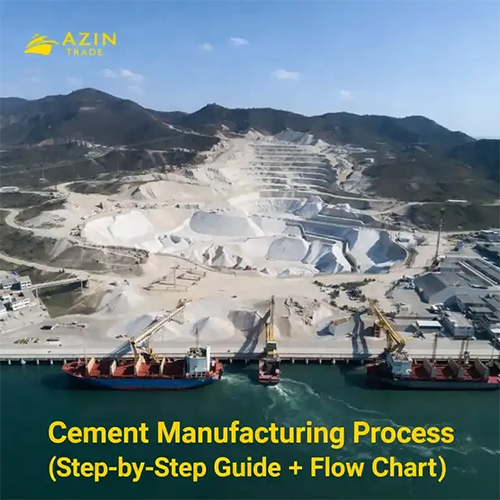
Cement Manufacturing Process: From Raw Materials to Final Cement Production :
The cement manufacturing process is a complex industrial procedure that transforms raw materials such as limestone, clay, and gypsum into one of the most essential construction materials used worldwide.”
Cement is one of the most important construction materials in the modern world. It is the fundamental ingredient used to produce concrete, mortar, and various building materials that support infrastructure, housing, bridges, roads, dams, and industrial facilities.
Understanding the **cement manufacturing process** is essential for engineers, construction professionals, and industrial buyers who rely on consistent cement quality for structural safety and durability.
Modern cement plants use advanced industrial systems and strict quality control procedures to convert raw natural materials into high‑performance cement products. The process involves several carefully controlled steps including raw material extraction, crushing, grinding, heating, clinker production, and final cement grinding.
This guide explains the **cement production process step by step**, the raw materials involved, the main equipment used in cement plants, and the different types of cement commonly manufactured in modern industrial facilities.
What is Cement?
Cement is a fine gray powder that acts as a **hydraulic binder**. When mixed with water, it forms a paste that hardens over time and binds sand, gravel, and aggregates together to create concrete.
The most common type is **Portland cement**, which is produced by heating a mixture of limestone and clay at high temperatures to form clinker. The clinker is then ground with small amounts of gypsum to produce the final cement powder.
Cement plays a crucial role in construction because it provides:
– Structural strength
– Durability
– Resistance to environmental conditions
– Long service life for buildings and infrastructure
Because of these properties, cement is one of the most widely produced industrial materials in the world.
Raw Materials Used in Cement Manufacturing
The cement manufacturing process begins with the extraction of natural raw materials from quarries. These materials provide the chemical components required to form clinker.
The primary raw materials include:
Limestone
Limestone is the main ingredient in cement production. It provides calcium carbonate, which supplies the calcium oxide needed for clinker formation.
Typically, limestone accounts for **70–80% of the raw mix**.
Clay
Clay contributes silica, alumina, and iron compounds that react with calcium during the kiln process.
Silica Sand
Silica helps form the silicate compounds responsible for cement strength.
Iron Ore
Iron ore is sometimes added to adjust the chemical composition of the raw mix and improve clinker formation.
These materials are carefully proportioned to achieve the desired chemical balance before entering the production process.
Chemical Composition of Cement
The performance of cement depends largely on its chemical composition. The main compounds found in Portland cement include:
– Calcium Oxide (CaO)
– Silicon Dioxide (SiO₂)
– Aluminum Oxide (Al₂O₃)
– Iron Oxide (Fe₂O₃)
During the kiln process, these oxides combine to form clinker minerals such as:
– Tricalcium Silicate (C₃S)
– Dicalcium Silicate (C₂S)
– Tricalcium Aluminate (C₃A)
– Tetracalcium Aluminoferrite (C₄AF)
These compounds control the strength, setting time, and durability of cement.
Cement Manufacturing Process Step by Step
The **cement manufacturing process** involves several sequential stages that transform raw materials into finished cement.
1. Quarrying and Raw Material Extraction
The process begins in limestone quarries where large deposits of limestone are extracted using drilling and blasting techniques.
2. Crushing
Large rocks of limestone and other raw materials are reduced in size using crushers. The crushing process ensures that the materials are small enough for efficient grinding and mixing.
Primary crushers and secondary crushers are commonly used in this stage.
3. Raw Material Grinding
After crushing, the raw materials are fed into **raw mills**, where they are ground into a fine powder known as *raw meal*. This powder must be extremely fine to ensure proper chemical reactions in the kiln.
Grinding is usually performed using vertical roller mills or ball mills.
4. Homogenization
The raw meal is stored in large silos where it is blended to create a uniform chemical composition. Proper homogenization ensures consistent clinker quality and stable kiln operation.
5. Preheating
The raw meal enters a **preheater tower**, where it is heated by hot gases coming from the rotary kiln. This stage removes moisture and begins the chemical decomposition process.
Preheaters significantly improve energy efficiency in modern cement plants.
6. Calcination
In the calcination stage, the raw meal is heated to around **850–900°C**. At this temperature, calcium carbonate decomposes into calcium oxide and carbon dioxide.
This chemical reaction is essential for the formation of clinker minerals.
7. Clinker Formation in the Rotary Kiln
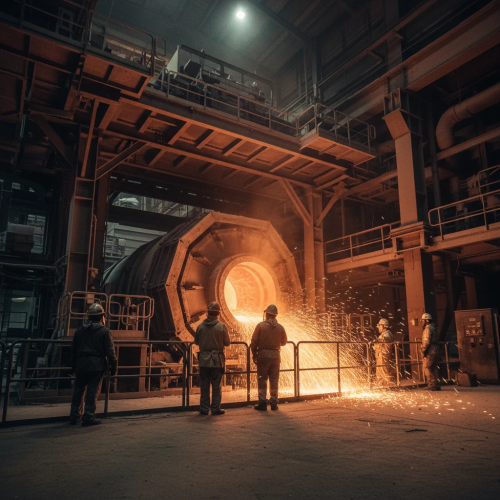
The partially processed material enters the **rotary kiln**, the heart of the cement plant.
Inside the kiln, temperatures reach **around 1450°C**. At this extreme heat, the raw materials melt and react to form clinker nodules.
The rotary kiln slowly rotates, allowing the materials to move gradually through different temperature zones until clinker formation is complete.
8. Clinker Cooling
Hot clinker exiting the kiln must be cooled rapidly to preserve its mineral structure.
Clinker coolers use powerful air systems to reduce the temperature from over 1000°C to around 100°C. The recovered hot air is often reused in the kiln process to improve energy efficiency.
9. Cement Grinding
The cooled clinker is mixed with a small amount of **gypsum** and ground into a very fine powder in cement mills.
Gypsum controls the setting time of cement and prevents flash setting.
The final product is the cement powder used in construction.
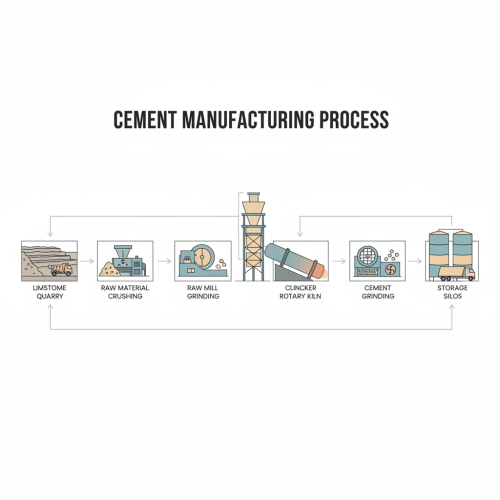
Cement Manufacturing Flow Diagram
In a typical cement plant, the production flow follows this sequence:
Raw Material Quarry → Crushing → Raw Grinding → Homogenization → Preheating → Calcination → Rotary Kiln → Clinker Cooling → Cement Grinding → Storage → Packaging
This integrated process ensures efficient large‑scale production and consistent product quality.
Main Equipment Used in Cement Plants
Modern cement plants rely on specialized industrial equipment designed to operate continuously under extreme conditions.
Important equipment includes:
– Quarry drilling machines
– Jaw and impact crushers
– Raw mills
– Preheater towers
– Precalciner systems
– Rotary kilns
– Clinker coolers
– Cement mills
– Storage silos
– Packing machines
These systems work together to maintain stable production and consistent cement quality.
Quality Control in Cement Production
Quality control is a critical aspect of cement manufacturing. Cement plants perform continuous testing during production to ensure the final product meets international standards.
Common quality control tests include:
– Chemical composition analysis
– Fineness testing
– Setting time measurement
– Compressive strength testing
– Soundness tests
Advanced laboratories and automated monitoring systems help maintain consistent product quality.
Types of Cement Manufactured in Modern Plants
Modern cement plants often produce multiple types of cement to meet different construction needs.
Ordinary Portland Cement (OPC)
OPC is the most widely used type of cement. It is suitable for general construction including buildings, bridges, and infrastructure projects.
Portland Pozzolana Cement (PPC)
PPC contains pozzolanic materials such as fly ash. It offers improved durability and resistance to chemical attack.
Sulfate Resistant Cement
This cement is designed for environments with high sulfate exposure, such as marine structures and sewage systems.
White Cement
White cement is produced using raw materials with very low iron content. It is commonly used for decorative architectural applications.
Oil Well Cement
Oil well cement is used in oil and gas drilling operations where cement must withstand extremely high pressure and temperature.
Clinker
Some cement plants also produce and export clinker as an intermediate product used by grinding plants worldwide.
Applications of Cement
Cement is used in a wide range of construction and industrial applications, including:
– Residential buildings
– Commercial structures
– Highways and bridges
– Dams and water infrastructure
– Industrial plants
– Marine construction
– Oil and gas wells
Its versatility and strength make it essential for modern infrastructure development.
Environmental Impact of Cement Production
The cement industry is energy‑intensive and contributes to global carbon dioxide emissions.
To reduce environmental impact, modern plants implement several sustainability strategies:
– Energy‑efficient kiln systems
– Waste heat recovery
– Alternative fuels
– Clinker substitution
– Carbon emission monitoring
These innovations help reduce the environmental footprint of cement production.
The Future of Sustainable Cement
Research and technological development are driving the cement industry toward more sustainable production methods.
Emerging solutions include:
– Low‑carbon cement formulations
– Carbon capture technologies
– Alternative raw materials
– Improved energy efficiency
– Recycling industrial by‑products
These innovations aim to reduce emissions while maintaining the performance required for modern construction.
Frequently Asked Questions
How is cement manufactured?
Cement is manufactured by heating a mixture of limestone, clay, and other materials in a rotary kiln to produce clinker. The clinker is then ground with gypsum to form cement powder.
What temperature is required to produce clinker?
Clinker formation occurs at temperatures of approximately **1450°C** inside a rotary kiln.
What is the difference between clinker and cement?
Clinker is the intermediate product formed in the kiln, while cement is the final powder produced by grinding clinker with gypsum.
Why is gypsum added to cement?
Gypsum controls the setting time of cement and prevents rapid hardening during mixing.
Conclusion
The **cement manufacturing process** is a complex industrial operation that transforms natural raw materials into one of the most important construction materials in the world.
From quarrying limestone to producing finely ground cement powder, each step of the process requires precise control, advanced equipment, and strict quality monitoring.
Modern cement plants use energy‑efficient technologies and environmental management systems to ensure sustainable production while maintaining the high performance required for construction and infrastructure development.
Understanding how cement is produced helps engineers, builders, and industry professionals appreciate the technology and expertise behind this essential material used in modern construction.