
Cement Manufacturing Process: Composition, Types, Properties and Industrial Applications
What Is Cement and Why It Is Essential in Modern Construction?
Cement is a hydraulic binding material that reacts chemically with water to form a hard, stone‑like mass. It is the fundamental ingredient in concrete, mortar, and grout, making it indispensable in infrastructure, residential buildings, and industrial construction.
When cement is mixed with water, a process called hydration begins. During hydration, cement compounds react to form calcium silicate hydrate (C‑S‑H), the primary compound responsible for mechanical strength in hardened concrete.
Cement is not simply powdered stone. It is a precisely engineered material whose chemical composition directly controls strength development, durability, permeability, and resistance to environmental attacks.
Cement Composition and Chemical Structure
Cement is primarily produced by grinding clinker with gypsum. The mineral composition of cement determines its performance characteristics.
Main Chemical Compounds in Cement
| Compound | Abbreviation | Function |
|---|---|---|
| Tricalcium Silicate | C3S | Early strength development |
| Dicalcium Silicate | C2S | Long‑term strength |
| Tricalcium Aluminate | C3A | Controls setting time |
| Tetracalcium Aluminoferrite | C4AF | Influences color and minor strength |
Typical Oxide Composition of Cement
| Oxide | Percentage Range |
|---|---|
| Calcium Oxide (CaO) | 60–67% |
| Silicon Dioxide (SiO₂) | 17–25% |
| Aluminum Oxide (Al₂O₃) | 3–8% |
| Iron Oxide (Fe₂O₃) | 0.5–6% |
| Gypsum (CaSO₄·2H₂O) | 3–5% |
Gypsum is added to control the setting time of cement. Without gypsum, cement would set almost immediately after adding water.
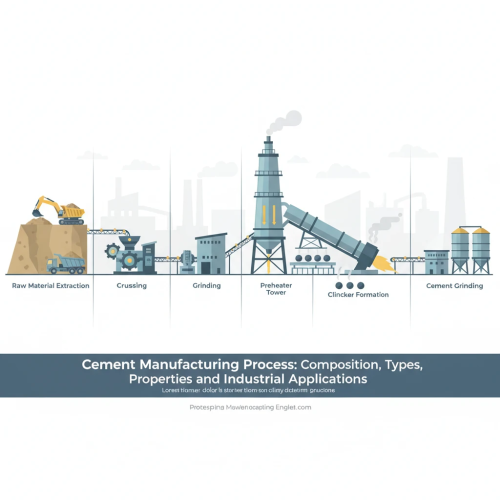
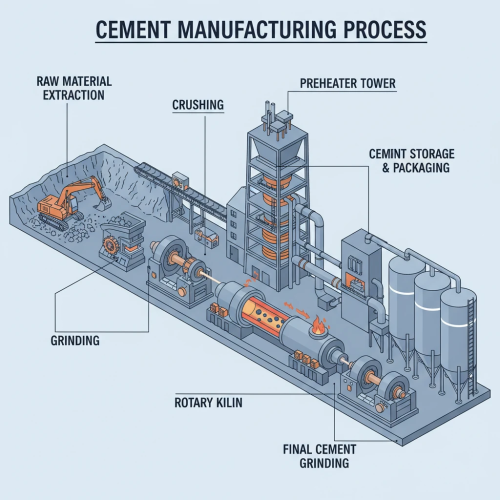
Cement Manufacturing Process Step by Step
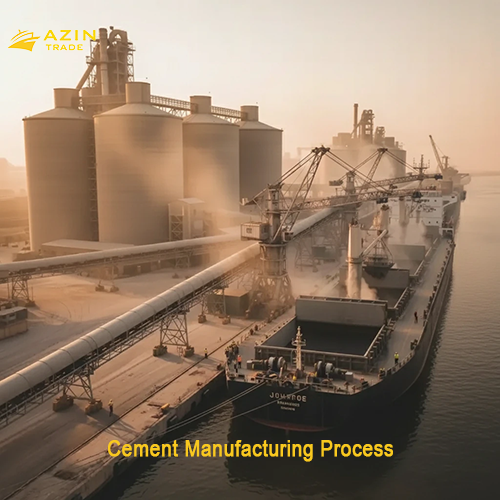
Cement production is a highly controlled industrial process involving multiple stages.
1. Raw Material Extraction and Crushing
Limestone and clay are extracted from quarries and crushed into smaller fragments. Chemical consistency at this stage is critical for the final cement quality.
2. Raw Meal Grinding and Homogenization
Crushed materials are finely ground and blended into a uniform raw meal to ensure proper chemical balance before kiln processing.
3. Preheating and Calcination
The raw meal is heated in a preheater tower. At approximately 850°C, limestone decomposes:
CaCO₃ → CaO + CO₂
This calcination stage accounts for a large portion of cement industry carbon emissions.
4. Clinker Formation in Rotary Kiln
At temperatures around 1450°C, clinker nodules form through partial melting and solid‑state reactions.
5. Clinker Grinding and Cement Production
Clinker is cooled and then ground with gypsum to produce cement. Additional materials such as fly ash or slag may be blended to produce different cement types.
Types of Cement Used in Construction
Different construction needs require different cement formulations.
Ordinary Portland Cement (OPC)
The most widely used cement for general construction applications.
Portland Pozzolana Cement (PPC)
Contains pozzolanic materials that improve durability and reduce permeability.
Sulfate Resistant Cement
Designed with low C3A content for use in aggressive soil or marine environments.
Rapid Hardening Cement
Contains higher C3S content for faster strength development.
Low Heat Cement
Used in mass concrete structures such as dams to reduce thermal cracking.
Physical and Mechanical Properties of Cement
Cement performance is evaluated using standardized laboratory tests.
| Property | Importance |
|---|---|
| Fineness | Affects strength development |
| Setting Time | Controls workability |
| Compressive Strength | Determines structural capacity |
| Soundness | Ensures volume stability |
| Heat of Hydration | Controls thermal performance |
Finer cement particles increase early strength but may also increase water demand.
Applications of Cement in Modern Infrastructure
Cement is widely used in:
- Reinforced concrete buildings
- Bridges and highways
- Tunnels and dams
- Marine structures
- Precast concrete elements
- Industrial flooring
Without cement, modern urbanization and infrastructure development would not be possible.
Environmental Impact of Cement Production
Cement production contributes approximately 7–8% of global CO₂ emissions.
Major emission sources include:
- Limestone calcination
- Fossil fuel combustion
- Electricity consumption
Sustainable strategies include:
- Reducing clinker factor
- Using alternative fuels
- Carbon capture technologies
- Using supplementary cementitious materials
Green cement innovations are becoming a central focus of the construction industry.
Frequently Asked Questions About Cement
What is cement made of?
Cement is primarily produced from clinker ground with gypsum and sometimes additional materials such as fly ash or slag.
How does cement gain strength?
Through hydration reactions that form calcium silicate hydrate (C‑S‑H).
What is the difference between cement and concrete?
Cement is a binding material, while concrete is a mixture of cement, water, sand, and aggregates.
Why is gypsum added to cement?
Gypsum controls the setting time and prevents flash setting.
How long does cement take to fully cure?
Concrete typically reaches most of its design strength within 28 days.