
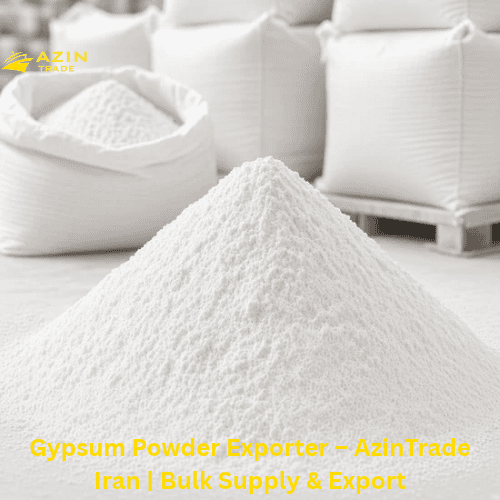
Gypsum Powder Exporter – AzinTrade Iran
Finding a reliable Gypsum Powder Exporter is important for buyers who need consistent quality, competitive prices, and dependable delivery. Iran is a major source of natural gypsum, while its geographic position provides access to markets across Asia, the Middle East, and other regions.
AzinTrade supplies Iranian gypsum products for international buyers in construction, cement manufacturing, plaster production, and industrial applications. Depending on the project, buyers can request specific requirements for purity, particle size, moisture, packaging, quantity, and delivery terms.
However, choosing an exporter should involve more than comparing prices. Product quality, laboratory analysis, packaging, logistics, documentation, and communication can all affect the final cost of imported gypsum powder.
Why Choose a Gypsum Powder Exporter from Iran?
Iran has significant gypsum resources and an established mining and mineral-processing sector. According to the U.S. Geological Survey, Iran produced an estimated 16 million metric tons of gypsum in 2025.
This production capacity gives international buyers access to a large domestic supply base.
Moreover, Iran is geographically close to several important importing markets. Persian Gulf ports can provide access to international maritime routes, while neighboring countries can also be served through regional land transportation.
The main advantages of sourcing gypsum from Iran include:
- Large domestic gypsum resources
- Established mining operations
- Competitive production costs
- Availability of bulk quantities
- Access to Persian Gulf shipping routes
- Proximity to Middle Eastern and Asian markets
- Experience in mineral exports
Still, production capacity does not automatically mean that every supplier offers the same quality. Therefore, buyers should evaluate each supplier according to technical specifications and export capability.
What Is Gypsum Powder?
Gypsum powder is a processed mineral product made from natural gypsum. The raw material primarily consists of calcium sulfate dihydrate.
Depending on the application, gypsum can be crushed, ground, screened, and processed into different particle sizes.
Some gypsum products are also heated to remove part of their chemically bound water. This process creates calcined gypsum, which is used for plaster and other applications.
Therefore, buyers should clearly distinguish between:
- Natural gypsum powder
- Ground gypsum
- Calcined gypsum
- Gypsum plaster
These products can have different specifications, applications, and customs classifications.
Gypsum Powder Specifications
A professional Gypsum Powder Exporter should provide clear technical information before a commercial order is confirmed.
The exact specification depends on the buyer’s application. Nevertheless, several parameters are commonly evaluated.
| Specification | Importance |
|---|---|
| Gypsum purity | Determines suitability for the application |
| CaSO₄ content | Indicates chemical composition |
| Particle size | Affects processing and performance |
| Moisture content | Important for storage and transportation |
| Whiteness | Relevant for some construction applications |
| Packaging | Protects the material during shipping |
| Quantity | Influences logistics and pricing |
Gypsum Purity
Purity is one of the most important factors when purchasing gypsum powder.
However, the required purity depends on the final application. A cement producer may have different requirements from a plaster manufacturer or agricultural buyer.
Consequently, importers should provide their technical specification rather than simply requesting “high-purity gypsum.”
Particle Size
Particle size affects how gypsum powder behaves during processing.
For example, a cement plant may require a different particle-size distribution from a manufacturer of plaster products.
Therefore, the exporter should confirm the required mesh or particle-size range before preparing the shipment.
Moisture Content
Moisture is another important consideration.
High moisture can affect handling, storage, and product performance. Proper packaging and transportation are therefore essential for international shipments.
Main Applications of Gypsum Powder
Gypsum powder has several important applications across construction and industry.
Common uses include:
- Cement manufacturing
- Plaster production
- Gypsum board production
- Construction materials
- Wall finishing
- Decorative products
- Industrial applications
- Agricultural applications
The correct specification should always be selected according to the intended use.
Gypsum Powder for Cement Manufacturing
Cement manufacturing is one of the most important applications of gypsum.
Gypsum is commonly added during cement grinding to help regulate setting time. As a result, the quality and consistency of gypsum can affect cement production.
AzinTrade provides additional information about gypsum’s role in cement and construction. Gypsum in Cement and Construction Industry
For cement producers, important factors can include chemical composition, purity, moisture, and particle size.
Gypsum Powder for Plaster and Construction
Gypsum powder is widely used in plaster and construction products.
Depending on the processing method, it can be used in:
- Plaster systems
- Joint compounds
- Wall finishing materials
- Gypsum boards
- Decorative products
- Interior construction materials
For these applications, buyers may pay particular attention to whiteness, fineness, purity, and setting characteristics.
Gypsum Powder for Agriculture
Gypsum can also be used in agriculture because it provides calcium and sulfur.
Agricultural applications can include soil improvement and nutrient management. However, agricultural gypsum should be selected according to the specific requirements of the soil and crop.
For that reason, industrial gypsum powder should not automatically be considered suitable for agricultural use.
How to Choose a Reliable Gypsum Powder Exporter
Choosing the right Gypsum Powder Exporter requires careful evaluation.
Price is important, but it should not be the only factor.
Check the Product Specification
Ask the supplier for a detailed technical specification.
The document should clearly identify the chemical and physical characteristics of the product.
Request Laboratory Analysis
For larger orders, buyers can request a Certificate of Analysis or laboratory test report.
This documentation can help confirm that the material meets the agreed requirements.
Evaluate Export Experience
International mineral shipments require proper documentation and logistics.
An experienced exporter can help coordinate loading, transportation, customs documentation, and shipping arrangements.
Compare Packaging
Gypsum powder can be supplied in different packaging formats.
Common options include:
- 25 kg bags
- 40 kg bags
- 50 kg bags
- Jumbo bags
- Bulk shipment
The best option depends on the buyer’s handling system and destination.
Compare the Complete Landed Cost
Do not compare suppliers using only the factory or FOB price.
Instead, consider:
- Product price
- Packaging
- Inland transportation
- Port charges
- Ocean freight
- Insurance
- Customs costs
- Destination handling
This approach gives the buyer a more realistic understanding of the final import cost.
Gypsum Powder Export Process from Iran
The export process normally begins when the buyer sends a product inquiry.
A typical transaction can include the following stages.
Product Inquiry
The buyer provides:
- Required product
- Purity
- Particle size
- Quantity
- Packaging
- Destination
- Preferred Incoterm
Technical Confirmation
The exporter confirms whether the requested specification is available.
Samples or laboratory reports can also be reviewed when necessary.
Commercial Quotation
The supplier prepares a quotation based on the product, quantity, packaging, destination, and delivery terms.
Order Confirmation
After the technical and commercial terms are accepted, the buyer and supplier confirm the order.
Production and Packaging
The product is prepared according to the agreed specification.
Packaging should be appropriate for the transportation method and destination.
Quality Control
Quality checks are performed before loading.
Depending on the agreement, the buyer may request laboratory documentation or inspection.
Loading and Shipping
The cargo is transported to the selected loading point or port.
It is then shipped according to the agreed delivery terms.
Documentation
The exporter prepares the required commercial and shipping documents.
The exact documentation depends on the destination country and transaction structure.
HS Code for Gypsum Powder
Correct customs classification is important for international gypsum trade.
Under the international Harmonized System, heading 2520 covers gypsum, anhydrite, and plasters. HS 252010 covers gypsum and anhydrite, while HS 252020 covers plasters based on calcined gypsum or calcium sulfate.
Buyers should nevertheless verify the complete tariff code with their customs broker or destination customs authority.
This is particularly important because natural gypsum powder and calcined gypsum products can fall under different classifications.
For official classification information, buyers can consult the United Nations Statistics Division’s Harmonized System resources. United Nations Statistics Division – Harmonized System
Gypsum Powder Export Packaging
Packaging plays an important role in maintaining product quality during transportation.
Depending on the order, an exporter may offer:
- PP bags
- Kraft bags
- Laminated bags
- Jumbo bags
- Bulk loading
The packaging should protect the material against moisture and contamination.
Furthermore, buyers should confirm net weight, gross weight, pallet requirements, and container-loading arrangements before shipment.
Gypsum Powder Shipping from Iran
Shipping is a major part of the international purchasing process.
The most appropriate transportation method depends on the destination and shipment size.
For nearby markets, road transportation can sometimes be practical. Meanwhile, sea freight can be more economical for larger international shipments.
Important logistics factors include:
- Loading location
- Port selection
- Container availability
- Inland transportation
- Ocean freight
- Destination port
- Customs clearance
- Insurance
- Final delivery
A professional Gypsum Powder Exporter should be able to discuss these factors with the buyer before the final quotation.
Gypsum Powder Price
There is no single global price for gypsum powder.
The final export price depends on several factors, including:
- Product purity
- Particle size
- Processing requirements
- Order volume
- Packaging
- Loading location
- Destination
- Freight rates
- Incoterms
- Payment conditions
Therefore, two quotations can have different prices even when both suppliers advertise “gypsum powder.”
The buyer should compare the complete commercial offer instead of focusing only on the product price.
Bulk Gypsum Powder Supply
Bulk purchasing can be attractive for cement plants, plaster manufacturers, distributors, and construction-material companies.
Large orders can sometimes provide better commercial conditions. However, bulk buyers should pay particular attention to consistency.
Before placing a large order, confirm:
- Monthly supply capacity
- Minimum order quantity
- Product specification
- Packaging
- Production lead time
- Loading capacity
- Shipping schedule
- Quality-control process
A clear supply agreement can also reduce misunderstandings between the importer and exporter.
Why Work with AzinTrade?
AzinTrade is an Iran-based supplier and exporter of mineral and construction materials. Its portfolio includes gypsum products and other materials used in international construction and industrial markets.
For buyers looking specifically for Iranian gypsum, AzinTrade provides detailed information about Iranian gypsum supply and applications.
Iran Gypsum Supplier – AzinTrade
AzinTrade also provides information about industrial gypsum powder and bulk export.
Industrial Gypsum Powder Supplier & Bulk Exporter
Buyers in Pakistan can also review AzinTrade’s dedicated information page for gypsum powder exports.
Gypsum Powder Export to Pakistan
For the Indian market, AzinTrade has published information about exporting gypsum from Iran to India.
Exporting Gypsum from Iran to India
The best approach is to provide the exact specification and destination first. Then, the supplier can prepare a more accurate commercial proposal.
Main Export Markets for Iranian Gypsum
Iran’s location provides access to several regional and international markets.
Potential markets include:
- India
- Pakistan
- United Arab Emirates
- Qatar
- Kuwait
- Oman
- Bahrain
- Afghanistan
- Georgia
- Armenia
- Central Asia
However, market conditions can change.
Import regulations, customs requirements, freight rates, payment conditions, and trade restrictions should therefore be checked before every transaction.
What Should Buyers Ask a Gypsum Powder Exporter?
Before placing an order, importers should ask several practical questions.
Product Questions
- What is the gypsum purity?
- What is the particle-size range?
- What is the moisture content?
- Is the product natural or calcined?
- Can you provide a Certificate of Analysis?
- Can you provide a sample?
Commercial Questions
- What is the minimum order quantity?
- What packaging options are available?
- What payment terms are available?
- Which Incoterms can you offer?
- What is the production lead time?
Logistics Questions
- Which port will be used?
- How many tons can be loaded?
- What is the estimated transit time?
- Can you offer FOB, CFR, or CIF?
- Which export documents will be provided?
Asking these questions before ordering can make supplier comparison easier.
Common Mistakes When Importing Gypsum Powder
International buyers sometimes focus too heavily on the initial quotation.
That can create problems later.
Choosing Only the Cheapest Supplier
The lowest price does not always represent the lowest total cost.
Quality, freight, packaging, and delivery reliability can change the final landed price.
Failing to Define the Product
“Gypsum powder” can describe different products.
Therefore, the buyer should define purity, particle size, moisture, and intended application before ordering.
Ignoring Moisture
Moisture can affect storage and handling.
Consequently, packaging and transportation conditions should be agreed in advance.
Ordering Without Quality Documentation
Industrial buyers should request suitable quality documentation.
A laboratory report or Certificate of Analysis can provide additional confidence.
Comparing Different Incoterms
FOB, CFR, and CIF prices represent different cost structures.
As a result, buyers should calculate the total landed cost before selecting a supplier.
Gypsum Powder Import Checklist
Before confirming an order with a Gypsum Powder Exporter, use this checklist:
- Product type confirmed
- Purity confirmed
- Particle size confirmed
- Moisture specification confirmed
- Sample reviewed
- Laboratory analysis reviewed
- Packaging confirmed
- Quantity confirmed
- Incoterms confirmed
- Destination port confirmed
- Freight quotation reviewed
- Payment terms agreed
- Export documents confirmed
- Delivery schedule agreed
This checklist can help reduce avoidable problems during international mineral purchases.
Frequently Asked Questions
What does a Gypsum Powder Exporter do?
A Gypsum Powder Exporter supplies gypsum products to international buyers and coordinates activities such as product preparation, packaging, documentation, and shipping.
Is Iran a major gypsum producer?
Yes. Iran has substantial gypsum resources and significant production capacity. USGS estimated Iranian gypsum mine production at approximately 16 million metric tons in 2025.
What is gypsum powder used for?
Gypsum powder can be used for cement manufacturing, plaster, gypsum boards, construction materials, decorative products, and selected agricultural applications.
What is the HS code for gypsum?
International HS heading 2520 covers gypsum, anhydrite, and plasters. HS 252010 covers gypsum and anhydrite, while HS 252020 covers plasters based on calcined gypsum or calcium sulfate.
Can gypsum powder be exported in bulk?
Yes. Depending on the product and buyer requirements, gypsum powder can be supplied in bags, jumbo bags, or bulk shipment formats.
What information should I provide when requesting a quotation?
Provide the product type, required purity, particle size, quantity, packaging preference, destination, and preferred Incoterm.
Can AzinTrade supply gypsum powder internationally?
AzinTrade operates as an Iran-based supplier and exporter of mineral and construction materials and offers gypsum products for international markets.
Final Thoughts
Choosing the right Gypsum Powder Exporter requires more than comparing prices.
Product consistency, technical specifications, quality control, packaging, logistics, documentation, and communication all influence the success of an international purchase.
Iran’s substantial gypsum production provides international buyers with an established source of gypsum products. Nevertheless, each order should be evaluated according to the required specification and destination.
In my opinion, the best exporter is not necessarily the company offering the lowest initial price. Instead, buyers should look for a supplier that can provide consistent quality, transparent specifications, reliable logistics, and clear communication.
For companies looking for an Iran Gypsum Powder Exporter, AzinTrade can be contacted to discuss product specifications, quantities, packaging, and international delivery requirements.