
Iranian Ceramic and Porcelain Tiles: A Complete Guide to Quality, Manufacturers, Export Markets, and Importing from Iran
Iranian ceramic and porcelain tiles have become an interesting option for international buyers seeking a balance between product variety, manufacturing capabilities, competitive sourcing, and access to regional construction markets. With a long tradition of ceramic craftsmanship and an established industrial base, Iran offers a wide selection of tiles for residential, commercial, and large-scale construction projects.
For importers, distributors, contractors, and building-material wholesalers, understanding the Iranian tile industry requires more than comparing prices. Buyers must evaluate technical specifications, water absorption, surface finishes, dimensional accuracy, packaging, logistics, and supplier reliability before placing an order.
This guide explores the Iranian ceramic and porcelain tile industry from a commercial and technical perspective. It explains available product categories, manufacturing methods, quality considerations, export opportunities, and the practical steps international buyers should follow when sourcing tiles from Iran.
1. Overview of the Iranian Ceramic Tile Industry
Iran has an established ceramic tile manufacturing sector supported by domestic mineral resources, industrial production facilities, technical expertise, and demand from the construction industry.
The country’s geographical position also provides potential logistical connections to markets in the Middle East, Central Asia, the Caucasus, South Asia, and parts of Africa. These connections can make Iran relevant to buyers who want to compare regional suppliers and diversify their sourcing options.
However, the suitability of Iranian tiles depends on the specific manufacturer, production line, product specifications, and destination market. Buyers should evaluate individual products rather than assume that every tile produced in the country offers the same quality or performance.
Several factors shape the commercial appeal of Iranian tiles:
- Product diversity: Manufacturers offer different formats, colors, textures, finishes, and applications.
- Manufacturing experience: Established producers have experience supplying products for residential and commercial construction.
- Sourcing flexibility: Buyers may be able to select products from different price and quality segments.
- Regional market access: Geographic proximity can support trade with several neighboring markets, depending on transport routes and export regulations.
- Customization opportunities: Certain manufacturers can produce or supply specific sizes, finishes, designs, and packaging configurations.
For international procurement teams, the main objective is to identify a supplier whose production capabilities match the technical and commercial requirements of the project.
2. Main Types of Iranian Ceramic and Porcelain Tiles
The Iranian market includes several tile categories. Understanding their differences helps buyers select products that meet the requirements of a particular building, climate, and installation environment.
2.1 Ceramic Wall Tiles
Ceramic wall tiles are commonly used in kitchens, bathrooms, residential interiors, and selected commercial spaces.
These products are available in a wide range of decorative patterns, colors, surface textures, and dimensions. Their suitability depends on factors such as water absorption, glaze durability, cleaning requirements, and the intended installation environment.
Common applications include:
- Kitchen backsplashes
- Bathroom walls
- Residential interior decoration
- Hotel and apartment interiors
- Retail and office wall coverings
Buyers should distinguish wall tiles from floor-rated products because their mechanical properties and intended uses may differ.
2.2 Ceramic Floor Tiles
Ceramic floor tiles serve residential and commercial flooring applications. Manufacturers produce them in different formats, colors, textures, and surface finishes.
When evaluating floor tiles, buyers should consider abrasion resistance, breaking strength, slip resistance, surface durability, and the expected level of foot traffic.
For example, a decorative tile designed for a private bedroom may not be appropriate for a busy shopping center or a commercial entrance.
International buyers should request the manufacturer’s technical data sheet and confirm that the selected product meets the applicable requirements for its intended use.
2.3 Porcelain Tiles
Porcelain tiles are a specific category of ceramic tiles generally characterized by low water absorption and a dense, compact body.
They are frequently selected for demanding residential and commercial applications because suitable products can provide high durability, low moisture absorption, and resistance to everyday wear.
Common applications include:
- Modern residential flooring
- Shopping centers and retail stores
- Hotel corridors and lobbies
- Office buildings
- Selected outdoor installations
- Commercial and public spaces
However, porcelain tiles are not automatically suitable for every environment. Buyers must also consider slip resistance, thermal conditions, installation methods, and the performance requirements of the project.
2.4 Polished Porcelain Tiles
Polished porcelain tiles feature a smooth, reflective surface that creates a premium visual appearance.
They are popular in contemporary interiors, luxury apartments, hotel lobbies, showrooms, and commercial spaces where a glossy finish supports the desired design.
Their main commercial advantages include:
- A reflective surface that can enhance the appearance of interior spaces
- Compatibility with modern architectural designs
- Availability in stone-inspired and marble-inspired patterns
- A premium appearance for residential and hospitality projects
Buyers should verify scratch resistance, stain performance, maintenance requirements, and slip characteristics. A polished finish may not be appropriate for every wet or outdoor application.
2.5 Matte and Textured Tiles
Matte and textured tiles offer an alternative to glossy surfaces. They are commonly used in contemporary interiors, selected outdoor spaces, commercial floors, and projects that require a more understated appearance.
Their performance depends on the tile’s surface treatment, material composition, and intended application.
When sourcing these products, importers should request slip-resistance test results where relevant rather than relying on the words matte or textured as proof of safety.
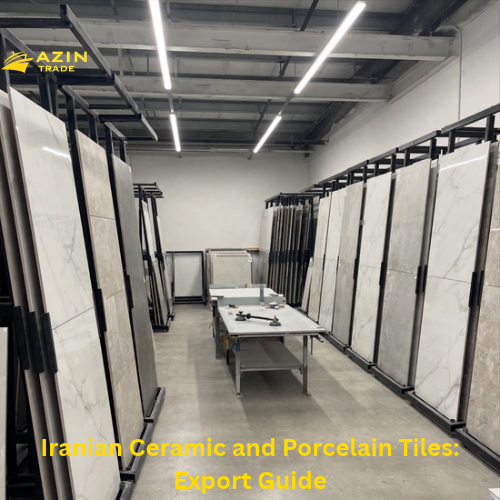
2.6 Large-Format Tiles
Large-format tiles can create a continuous visual appearance with fewer grout lines. They are particularly relevant to modern residential developments, hotels, commercial interiors, and premium architectural projects.
However, large dimensions introduce additional procurement and installation considerations, including:
- Dimensional consistency
- Flatness and warpage
- Packaging strength
- Transportation protection
- Handling equipment
- Installer experience
- Substrate preparation
Before ordering large-format products, buyers should confirm the manufacturer’s production capabilities, tolerances, packing methods, and recommended installation procedures.
3. How Iranian Ceramic Tiles Are Manufactured
Understanding the manufacturing process helps importers evaluate product consistency and identify the technical information they should request from suppliers.
Although production details vary by factory and product type, ceramic tile manufacturing generally includes the following stages.
Stage 1: Raw Material Selection
Manufacturers select mineral raw materials according to the required body composition and final product characteristics.
Depending on the formulation, these materials may include clay, feldspar, silica, and other mineral components.
The quality and consistency of the raw materials influence the behavior of the body during production, including shrinkage, strength, and dimensional stability.
Stage 2: Preparation and Mixing
Producers prepare the raw materials through crushing, grinding, mixing, and other processing operations appropriate to the production line.
Many manufacturing processes use a controlled suspension of finely ground materials, which is subsequently converted into powder suitable for forming.
Consistent preparation helps manufacturers maintain stable production conditions and reduce variations between batches.
Stage 3: Powder Preparation
In many industrial tile production lines, spray drying converts a prepared slurry into granulated powder with suitable moisture content.
The resulting powder must have properties that support uniform filling, compaction, and forming.
Variations in moisture content or granule distribution can influence the consistency of the finished tile.
Stage 4: Pressing and Forming
Manufacturers typically use industrial presses to form tiles from prepared powder.
The pressing process establishes the tile’s initial dimensions and compacted structure. Pressure distribution and powder characteristics influence the uniformity of the resulting body.
For larger tiles, manufacturers must pay particular attention to forming conditions and dimensional control.
Stage 5: Drying
After forming, tiles undergo controlled drying to remove excess moisture before glazing and firing, where applicable.
Poorly controlled drying can increase the risk of defects. Manufacturers therefore manage drying conditions according to the product composition, dimensions, and production requirements.
Stage 6: Glazing and Surface Decoration
Depending on the product, manufacturers may apply glazes, digital decoration, surface textures, or other finishing treatments.
Digital printing allows producers to reproduce designs inspired by natural marble, granite, limestone, concrete, wood, and other materials.
The final appearance depends on the decoration system, glaze formulation, firing behavior, and quality-control procedures.
Stage 7: Firing
Kiln firing develops the ceramic body’s final properties and establishes the characteristics of the glaze or surface treatment.
Temperature profiles and firing duration vary according to the tile type and manufacturing process.
Properly controlled firing helps manufacturers achieve the intended strength, water absorption, color consistency, and dimensional characteristics.
Stage 8: Sorting and Quality Control
After firing, manufacturers inspect finished products and sort them according to their internal classification systems.
Quality-control checks may include:
- Dimensions and dimensional tolerances
- Surface appearance and visible defects
- Color and shade consistency
- Warpage and flatness
- Water absorption
- Breaking strength
- Surface performance
- Packaging condition
Buyers should request the manufacturer’s documented grading system because commercial terms such as first quality may not mean exactly the same thing across suppliers.
Stage 9: Packaging and Shipment Preparation
The final stage involves sorting, labeling, packing, palletizing, and preparing the products for transportation.
For export orders, packaging must protect tiles against impacts, movement, moisture exposure where relevant, and handling damage.
The supplier should also provide accurate carton and pallet information so the importer can calculate shipment quantities and logistics costs.
4. Technical Specifications International Buyers Should Check
The most effective way to compare Iranian tile suppliers is to evaluate products using measurable technical characteristics rather than appearance and price alone.
| Specification | Why it matters |
|---|---|
| Water absorption | Helps determine whether the tile meets the requirements of its intended application |
| Dimensions and tolerances | Supports installation accuracy and consistent grout joints |
| Thickness | Affects compatibility with installation systems and project requirements |
| Breaking strength | Indicates resistance to specified mechanical loading |
| Surface abrasion resistance | Helps assess suitability for relevant flooring applications |
| Slip resistance | Important for wet areas, public spaces, and selected outdoor environments |
| Chemical resistance | Relevant to cleaning agents and certain commercial environments |
| Stain resistance | Helps determine maintenance requirements |
| Frost resistance | Important for products exposed to freezing conditions |
| Shade variation | Helps control visual consistency across installed areas |
| Rectification and edge quality | Influences joint appearance and installation tolerances |
Not every specification applies equally to every tile. The required tests depend on the product category, installation environment, and destination-market regulations.
Understanding Water Absorption
Water absorption is an important technical characteristic because it helps classify ceramic products and assess their suitability for different environments.
Under ISO 13006 and related tile-testing standards, ceramic tiles are classified according to characteristics that include water absorption and forming method.
Porcelain tiles are generally associated with water absorption of no more than 0.5% under the relevant classification and testing requirements.
Buyers should verify the applicable standard, the manufacturer’s declared classification, and the supporting test report. A product description alone does not establish compliance.
Understanding Tile Grades
Suppliers may describe products using commercial grades such as first, second, or third quality.
These labels can reflect differences in appearance, dimensional consistency, or the manufacturer’s internal sorting policy. However, the precise criteria can vary.
Before confirming an order, importers should request written definitions of the supplied grade, agreed defect tolerances, and procedures for handling nonconforming products.
Relevant International Standards
Importers may find the following standards useful when preparing technical specifications:
- ISO 13006: Classification, characteristics, and marking requirements for ceramic tiles.
- ISO 10545 series: Test methods covering different ceramic tile properties.
- EN 14411: European product standard for ceramic tiles.
- Destination-market regulations: Additional requirements that may apply to building products in the country of import.
Official reference: https://www.iso.org/
The buyer should confirm the current edition, applicable product category, and specific testing requirements before placing an order.
5. Iranian Tile Designs and Architectural Applications
Design flexibility is one reason ceramic tiles remain important in residential and commercial construction.
Iranian suppliers may offer products in a range of styles, from simple neutral surfaces to decorative designs intended for premium interiors.
Marble-Look Tiles
Marble-inspired tiles reproduce the visual patterns of natural stone while offering a manufactured alternative to quarried marble.
They are commonly specified for hotels, apartments, reception areas, showrooms, and contemporary residential projects.
Importers should compare print quality, pattern variation, surface finish, and the number of distinct designs within a production series.
Stone-Look Tiles
Stone-inspired tiles can reproduce the appearance of limestone, travertine, granite, and other natural materials.
They suit projects where designers want a natural visual effect combined with the predictable dimensions of manufactured tiles.
For outdoor use, the selected product must also meet the relevant requirements for slip resistance, weather exposure, and installation.
Concrete-Look Tiles
Concrete-look designs are popular in minimalist interiors, offices, retail spaces, and contemporary architectural projects.
Their neutral colors can work well with metal, wood, glass, and other modern building materials.
Wood-Look Tiles
Wood-look ceramic tiles combine a timber-inspired appearance with ceramic construction.
Depending on the specific product, they can be considered for living spaces, kitchens, selected bathrooms, and commercial interiors.
The surface texture and slip characteristics should match the intended environment.
Decorative and Patterned Tiles
Decorative tiles can support projects that require distinctive visual features, accent walls, or traditional and contemporary design elements.
For importers, the main considerations include repeatability of the design, consistency between batches, availability of replacement quantities, and the risk of discontinuation.
6. Major Export Opportunities for Iranian Ceramic Tiles
Iran’s tile industry may serve buyers across multiple regional markets. However, actual commercial opportunities depend on local demand, import regulations, freight costs, payment arrangements, and competition from other producing countries.
The following markets are worth evaluating when developing an export sourcing strategy.
Gulf Cooperation Council Markets
The GCC includes the United Arab Emirates, Saudi Arabia, Qatar, Kuwait, Bahrain, and Oman.
These markets contain residential, hospitality, commercial, and infrastructure projects that create demand for a wide range of building materials.
Potential opportunities for Iranian tile suppliers include:
- Residential development
- Apartment and villa construction
- Hotel and hospitality interiors
- Retail and office buildings
- Renovation and replacement projects
Importers should evaluate local product preferences, technical compliance requirements, distributor margins, and competition from established international tile brands.
Iraq and Afghanistan
Regional trade connections can make Iran a potential sourcing option for buyers in Iraq and Afghanistan.
Potential applications include housing, retail construction, residential renovation, and commercial developments.
Nevertheless, buyers must assess border procedures, transport arrangements, applicable sanctions and trade restrictions, payment feasibility, and product-specific import requirements before committing to a shipment.
Central Asia and the Caucasus
Markets such as Armenia, Georgia, and selected Central Asian countries may offer opportunities for distributors and construction-material traders.
Commercial viability depends on delivered prices, available transport routes, market preferences, and competition from regional and international manufacturers.
Importers should compare the full landed cost rather than relying on the factory price alone.
African Markets
Selected African markets may provide opportunities for tile distributors, project contractors, and building-material wholesalers.
However, long-distance shipping can significantly affect the final cost. Buyers should carefully evaluate container utilization, packaging strength, insurance, port charges, customs procedures, and local distribution costs.
A competitive export offer must account for the complete supply chain.
7. Iranian Ceramic Tiles vs. Other International Suppliers
Importers should compare Iranian products with alternatives from countries such as China, India, Turkey, Spain, and Italy.
Each market contains manufacturers operating at different quality levels and price points, so broad country-level comparisons can be misleading.
| Purchasing factor | What buyers should evaluate |
|---|---|
| Purchase price | Factory price, order volume, and commercial terms |
| Technical quality | Test reports, declared specifications, and inspection results |
| Design selection | Available finishes, patterns, dimensions, and product collections |
| Minimum order quantity | Supplier-specific production and packing requirements |
| Lead time | Production schedule and shipment preparation |
| Freight | Origin, destination, route, and shipment size |
| Certification | Requirements of the buyer and destination market |
| Supply continuity | Repeat-order capacity and product availability |
| Payment terms | Permitted and practical arrangements for both parties |
| After-sales support | Claims, replacement products, and dispute procedures |
Iranian tiles may be commercially attractive when a supplier combines appropriate technical quality with competitive pricing, reliable production, and workable logistics.
However, the best supplier is not necessarily the one offering the lowest quotation. A slightly more expensive product may deliver better value if it reduces breakage, installation problems, delays, or customer complaints.
8. How to Calculate the Real Cost of Importing Iranian Tiles
The factory quotation represents only one part of the total purchasing cost.
International buyers should calculate the landed cost before comparing competing offers.
A useful starting formula is:
Total landed cost = Product cost + Inland transport + Export handling + International freight + Insurance + Customs duties and taxes + Destination charges + Other applicable costs
The exact components depend on the agreed Incoterm, shipping method, destination, and applicable regulations.
Example of a Procurement Calculation
Consider a hypothetical order of 10,000 square meters of ceramic tiles.
Assume the following illustrative figures:
| Cost component | Example amount |
|---|---|
| Tile purchase: 10,000 m² × $5.00 | $50,000 |
| Inland transport and export handling | $2,000 |
| International freight and insurance | $5,000 |
| Destination handling and other charges | $2,000 |
| Illustrative total before import duties and taxes | $59,000 |
The resulting cost is $5.90 per square meter before any import duties, taxes, or additional costs not included above.
These figures are examples only, not current Iranian market quotations or freight offers.
For an accurate calculation, the importer should obtain a written quotation covering product specifications, packaging, shipment terms, and the relevant destination.
9. Packaging, Container Loading, and Logistics
Ceramic tiles are relatively heavy and vulnerable to impact damage. Therefore, packaging and logistics planning play a major role in export performance.
Export Packaging Requirements
A professional export shipment should have packaging appropriate for the tile format, weight, and transportation route.
Common packaging elements include:
- Strong cartons designed for the product weight
- Internal protection where required
- Clear product and batch identification
- Accurate square-meter quantities per carton
- Pallets or other suitable loading arrangements
- Appropriate protection against movement and handling damage
For long-distance transportation, the exporter and buyer should agree on the packaging specification before production begins.
Container Loading
Container planning should consider both cargo weight and available loading space.
Large-format tiles, thick tiles, and heavy porcelain products can reach the container’s payload limit before fully using the available volume.
The supplier should provide the following information:
- Total square meters
- Number of cartons
- Carton dimensions
- Gross and net weight
- Number of pallets, if applicable
- Loading configuration
- Estimated container quantity
Buyers should not rely on a universal square-meter-per-container figure because actual capacity depends on product dimensions, packaging, palletization, and container restrictions.
Incoterms and Delivery Responsibilities
International buyers should clearly identify the delivery term in the quotation and contract.
Relevant Incoterms may include EXW, FCA, FOB, CFR, and CIF, depending on the transport method and agreed commercial arrangement.
The parties should specify the named place or port and the applicable Incoterms edition. They should also clarify export clearance, freight responsibilities, insurance, and destination charges.
Official reference: https://iccwbo.org/
Clear delivery terms reduce misunderstandings and help both parties calculate their actual responsibilities.
10. How to Choose a Reliable Iranian Tile Supplier
Selecting the right manufacturer or export partner is one of the most important stages of the procurement process.
An attractive quotation is not enough to establish that a supplier can consistently meet the buyer’s requirements.
Verify the Supplier’s Business Information
Request the supplier’s legal business details, factory information where applicable, product catalogue, export experience, and references.
Confirm the identity of the contracting party and verify that the company can legally conduct the proposed transaction.
Request Technical Documentation
Ask for product-specific documentation, including:
- Technical data sheets
- Relevant test reports
- Declared water absorption
- Dimensional tolerances
- Surface and finish specifications
- Applicable quality certificates
- Packing details
Certificates should be checked for authenticity, validity, scope, and relevance to the specific product.
Evaluate Samples
Samples help buyers examine appearance, texture, edge quality, color, and finish before placing a large order.
However, a small sample cannot establish the consistency of an entire production batch.
For larger purchases, the buyer should agree on an inspection procedure that covers the finished order and the relevant acceptance criteria.
Establish Written Quality Requirements
The purchase contract should define the product grade, dimensions, thickness, finish, shade requirements, quantity tolerances, packaging, and treatment of nonconforming goods.
Where appropriate, it should also specify independent inspection, sampling methods, and the procedure for submitting claims.
Assess Export and Logistics Capabilities
A supplier should be able to explain how it prepares export documentation, organizes packing, coordinates loading, and communicates shipment updates.
Buyers should also evaluate the proposed route, payment method, insurance arrangements, and the legal feasibility of the transaction.
11. Common Mistakes When Importing Iranian Tiles
Even experienced buyers can encounter problems when the procurement process lacks detailed specifications.
The following mistakes deserve particular attention.
Choosing only by price: A low quotation may conceal differences in product grade, packaging, finish, or technical performance.
Ignoring batch consistency: Tiles from different production batches may show visible shade or dimensional variations. Buyers should discuss batch planning and reserve quantities where necessary.
Confusing ceramic and porcelain tiles: These categories can have different properties. The buyer should verify the declared product classification rather than relying on marketing descriptions.
Failing to check slip resistance: A visually attractive tile may not meet the safety requirements of a wet area or commercial floor.
Underestimating freight and handling: Heavy cargo, port charges, and breakage risks can affect the final cost.
Accepting vague quality terms: Words such as premium, first grade, and export quality should be supported by written specifications.
Overlooking import regulations: Product standards, customs procedures, trade restrictions, and payment requirements may vary by destination and change over time.
A structured procurement process helps buyers avoid these risks and build more reliable supplier relationships.
12. Why Work with AzinTrade to Source Iranian Building Materials?
AzinTrade focuses on connecting international buyers with Iranian building-material supply opportunities, including ceramic and porcelain tiles.
For importers and distributors evaluating Iranian products, the sourcing process should begin with a clear definition of the project requirements.
A useful inquiry should identify:
- Tile type and intended application
- Required dimensions and thickness
- Surface finish and design preferences
- Estimated quantity in square meters
- Destination country and delivery location
- Preferred packaging arrangement
- Required technical documents
- Target delivery schedule
These details help establish whether a proposed product and commercial offer fit the buyer’s requirements.
AzinTrade can be contacted through its official website at https://azintrade.com/ to discuss building-material sourcing and export inquiries.
For a product-specific quotation, buyers should request confirmation of the manufacturer’s identity, available specifications, current production capacity, packing details, delivery terms, and any applicable compliance requirements before proceeding.
13. Future Opportunities for Iranian Ceramic Tile Exports
The long-term potential of Iranian tile exports will depend on manufacturers’ ability to compete on more than price.
Several commercial priorities can support stronger international positioning.
Consistent Product Quality
Importers need predictable product specifications and repeatable production results. Manufacturers that invest in quality control and documented testing can improve buyer confidence.
Design and Product Development
Contemporary surface designs, large formats, coordinated collections, and finishes suited to specific applications can help suppliers serve more specialized market segments.
Better Export Documentation
Clear technical data sheets, accurate packing lists, reliable invoices, and appropriate certificates reduce procurement uncertainty.
Stronger Distribution Relationships
International distributors often value stable supply, responsive communication, and consistent product availability as much as an attractive initial quotation.
Efficient Logistics
Careful packaging, container planning, shipment coordination, and accurate delivery estimates can improve the competitiveness of an export offer.
For Iranian tile suppliers, combining these capabilities with realistic market selection can support sustainable international trade.
Frequently Asked Questions About Iranian Ceramic and Porcelain Tiles
1. Are Iranian ceramic tiles suitable for international construction projects?
They can be suitable when the selected product meets the project’s technical specifications and the destination market’s applicable requirements. Buyers should verify product-specific test reports, dimensional tolerances, water absorption, and other relevant performance characteristics.
2. What is the difference between Iranian ceramic tiles and porcelain tiles?
Porcelain tiles are a category of ceramic tiles generally characterized by low water absorption and a dense body. Conventional ceramic tiles cover a broader range of products with different compositions and performance characteristics. The appropriate choice depends on the intended application and verified specifications.
3. Which Iranian tiles are suitable for commercial flooring?
Suitable products may include ceramic or porcelain floor tiles designed and tested for the expected level of traffic. Buyers should examine breaking strength, abrasion resistance, slip characteristics, and the manufacturer’s recommended applications.
4. Can Iranian tiles be used in outdoor projects?
Some products are suitable for outdoor applications, but not every tile is appropriate for external installation. Buyers should verify frost resistance where necessary, slip resistance, water absorption, and compatibility with local weather conditions and installation systems.
5. How can importers evaluate the quality of Iranian tiles?
Importers should request technical data sheets, relevant laboratory reports, product samples, documented grading criteria, and inspection arrangements. For significant orders, independent pre-shipment inspection can help verify compliance with the agreed specifications.
6. What information is required to request an export quotation?
The buyer should provide the tile type, size, thickness, finish, quantity, destination, preferred delivery terms, packaging requirements, and any necessary certifications. Detailed information helps suppliers prepare a more accurate commercial offer.
7. How much do Iranian ceramic tiles cost?
Prices vary according to product category, dimensions, finish, quality, order volume, packaging, delivery terms, and market conditions. Importers should compare written quotations based on equivalent specifications and calculate the complete landed cost.
8. Which countries can import Iranian ceramic tiles?
Potential markets include neighboring countries, GCC markets, the Caucasus, Central Asia, and selected markets in Africa and South Asia. Actual export feasibility depends on applicable trade rules, sanctions, customs procedures, payment arrangements, and logistics.
9. What documents may be required when importing Iranian tiles?
Depending on the transaction and destination, documents may include a commercial invoice, packing list, transport document, certificate of origin, and product-specific certificates or test reports. The importer should confirm the exact requirements with the relevant customs authority and qualified trade professionals.
10. How can I contact AzinTrade about Iranian ceramic tiles?
Visit https://azintrade.com/ to make an inquiry. Include the required tile specifications, order quantity, destination country, and preferred delivery terms to help clarify the sourcing requirements.
Conclusion
Iranian ceramic and porcelain tiles offer international buyers a broad range of potential sourcing options, from everyday wall and floor products to polished porcelain and design-focused architectural finishes.
Successful procurement requires careful evaluation of technical specifications, manufacturing consistency, supplier credibility, packaging, logistics, and destination-market requirements. Buyers who compare complete commercial offers rather than factory prices alone can make more informed purchasing decisions.
For importers, distributors, contractors, and construction companies considering Iranian tiles, the next step is to define the required product specifications and request a documented quotation from a suitable supplier.
AzinTrade provides a starting point for exploring Iranian building-material sourcing opportunities and discussing the requirements of international buyers.