
Tile and Ceramic Export from Iran to Afghanistan: The Complete Guide for Importers and Distributors
I read through the five highest-ranking pages on tile and ceramic export from Iran to Afghanistan before writing a word of this guide. Here’s what I found: a lot of repetition, a lot of “cultural similarities make trade easier and almost nothing useful. None of them name the actual border crossing that moves your cargo. and explain what happens when that crossing closes. not give you a real documents checklist. This guide fixes that gap instead of adding another version of the same three paragraphs.
Why Afghanistan Is One of Iran’s Most Important Ceramic Tile Markets
Afghanistan produces almost no ceramic tile domestically. Its construction sector has to import essentially everything it uses.
Decades of conflict left much of Afghanistan’s housing and commercial infrastructure in need of rebuilding, and that reconstruction work continues in cities like Herat, Kabul, and Kandahar. Every apartment block, shop, and public building going up needs flooring and wall tile. None of that gets manufactured locally at any meaningful scale. Iran sits directly across the border with an established ceramic tile industry, shared language, and centuries of trade history. That combination explains why Afghanistan consistently ranks among Iran’s top three destination markets for tile exports, alongside Iraq and Pakistan.
Herat deserves particular attention here, since it sits closest to the Islam Qala crossing. It absorbs a disproportionate share of Iranian tile shipments before distributors move them further into the country. Kabul represents the larger long-term prize — it’s the biggest single construction market in Afghanistan. But it also sits furthest from the border, which adds transit time and cost that a Herat-based distributor doesn’t face. Buyers and exporters both benefit from understanding this internal geography rather than treating “the Afghan market” as one undifferentiated destination.
How Big Is This Trade, Really?
Numbers matter more than a supplier’s confidence when you’re deciding whether to enter a market. It’s worth looking at what’s actually documented rather than taking anyone’s word for it.
According to Mordor Intelligence’s analysis of the Iran ceramic tiles market, Iraq, Pakistan, Afghanistan, and Central Asian nations together account for the strong majority of Iran’s ceramic tile export activity, with Iraq holding the largest single share. That same report flags a domestic complication worth knowing about: a construction sector recession inside Iran has led to excess tile inventory and more aggressive export pricing from Iranian manufacturers. From a buyer’s seat in Kabul or Herat, that actually works in your favor on price right now. For context on how competitive the wider regional ceramic trade looks, Afghanistan’s ceramic product imports from China alone were valued at nearly $10 million in the most recent recorded year according to UN Comtrade data. That figure gives you a useful benchmark for how much of this market Iran is realistically competing to capture from other suppliers.
Why Afghan Buyers Choose Iranian Tile Over Chinese or Pakistani Alternatives
Price alone doesn’t explain why Iranian tile keeps winning this market. Logistics and product fit matter just as much.
A few factors show up consistently in why Afghan importers keep coming back to Iranian suppliers:
- A land border that removes ocean freight entirely — Chinese tile has to cross the sea and then move overland through Pakistan or Central Asia to reach Afghanistan, adding weeks and real cost that Iranian trucks simply don’t face.
- Design and color preferences that already match Afghan taste — Iranian manufacturers in Yazd and Isfahan produce patterns and tones that Afghan buyers already gravitate toward, without needing a separate product line for this specific market.
- A shared language for negotiation and after-sales support — Persian speakers work on both sides of this border, which removes a translation layer that Chinese or European suppliers can’t avoid.
- Established trust built over decades — this isn’t a new trade relationship being built from scratch. Iranian tile has sold into Afghan markets for years, and that history matters to risk-averse buyers.
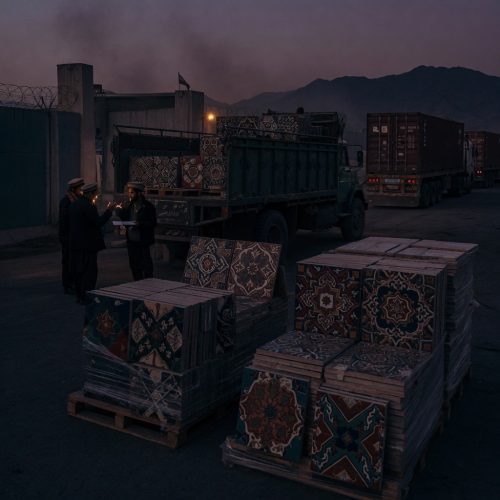
Best Products for Tile and Ceramic Export from Iran to Afghanistan
Not every product line in an Iranian factory’s catalog moves the same way in Afghanistan. Matching the right type to the right buyer segment saves both sides time.
Glazed Ceramic Floor and Wall Tile
This is the highest-volume category by a wide margin. Standard glazed tile in neutral, light tones suits the residential and mid-range commercial construction that makes up most of Afghanistan’s current building activity, and it’s priced to move in bulk.
Porcelain Tile
Porcelain demand is smaller but growing. It concentrates in higher-end commercial projects, government buildings, and private villas in Kabul, where buyers pay more for a denser, more polished finish.
Unglazed and Rustic-Finish Tile
Exterior walkways, courtyards, and public infrastructure projects favor unglazed or textured tile for its slip resistance. This category sees steady demand tied directly to public works spending rather than private construction cycles.
Matching product line to buyer type matters more in a market like Afghanistan than in larger, more fragmented markets. A distributor supplying small retail shops across Herat typically wants a narrower, faster-moving range of popular sizes and colors. A contractor working on a specific government or NGO-funded reconstruction project often needs a single consistent batch large enough to cover an entire building without visible variation between production runs. Exporters who ask which of these two buyer types they’re dealing with — before quoting a price — tend to avoid the mismatched orders that cause disputes later.
Border Crossings and Shipping Routes for Tile and Ceramic Export from Iran to Afghanistan
This is the section every competing article I read skipped almost entirely. It’s arguably the single most important part of planning a shipment.
Islam Qala-Dogharoon: The Main Trade Corridor
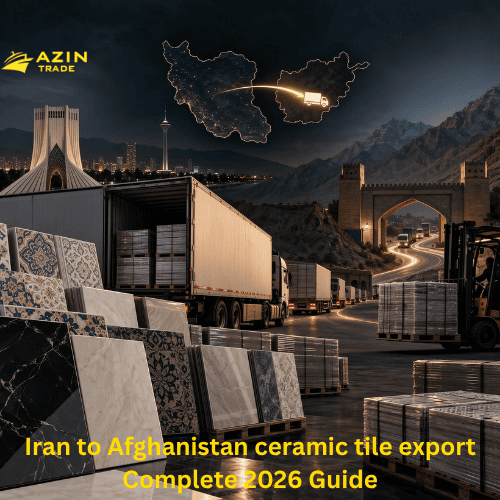
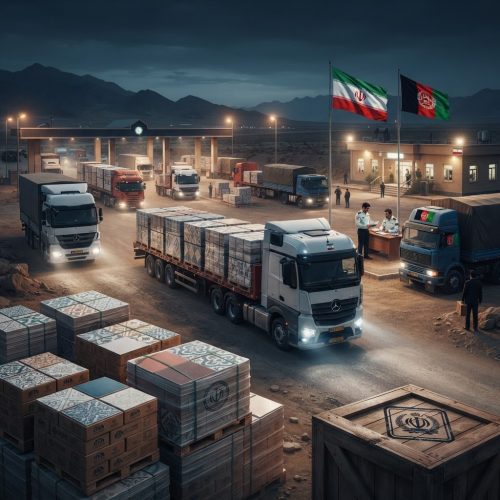
This crossing links Iran’s Khorasan Razavi province to Afghanistan’s Herat province, and it handles the overwhelming majority of trade between the two countries. According to the Digital Logistics Capacity Assessment, a logistics resource maintained for humanitarian and commercial supply chain planning, this crossing includes dedicated customs offices, immigration facilities, and truck parking areas. It processes a high volume of commercial traffic daily. One source tracking regional border activity puts annual trade through this single crossing at roughly $3 billion, with around 1,200 trucks crossing daily. That single number tells you why almost every serious tile shipment to western and central Afghanistan moves through here.
Milak-Zaranj: The Southern Alternative
This crossing sits further south, connecting Iran’s Sistan-Baluchestan province to Afghanistan’s Nimruz province. Milak-Zaranj serves as the primary backup route when Islam Qala faces congestion, closure, or security issues. It’s less developed than the main crossing, but it remains functional for buyers who need a fallback plan.
Mahirud: The Smaller Third Crossing
A third, lower-volume crossing near Birjand in South Khorasan province rounds out the options. Commercial cargo uses it far less frequently than the other two.
A Logistics Reality Check: Border Closures and Political Risk
None of the top-ranking pages I reviewed mention this. I think that’s a genuine disservice to anyone actually planning a shipment.
The Islam Qala-Dogharoon crossing has closed more than once in recent years for reasons entirely outside any exporter’s control. It shut down in 2021 during the Taliban’s takeover of border facilities, and it closed again in June 2025 amid escalating regional tensions following exchanges between Iran and Israel, according to reporting from KabulNow. During the 2021 disruption, Iranian customs authorities temporarily redirected all traffic to the Milak-Zaranj crossing further south while the main route remained inaccessible.
What strikes me most about this pattern is how consistently export guides for this exact route leave it out. Two significant closures within a four-year window isn’t a freak event. It’s close to a recurring feature of doing business on this particular border, tied to a mix of security transitions and regional geopolitics that show no sign of fully stabilizing. If you’re planning a shipment on a tight construction deadline, build in a contingency plan. Ask your supplier directly how they’d handle a sudden closure at Islam Qala — that’s not optional caution, it’s basic risk management for this specific trade route. A supplier who can’t answer that question clearly probably hasn’t shipped through a real disruption before.
Documents Required for Tile and Ceramic Export from Iran to Afghanistan
Every competing guide I read said some version of “documents are required” without actually listing them. Here’s the real checklist.
At minimum, expect to prepare:
- A commercial invoice and detailed packing list, with unit values and currency clearly stated
- A certificate of origin
- A waybill or bill of lading matching your transport mode
- A customs declaration form for both the Iranian export side and Afghan import side
- An import/export license where applicable
- Transit documentation if the shipment moves through a third country en route
Afghanistan’s Ministry of Finance Customs Department handles clearance on the Afghan side. The Islamic Republic of Iran Customs Administration (IRICA) manages the Iranian side. Missing or incomplete paperwork causes most clearance delays at Islam Qala, so confirm this list with your specific exporter before the truck leaves.
It’s also worth flagging the HS code on your commercial invoice up front rather than leaving it for customs officers to determine. Ceramic tile generally falls under HS heading 6907 (unglazed ceramic flags, paving, and wall tiles) or 6908 (glazed versions of the same). Getting this classification wrong on your paperwork is a common, avoidable source of clearance delays. A supplier experienced on this specific route should already know which code applies to your product line and include it correctly without being asked.
Packaging Standards for Tile Shipments to Afghanistan
Tile is heavy and brittle. The overland journey through Islam Qala or Milak involves multiple handling points that a sea-freight container never faces.
Standard export packaging uses reinforced cardboard boxes stacked on wooden pallets, with corner protection and shrink-wrapping to prevent shifting during the multi-hour border wait times common at Islam Qala. Water-resistant packaging matters more on this route than buyers sometimes expect, since trucks can sit exposed at customs yards for hours before clearance completes. A supplier who cuts corners on pallet wrapping to save a small amount per shipment usually costs the buyer far more in breakage claims once the tile actually arrives.
Price Factors for Tile and Ceramic Export from Iran to Afghanistan
The quoted FOB price is a starting point. It’s not the number you’ll actually pay once a shipment clears customs and reaches your warehouse.
Several factors shift the final landed cost:
- Tile grade and finish — porcelain costs more than standard glazed ceramic, and a transparent supplier will break this out clearly rather than bundling it into a vague premium.
- Order volume — larger orders unlock better per-square-meter pricing and more favorable truck freight rates.
- Border conditions — congestion or temporary closures at Islam Qala can add unplanned transit time and cost, which is exactly why the political risk section above isn’t a side note.
- Currency fluctuations — most contracts settle in US dollars, so exchange rate shifts on either side of the deal affect your final number.
It’s also worth asking for pricing in more than one format — per square meter and per truckload. The two don’t always scale the way buyers expect once packaging weight, box count, and border handling fees enter the calculation. A supplier who resists breaking down these numbers separately is usually hiding a markup somewhere in the conversion. Catch that before signing a contract, not after the first shipment lands short of what you expected.
Iran vs. China, Pakistan, and Turkey in the Afghan Tile Market
Afghan buyers do compare Iran against other options. It’s worth being straightforward about where each stands.
China competes on price for basic tile at large volumes, but sea freight followed by overland transit through Pakistan or Central Asia adds weeks and real cost that Iranian trucks avoid entirely. Pakistan produces some of its own tile and sits closer to eastern Afghan markets like Kandahar and Kabul, giving it a logistics edge in that specific region. Its product range and design variety are generally viewed as narrower than Iran’s, though. Turkey offers strong design quality and a premium reputation, but shipping into landlocked Afghanistan from Turkey involves either long overland transit through Iran anyway or costly multi-leg freight. That means Iran often ends up handling the last leg of Turkish shipments regardless. Iran’s actual advantage here isn’t abstract “cultural similarity” — it’s the concrete fact that no competitor can move tile from factory to Afghan warehouse faster or cheaper than a truck crossing at Islam Qala.
None of this means Iran wins every order automatically. A buyer in eastern Afghanistan closer to the Pakistani border, or a project specifically calling for a Turkish design aesthetic, may reasonably choose a different supplier despite the logistics trade-off. The honest comparison isn’t “Iran is always best.” Iran wins by default on cost and speed for the large majority of standard construction-grade tile orders, and it loses ground only in specific niches where design specificity or eastern-region proximity outweighs that logistics advantage.
Payment Terms Buyers Typically Encounter
Payment structure often gets discussed last, right before a contract gets signed. It should really come up in the first serious conversation.
Most Iranian tile exporters work with new Afghan buyers on a partial advance basis, commonly around 30% deposit with the balance due against shipping documents or on arrival, depending on the trust built over previous orders. Established relationships with repeat buyers sometimes shift toward more flexible terms once a track record exists on both sides. Iranian trade generally faces banking restrictions, so confirm early exactly how funds will move. Many transactions on this specific route rely on money exchange networks (hawala-style transfers) rather than standard international wire transfers — a meaningful difference from how payment typically works with suppliers in Turkey or China. A transparent exporter walks through this before any deposit moves, not after.
How to Choose a Reliable Partner for Tile and Ceramic Export from Iran to Afghanistan
A polished website and a low quoted price tell you very little about whether a supplier can actually get your shipment across the border on schedule.
Before signing a contract, check:
- Border-specific experience — has this exporter actually shipped through Islam Qala or Milak before, or only to sea-freight destinations with no overland experience?
- A contingency plan for closures — ask directly what happens to your shipment if Islam Qala closes unexpectedly mid-transit.
- Sample consistency — does a sample shipment match what arrives in a full container, or does quality drift across production runs?
- Documentation support — will they walk you through the Afghan-side customs requirements, or leave you to figure that out alone?
Common Mistakes First-Time Exporters Make on This Route
Most problems on this specific route come from planning gaps, not from bad tile.
- Assuming Islam Qala works like a stable, predictable port — it’s a land border subject to political and security disruptions that a container terminal in Bandar Abbas simply doesn’t face.
- Skipping a backup route entirely — not knowing whether your supplier can reroute through Milak-Zaranj if the main crossing closes.
- Underestimating documentation timelines — assuming Afghan customs clearance moves as fast as more familiar routes and missing delivery windows as a result.
- Ordering standard packaging without confirming border wait times — a shipment packed for a quick, direct route can arrive damaged if it sits exposed at a customs yard for hours.
A Critical Look at What’s Already Written About This Topic
You asked me to write this with a critic’s eye, so here’s my honest assessment of the existing content landscape for this exact query.
Nearly every page currently ranking for “exporting ceramic tiles to Afghanistan” repeats the same three or four talking points: shared culture, shared language, geographic proximity. None of them go a single layer deeper into what a buyer actually needs to plan a shipment. Several recycle the exact same paragraph twice within a single page, which suggests these pages were built quickly rather than researched carefully. Not one of the five top-ranking pages I reviewed names the actual border crossings by name. None mention that this exact route has shut down multiple times in the past five years. None provide a real, specific documents checklist instead of a vague reference to “required paperwork.” That’s not a minor gap. For a buyer trying to plan around a construction deadline, knowing that Islam Qala has closed twice in recent years matters more than any amount of language about cultural affinity.
My Take as the Writer: Is This Still a Good Market to Prioritize in 2026?
Yes, with one honest caveat that I haven’t seen anyone else state plainly.
The fundamentals are genuinely strong. Afghanistan has essentially no domestic ceramic tile production. Iran has both the manufacturing base and the direct land border to serve it cheaply. Iranian export pricing is currently more aggressive than usual because of the domestic oversupply Mordor Intelligence flagged in its market data. That combination doesn’t come along often. The caveat: this route carries real political and security risk that a buyer sourcing from, say, Turkey or Spain simply doesn’t have to think about. My honest recommendation is to treat Afghanistan as a strong market worth prioritizing, but build every contract and shipping timeline around the assumption that Islam Qala could close without warning. Based on the last five years, that’s not a hypothetical — it’s a pattern.
Why Azintrade Is a Strong Partner for Tile and Ceramic Export to Afghanistan
Sourcing tile directly from Iranian factories without a partner who understands the Islam Qala route can turn a straightforward order into a logistics crisis — especially if that partner has no real answer for what happens if the route closes.
Azintrade’s tile and ceramic supplier page covers both ordinary and porcelain tile categories for bulk export. The company’s separate coverage of ceramic tile export growth across the Middle East shows how it handles cross-border logistics at scale beyond a single market. Azintrade has also documented its work supplying gypsum to major regional buyers including Afghanistan. That means the company already has established shipping and customs relationships on this exact border — real operational history moving construction materials into Afghan markets, not just tile-specific experience. Buyers comparing options can also review Azintrade’s broader look at leading global ceramic exporters to see how Iranian manufacturing stacks up internationally, or check its ceramic floor tile supplier page for product-specific details.
Frequently Asked Questions
Does Iran export ceramic tile to Afghanistan?
Yes. Afghanistan is consistently one of Iran’s top three destination markets for ceramic tile exports, alongside Iraq and Pakistan. Afghanistan’s minimal domestic tile production and its ongoing construction and reconstruction activity drive that demand.
Which border crossing is used to ship tile from Iran to Afghanistan?
Most shipments move through the Islam Qala-Dogharoon crossing between Iran’s Khorasan Razavi province and Afghanistan’s Herat province. Milak-Zaranj, further south, serves as the main backup route, with Mahirud as a smaller third option.
Has the Iran-Afghanistan border ever closed for trade?
Yes, more than once. The Islam Qala crossing closed in 2021 during the Taliban’s takeover of Afghan border facilities and again in June 2025 amid regional tensions between Iran and Israel. Buyers should plan for this possibility rather than assume the route will always stay open.
What documents are needed to export tile to Afghanistan?
At minimum: a commercial invoice, packing list, certificate of origin, waybill or bill of lading, customs declaration forms for both countries, and an import/export license where applicable.
Is Iranian tile cheaper than Chinese tile in Afghanistan?
Landed cost usually favors Iran once freight is included. Overland trucking through Islam Qala avoids the sea-freight and multi-leg overland costs that Chinese suppliers can’t eliminate when serving a landlocked market.
What tile sizes are most popular in the Afghan market?
Standard sizes like 30×30 cm and 60×60 cm dominate residential and mid-range commercial flooring, consistent with broader regional demand patterns across neighboring Central and South Asian markets.
How long does customs clearance take at Islam Qala?
Wait times vary significantly, ranging from under an hour during quiet periods to several hours during peak traffic. Clearance can extend further if documentation is incomplete or the crossing is experiencing congestion.
What happens to my shipment if Islam Qala closes while it’s in transit?
Experienced exporters typically reroute affected shipments through the Milak-Zaranj crossing further south, as happened during the 2021 disruption. This adds transit time and sometimes cost, which is why confirming a supplier’s contingency plan before shipping matters more on this route than on most others.
Can small or first-time importers order tile from Iranian exporters for Afghanistan?
Yes, though minimum order quantities vary by supplier and product line. Starting with a smaller trial shipment before committing to a full truckload order is generally the safer approach for a first-time buyer testing a new supplier relationship.
Request a Quote for Tile and Ceramic Export to Afghanistan
If you’re comparing suppliers for tile and ceramic export to Afghanistan, Azintrade can walk you through current pricing, lead times, and documentation for shipments via Islam Qala or Milak-Zaranj — including a real contingency plan if the main route gets disrupted.
Contact Azintrade today to request a quotation and see how direct access to Iranian manufacturers, backed by real border logistics experience, compares to your current sourcing options.