
Tile and Ceramic Export from Iran to Turkmenistan: The Complete Guide for Importers and Buyers
If you’re looking into tile and ceramic export to Turkmenistan, you’ve probably noticed something: most of what’s written on this topic online is either outdated, painfully generic, or written by someone who’s never actually shipped a container across the Sarakhs border. This guide is different. It’s built around real trade data, real border crossings, and the kind of details a serious importer actually needs before placing an order.
Why Turkmenistan Is a Growing Market for Iranian Tile and Ceramic Exporters
Turkmenistan doesn’t get much attention in global trade coverage, but that’s exactly what makes it interesting for exporters willing to look closely.
The country has been investing heavily in state-driven construction over the past decade, with new residential districts, government buildings, and commercial developments concentrated around Ashgabat and other regional centers. Turkmenistan produces very little of its own ceramic tile, which means almost everything used in these projects has to come from somewhere else. That “somewhere else” is increasingly Iran, thanks to a border that’s hard to ignore on a map.
Iran and Turkmenistan Share More Than a Border
Trade between these two countries isn’t a recent development — it’s built on decades of cooperation.
Iran and Turkmenistan share a border of more than 1,148 kilometers, running from the Caspian Sea all the way to the tripoint with Afghanistan. According to Wikipedia’s overview of Iran-Turkmenistan relations, the two countries have cooperated closely on transportation and infrastructure since Turkmenistan’s independence in 1991, and Iran currently holds the second-largest trade volume with Turkmenistan, behind only Russia. That’s a meaningful data point. It tells you this isn’t a fringe trading relationship — it’s one of Turkmenistan’s core supply lines.
What the Trade Numbers Actually Show
Numbers matter more than impressions when you’re deciding whether to enter a new export market.
According to UN Comtrade data compiled by Trading Economics, Iran exported $9.8 million worth of ceramic products to Turkmenistan in a recent trade year. Within that figure, unglazed ceramic flags, paving, and wall tiles made up the largest single category, followed by tableware and ceramic sanitary fixtures. That’s a modest number compared to Iran’s ceramic exports to markets like Azerbaijan or Iraq, and that gap is worth sitting with for a second — it suggests Turkmenistan is still an underserved market relative to its construction activity, not a saturated one.
Why Iranian Tile and Ceramic Products Appeal to Turkmenistan Buyers
Buyers don’t choose a supplier out of loyalty. They choose based on what actually shows up in the numbers on a quote.
A few factors consistently pull Turkmen buyers toward Iranian tile and ceramic exporters:
- Proximity — shorter transit times than shipments from China or even Turkey, especially for buyers in the western and southern regions of Turkmenistan.
- Price-to-quality ratio — Iranian ceramic manufacturing has matured significantly over the past decade, and pricing remains competitive against both Chinese and Turkish alternatives.
- Established rail and road links — a direct rail connection through Sarakhs removes a layer of complexity that sea-freight competitors simply can’t match.
- Product variety — Iranian factories produce everything from budget glazed floor tiles to higher-end porcelain, covering both government-tender projects and private developments.
Best Iranian Tile and Ceramic Types for the Turkmenistan Market
Not every product in an exporter’s catalog fits every market, and Turkmenistan has its own pattern of demand.
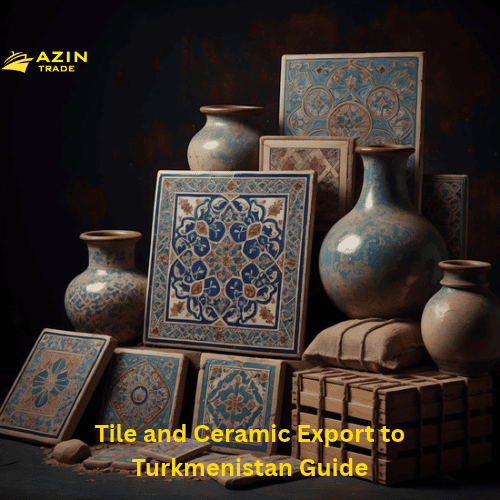
Glazed ceramic floor and wall tiles remain the highest-volume category, largely because they suit both residential apartment construction and mid-range commercial buildings. Unglazed ceramic paving tiles come in close behind, driven by exterior walkways and public infrastructure projects. Porcelain tile demand is smaller but growing, concentrated mostly in higher-end commercial buildings and government facilities in Ashgabat where a more polished finish matters. Sanitary ceramic products — sinks, basins, and similar fixtures — round out the mix as a smaller but steady category tied directly to new housing construction.
Buyers sourcing for large residential projects tend to favor neutral, light-toned glazed tiles in standard formats, since these move fastest through approval processes on government-linked developments. Private commercial buyers — hotels, retail spaces, restaurants — show more appetite for textured or large-format porcelain, closer to what you’d see requested in Gulf markets. Matching the right product line to the right buyer segment matters more in Turkmenistan than in larger, more fragmented markets, simply because there are fewer buyers overall and each relationship carries more weight.
Border Crossings and Shipping Routes from Iran to Turkmenistan
Getting the product made is only half the job. Getting it across the border efficiently is the other half, and this is where a lot of first-time exporters lose money.
Two routes handle most of the tile and ceramic trade between the two countries:
- Sarakhs — this is the most established crossing, connecting Iran’s Razavi Khorasan province directly to Sarakhs, Turkmenistan. It functions as both a road crossing and a break-of-gauge railway station, meaning cargo is transferred between Iranian and Turkmen rail gauges here. For bulk tile and ceramic shipments, this rail link is often the most cost-effective option.
- Incheh Borun — located in Golestan province, this crossing serves buyers in Turkmenistan’s western regions and offers a road-based alternative when rail scheduling doesn’t align with a shipment’s timeline.
Choosing between rail and road usually comes down to volume and urgency. Rail wins on cost for large, non-urgent orders. Road trucking wins when a buyer needs product faster or in smaller quantities that don’t justify booking rail capacity.
Export Documents and Customs Requirements
Paperwork is where shipments actually get delayed — not on the road, not at sea, but sitting in a customs office because one document didn’t match another.
At minimum, a tile and ceramic shipment from Iran to Turkmenistan typically requires:
- A commercial invoice and detailed packing list
- A certificate of origin
- A quality or conformity certificate for the ceramic products
- Rail waybill or road transport documentation, depending on the route
- Any import permits required by Turkmen customs authorities for construction materials
Requirements can shift with little notice, so it’s worth confirming current documentation with your exporter before finalizing a contract rather than relying on what worked last year.
Packaging Standards for Tile and Ceramic Shipments
Tile breakage during transit is one of the most common — and most avoidable — sources of dispute between buyers and exporters.
Ceramic tiles typically ship in reinforced cardboard boxes stacked on wooden pallets, with each box clearly labeled for size, grade, and batch number. For rail shipments through Sarakhs, where cargo gets physically transferred between gauges, extra attention to pallet wrapping and corner protection matters more than it does for a direct truck route. A supplier who skips this step to save a few dollars per pallet usually costs the buyer far more in breakage claims down the line.
Pricing Factors for Tile and Ceramic Exports to Turkmenistan
The FOB price on a supplier’s price list is rarely the number that ends up mattering most.
Several factors combine to shape the final landed cost:
- Tile grade and finish — polished porcelain costs more than standard glazed ceramic, and pricing should reflect that clearly, not get bundled into a vague “premium” line item.
- Order volume — larger orders unlock better per-square-meter pricing and more favorable rail freight rates.
- Route and mode — rail through Sarakhs is typically cheaper per ton than road freight, but road can be faster for smaller or time-sensitive orders.
- Currency movements — since most contracts settle in US dollars, exchange rate shifts on either side affect the final number.
Any Iranian tile exporter who can’t break these line items apart on request probably isn’t the right long-term partner.
It’s also worth asking for pricing in more than one format — per square meter and per container — since the two don’t always scale the way buyers expect once packaging weight and box count enter the calculation. A supplier quoting only one format, and resisting a request to show the other, is usually hiding a markup somewhere in the conversion.
Iran vs. China, Turkey, and Russia in the Turkmenistan Market
Turkmen buyers do have other options, and it’s worth being honest about where Iran wins and where it doesn’t.
China competes aggressively on price for basic, high-volume ceramic tile, especially in large government-tender projects where the lowest bid often wins regardless of finish quality. Turkey offers strong design variety and a premium brand reputation, but shipping costs into landlocked Turkmenistan work against it compared to Iran’s direct rail and road links. Russia holds the largest overall trade relationship with Turkmenistan, but its tile and ceramic exports specifically are a smaller piece of that broader trade picture. Iran’s advantage sits squarely in the middle: better logistics than China or Turkey for this specific market, and a price-to-quality balance that’s hard for distant suppliers to match once freight costs are factored in.
Turkmenistan’s Construction Boom: What’s Actually Driving Demand
It helps to understand why this market moves the way it does before deciding whether it’s worth the effort.
Turkmenistan’s government has poured resources into large-scale urban development for years, with Ashgabat in particular known for marble-clad government buildings, new residential complexes, and public infrastructure projects. That marble-heavy aesthetic gets most of the attention, but it’s the surrounding residential and commercial construction — the apartment blocks, hospitals, schools, and retail developments — that actually drives steady tile and ceramic demand. These projects don’t need showpiece marble facades. They need reliable, mid-range ceramic flooring and wall tile in consistent volumes, which is exactly the segment where Iranian manufacturers compete best. Regional cities like Türkmenabat and Mary add a second layer of demand outside the capital, often with less competition from suppliers who focus exclusively on Ashgabat’s flagship projects.
Common Mistakes First-Time Exporters Make in This Market
A lot of exporters lose money in Turkmenistan not because of bad products, but because of avoidable planning mistakes.
- Treating Sarakhs like any other border — the gauge change between Iranian and Turkmen rail systems means cargo handling here works differently than a straightforward truck crossing. Exporters who don’t plan for this lose time and sometimes damage product during the transfer.
- Underestimating documentation lead time — assuming paperwork will clear as fast as it does on more familiar routes, like Iran-Iraq, and then missing delivery windows.
- Ignoring regional demand outside Ashgabat — focusing exclusively on the capital and missing steady, lower-competition demand in cities like Türkmenabat and Mary.
- Skipping sample orders — going straight to a full container order without confirming that a factory’s sample quality holds up across a full production run.
Avoiding these four mistakes alone puts an exporter ahead of a large share of the competition in this market.
Payment Terms Buyers Typically Encounter
Payment structure is often the last thing discussed and the first thing that causes friction, so it’s worth addressing directly.
Most Iranian tile and ceramic exporters work with a combination of advance deposit and balance-on-shipment terms for new buyers, typically 30% upfront with the remainder due against shipping documents. Established relationships with repeat orders can sometimes shift toward more flexible terms, including balance-on-delivery for buyers with a proven payment history. Given banking restrictions that affect some Iranian trade routes, it’s worth confirming early in the conversation exactly how payment will move between your bank and the exporter’s, rather than assuming standard SWIFT transfers will work the same way they do with suppliers in other countries. A transparent exporter will walk through this before you commit to an order, not after.
How to Choose a Reliable Tile and Ceramic Exporter
A polished catalog and a professional-looking website tell you almost nothing about whether a supplier can actually deliver on time.
Before signing a contract, it’s worth checking:
- Production capacity — can the factory actually support your order volume without pulling from multiple unrelated batches?
- Sample consistency — does a sample match what arrives in the full shipment, or does quality drift between production runs?
- Export track record — has this exporter shipped into Turkmenistan specifically, or only to markets with different customs procedures?
- Documentation support — will they walk you through Sarakhs or Incheh Borun paperwork, or leave you to figure it out alone?
Azintrade’s tile and ceramic supplier page outlines the range of products available for bulk export, and the company’s broader work on ceramic tile exports across the Middle East gives a sense of how it handles cross-border logistics at scale.
My Take: Is Turkmenistan Worth Prioritizing Right Now?
Since you asked for an honest opinion, here’s mine: Turkmenistan is one of the more underrated markets in Iran’s regional tile and ceramic trade right now.
The $9.8 million export figure isn’t large in absolute terms, but it’s small precisely because few exporters have bothered to build real relationships there — not because demand is weak. A country running large state-funded construction programs with almost no domestic ceramic tile industry, sitting directly across a well-established rail border from one of the world’s more competitive ceramic manufacturing bases, is not a market that should stay this quiet. My honest read is that the exporters who invest in Turkmenistan-specific logistics and relationships now — rather than treating it as an afterthought behind Iraq or Azerbaijan — are the ones who’ll hold a real advantage in three or four years, once more competitors notice the same gap.
Why Azintrade Is a Strong Partner for Tile and Ceramic Export to Turkmenistan
Sourcing directly from Iranian ceramic factories without a partner who understands the Sarakhs and Incheh Borun routes can turn a straightforward order into a logistics headache.
Azintrade works as a tile and ceramic supplier for international construction projects, connecting buyers with Iranian manufacturers while handling the export side directly. That includes:
- Product sourcing across glazed, unglazed, and porcelain tile categories
- Export documentation and customs coordination for both rail and road routes
- Packaging built for long-distance and cross-gauge rail transfers
- Ongoing supply relationships for buyers with recurring project needs
Buyers evaluating ceramic floor tile suppliers or comparing options among the broader list of leading global ceramic suppliers can use Azintrade as a direct point of contact for Turkmenistan-specific pricing and lead times.
Frequently Asked Questions
Does Iran export tile and ceramic products to Turkmenistan?
Yes. Iran exported approximately $9.8 million in ceramic products to Turkmenistan in the most recent recorded trade year, with unglazed ceramic tiles as the largest single category.
What’s the best border crossing for shipping tile and ceramic to Turkmenistan?
Sarakhs is the primary route, offering both road access and a rail link with gauge-transfer facilities. Incheh Borun serves as an alternative for buyers in Turkmenistan’s western regions.
How long does it take to ship tile and ceramic from Iran to Turkmenistan?
This depends on the route and mode. Road shipments through Sarakhs or Incheh Borun typically move faster for smaller orders, while rail shipments take longer to schedule but cost less per ton for bulk volumes.
What documents do I need to import Iranian tiles into Turkmenistan?
At minimum, a commercial invoice, packing list, certificate of origin, a quality/conformity certificate, and transport documentation matching the shipping mode (rail waybill or road documentation).
Is Iranian tile cheaper than Chinese or Turkish tile in Turkmenistan?
Landed cost often favors Iran once freight is factored in, even when the raw factory price looks similar to Chinese pricing, because of the direct rail and road access through Sarakhs.
What tile sizes are most common in Turkmenistan’s construction market?
Standard sizes like 30×30 cm and 60×60 cm dominate residential and mid-range commercial flooring, similar to demand patterns across the wider Central Asian region.
Can small or first-time importers order from Iranian tile exporters?
Yes, though minimum order quantities vary by supplier. Working with an exporter that offers flexible MOQs and sample orders is usually the safer starting point for a first shipment.
What’s the difference between glazed and unglazed ceramic tile for export?
Glazed tile has a fired-on coating that gives it color, gloss, and stain resistance, making it the standard choice for interior floors and walls. Unglazed tile keeps the natural clay finish, offering better slip resistance, which is why it’s more common in exterior paving and public walkway projects.
Do Iranian ceramic factories offer custom sizes or designs for Turkmenistan buyers?
Many do, particularly for larger orders tied to specific commercial or government projects. Custom sizing and pattern work typically require longer lead times and higher minimum order quantities than standard catalog products.
Request a Quote for Tile and Ceramic Export to Turkmenistan
If you’re comparing suppliers for tile and ceramic export to Turkmenistan, Azintrade can walk you through current pricing, lead times, and documentation for shipments via Sarakhs or Incheh Borun.
Contact Azintrade today to request a quotation and see how direct access to Iranian manufacturers compares to your current sourcing options.