
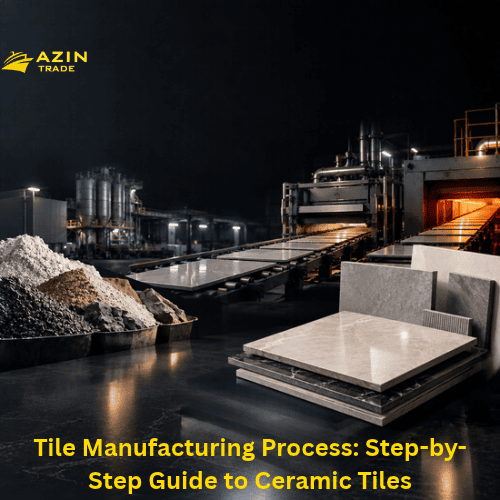
Tile Manufacturing Process: Step-by-Step Guide to Ceramic Tiles
The tile manufacturing process is a carefully controlled industrial procedure that transforms natural raw materials into durable ceramic, porcelain, and other types of tiles. From raw material preparation and grinding to pressing, drying, glazing, firing, and quality control, every stage affects the final tile’s strength, appearance, water absorption, and performance.
Understanding the tile manufacturing process is important for importers, distributors, contractors, architects, and construction companies that need to evaluate tile quality before purchasing in bulk. A professional manufacturing process helps manufacturers produce tiles with consistent dimensions, attractive surfaces, high mechanical strength, and reliable performance.
This guide explains how ceramic and porcelain tiles are manufactured, what materials are used, how tiles are fired, and which quality-control procedures determine the final product.
What Is the Tile Manufacturing Process?
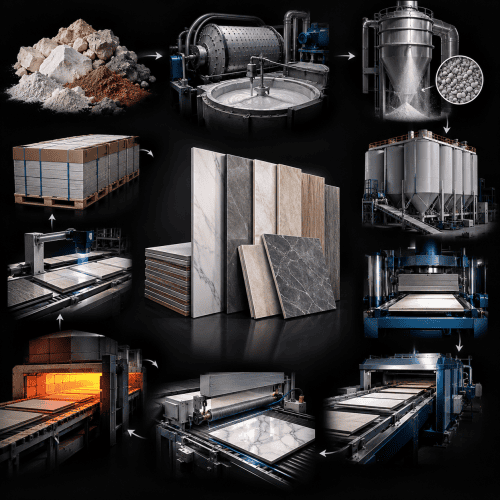
The tile manufacturing process consists of several interconnected stages that convert mineral raw materials into finished tiles. Although production methods can vary depending on the tile type and factory technology, the general process includes:
- Raw material selection
- Raw material preparation
- Grinding and mixing
- Spray drying
- Powder storage
- Pressing and shaping
- Drying
- Glazing and surface decoration
- Firing
- Sorting and quality control
- Packaging
- Storage and transportation
Each stage must be carefully controlled because a problem in one step can affect the quality of the finished product.
For example, incorrect moisture content during powder preparation can cause pressing problems, while improper firing temperatures can lead to warping, cracks, color variations, or inadequate mechanical strength.
Raw Materials Used in Tile Manufacturing
The first stage of the tile manufacturing process is selecting and preparing the appropriate raw materials.
Ceramic and porcelain tiles are primarily manufactured from mineral-based materials. The exact formulation depends on the type of tile, required technical properties, production technology, and desired appearance.
Common raw materials include:
- Clay
- Kaolin
- Feldspar
- Quartz
- Silica
- Calcium carbonate
- Dolomite
- Talc
- Pigments and mineral additives
- Glazing materials
Clay
Clay provides plasticity and helps the raw material mixture form a stable body during shaping. Different types of clay can affect the tile’s color, strength, shrinkage, and firing behavior.
Feldspar
Feldspar acts as a flux during firing. It helps lower the melting temperature of the ceramic mixture and contributes to the formation of a dense and durable tile body.
Quartz and Silica
Quartz helps control the dimensional stability of the tile body and contributes to its mechanical properties. The amount and particle size of silica-containing materials must be carefully controlled.
Kaolin
Kaolin can improve whiteness and contribute to the structure and firing behavior of ceramic bodies. It is particularly important in formulations where a lighter tile body is required.
Step 1: Raw Material Selection and Preparation
Manufacturers begin by selecting raw materials according to the required tile specifications.
The materials are tested for factors such as:
- Chemical composition
- Moisture content
- Particle size
- Mineral composition
- Color
- Plasticity
- Firing behavior
The selected materials are then stored separately or combined according to a specific production formula.
Consistent raw material quality is essential because variations in mineral composition can produce differences in color, shrinkage, water absorption, and mechanical strength.
Step 2: Grinding and Mixing
After raw materials are selected, they are ground and mixed to create a homogeneous ceramic body.
Many modern tile factories use wet grinding systems. In this method, raw materials are mixed with water and processed in industrial ball mills.
The grinding process reduces particle size and creates a uniform suspension known as slurry.
The objective is to achieve:
- Uniform particle distribution
- Consistent chemical composition
- Suitable particle size
- Proper moisture characteristics
- Stable production performance
After grinding, the slurry is stored in tanks where continuous mixing helps prevent sedimentation.
Step 3: Spray Drying
One of the most important stages of modern ceramic tile production is spray drying.
The ceramic slurry is pumped into a spray dryer, where it is exposed to a stream of hot air. Water evaporates rapidly, leaving behind small, partially spherical granules of ceramic powder.
The resulting powder has controlled moisture and particle characteristics that make it suitable for pressing.
Proper spray drying helps improve:
- Powder flowability
- Pressing performance
- Density distribution
- Tile dimensions
- Production consistency
The moisture level of the powder must be carefully controlled because excessive or insufficient moisture can create defects during pressing.
Step 4: Powder Storage
After spray drying, the ceramic powder is transferred to storage silos.
The powder may be allowed to stabilize before entering the pressing stage.
During storage, manufacturers monitor moisture and material consistency. Automated handling systems can transfer the powder from silos to the production line.
Proper powder storage is important because changes in moisture can influence pressing pressure, green strength, shrinkage, and final dimensions.
Step 5: Pressing and Shaping
The next stage of the tile manufacturing process is pressing.
Hydraulic presses compress the prepared ceramic powder inside specially designed molds. Very high pressure is applied to form the tile body into its required dimensions and thickness.
Modern presses can produce tiles in a wide range of sizes and formats.
The pressing stage determines important characteristics such as:
- Tile thickness
- Density
- Shape
- Surface flatness
- Mechanical strength
- Dimensional stability
Uniform pressure distribution is essential. Uneven pressing can create density differences within the tile body, which may later cause warping, cracking, or other defects during drying and firing.
Step 6: Drying
Freshly pressed tiles still contain a certain amount of moisture and therefore need to be dried before glazing and firing.
Industrial dryers gradually remove moisture from the tile body.
The drying process must be controlled carefully. If moisture is removed too quickly, the tile can develop:
- Cracks
- Deformation
- Internal stresses
- Uneven shrinkage
Modern production lines use controlled temperature and airflow to achieve uniform drying.
The objective is to produce a tile body that is strong enough to withstand subsequent processing.
Step 7: Glazing
Glazing is an important stage for many ceramic and porcelain tile products.
A glaze is a specially formulated coating applied to the surface of the tile. Depending on the product design, glazing can provide:
- Color
- Gloss
- Texture
- Stain resistance
- Easier cleaning
- Decorative effects
- Additional surface protection
Glaze formulations can contain minerals, frits, pigments, and other specialized materials.
The glaze application must be uniform to achieve consistent appearance across large production batches.
Step 8: Digital Printing and Surface Decoration
Modern tile factories increasingly use digital printing technology to create highly detailed designs.
Digital printers can reproduce patterns inspired by:
- Natural stone
- Marble
- Granite
- Wood
- Concrete
- Metal
- Textile
- Geometric designs
High-resolution digital printing allows manufacturers to produce complex visual effects while maintaining consistent production quality.
For stone-look porcelain tiles, for example, digital printing can reproduce natural veins and patterns across large tile surfaces.
Step 9: Firing
Firing is one of the most critical stages in the tile manufacturing process.
The shaped and, where applicable, glazed tiles are transported through industrial kilns. The temperature profile depends on the tile type, body formulation, glaze system, and desired technical properties.
During firing, several physical and chemical transformations occur.
The ceramic body becomes denser and stronger, while the glaze can melt and form a durable surface layer.
Important firing parameters include:
- Maximum temperature
- Heating rate
- Kiln atmosphere
- Firing time
- Cooling rate
- Temperature distribution
Incorrect firing conditions can cause defects such as:
- Cracking
- Warping
- Pinholes
- Surface defects
- Color variation
- Excessive shrinkage
- Low mechanical strength
For this reason, industrial kilns use precise temperature-control systems.
Ceramic Tile vs. Porcelain Tile Manufacturing
Although ceramic and porcelain tiles share many production stages, their formulations and technical characteristics differ.
Porcelain tiles generally use highly refined raw materials and are manufactured to achieve very low water absorption and high density.
| Feature | Ceramic Tile | Porcelain Tile |
|---|---|---|
| Raw materials | Clay and minerals | Refined clay, feldspar, quartz and minerals |
| Density | Generally lower | Generally higher |
| Water absorption | Higher than porcelain | Very low |
| Firing | High temperature | Typically very high temperature |
| Applications | Walls and floors | Floors, walls and demanding applications |
| Durability | Good | Generally higher |
| Design options | Wide | Wide |
The appropriate product depends on the intended application, environmental conditions, technical specifications, and project requirements.
Step 10: Cutting, Rectification and Finishing
After firing, some tiles undergo additional mechanical finishing.
Rectification is a process in which the edges of fired tiles are mechanically cut and calibrated to achieve highly consistent dimensions.
Rectified tiles can provide:
- Precise dimensions
- Straight edges
- Narrower grout joints
- More uniform installation
Some products may also receive additional surface treatments, polishing, lapping, brushing, or texturing.
The finishing method depends on the product category and its intended application.
Step 11: Tile Sorting and Quality Control
Quality control is performed throughout the production process rather than only at the end.
Finished tiles can be inspected for:
- Dimensions
- Thickness
- Flatness
- Edge straightness
- Surface appearance
- Color consistency
- Water absorption
- Breaking strength
- Abrasion resistance
- Slip resistance
- Frost resistance where applicable
Automated inspection systems can detect surface defects and dimensional variations at high production speeds.
Tiles are then classified according to the manufacturer’s quality standards and applicable technical requirements.
Common Tile Manufacturing Defects
Even advanced manufacturing facilities can experience production defects if raw materials or process parameters are not properly controlled.
Common defects include:
Cracks
Cracks can result from improper drying, uneven pressing, thermal stress, or problems during handling.
Warping
Warping can occur when density, moisture, drying, or firing conditions are not uniform.
Color Variation
Differences in raw materials, glaze composition, digital printing, or firing conditions can result in variations between production batches.
Pinholes
Small holes or imperfections on glazed surfaces may be caused by gases escaping from the tile body or glaze during firing.
Dimensional Variation
Inconsistent pressing, drying, firing shrinkage, or calibration can affect tile dimensions.
Effective quality control helps manufacturers identify and minimize these problems.
Tile Quality Standards
International buyers often evaluate tiles according to technical standards and project specifications.
Depending on the destination market and product category, manufacturers may need to consider standards covering:
- Water absorption
- Dimensions and tolerances
- Surface quality
- Breaking strength
- Modulus of rupture
- Abrasion resistance
- Slip resistance
- Frost resistance
- Chemical resistance
Standards such as ISO and regional standards can provide testing frameworks for ceramic and porcelain tiles.
For international trade, buyers should always confirm the required standard and testing method before placing a bulk order.
Packaging of Finished Tiles
After inspection and classification, tiles are packaged for storage and transportation.
Packaging normally protects the products from:
- Impact
- Moisture
- Scratching
- Contamination
- Breakage during transportation
Cartons are commonly placed on pallets and secured for shipment.
For international exports, packaging must be appropriate for long-distance transportation and the handling conditions expected at ports, warehouses, and construction sites.
Tile Manufacturing for Export Markets
The tile manufacturing process becomes especially important when products are prepared for international export.
Export buyers generally need more than attractive designs. They also require consistent specifications, reliable production capacity, appropriate packaging, documentation, and stable quality between batches.
Before purchasing tiles in bulk, importers should consider:
- Tile type
- Size and thickness
- Water absorption
- Surface finish
- Color and design
- Technical specifications
- Applicable standards
- Packaging requirements
- Minimum order quantity
- Production capacity
- Lead time
- Shipping terms
- Export documentation
A reliable supplier should be able to provide product specifications and relevant quality documentation before the order is finalized.
How Technology Is Improving Tile Manufacturing
The ceramic tile industry has become increasingly automated.
Modern factories can use automated systems for:
- Raw material dosing
- Grinding
- Spray drying
- Pressing
- Drying
- Glazing
- Digital printing
- Firing
- Sorting
- Packaging
Automation improves production consistency and can reduce human error.
Digital inspection technologies are also becoming increasingly important because they can identify surface and dimensional defects more quickly than manual inspection alone.
Energy efficiency is another important area of development. Modern kilns, dryers, and production systems are designed to reduce energy consumption while maintaining the required production conditions.
Environmental Considerations in Tile Production
Tile manufacturing involves significant energy and raw material consumption. As a result, manufacturers are increasingly focusing on more efficient production methods.
Important environmental considerations include:
- Energy consumption
- Water usage
- Dust control
- Waste reduction
- Recycling of ceramic materials
- Emissions control
- Efficient kiln technology
Some manufacturing facilities recycle water and ceramic waste back into the production process where technically appropriate.
Energy-efficient equipment can also reduce the environmental impact associated with firing and drying.
How to Choose Tiles From a Manufacturer
Understanding the production process can help buyers evaluate suppliers more effectively.
When comparing tile manufacturers or exporters, buyers should look beyond price alone.
Important factors include:
Product Quality
Check technical specifications and test reports where available.
Production Capacity
A supplier should have sufficient capacity to maintain consistent deliveries for large projects.
Product Range
Consider whether the manufacturer can supply the required sizes, finishes, colors, and tile categories.
Quality Consistency
Consistency between batches is particularly important for large construction projects.
Packaging
Strong export packaging can reduce the risk of damage during transportation.
Documentation
International buyers may require invoices, packing lists, certificates, test reports, certificates of origin, and other export documentation.
Logistics
The supplier should be able to coordinate production and shipping according to the agreed commercial terms.
Tile Manufacturing Process: From Raw Materials to Finished Product
The complete tile manufacturing process can be summarized as follows:
Raw materials → Grinding → Mixing → Spray drying → Powder storage → Pressing → Drying → Glazing → Digital printing → Firing → Rectification → Quality control → Packaging → Export
Each stage contributes to the final performance and appearance of the tile.
A well-controlled manufacturing process allows producers to achieve consistent dimensions, mechanical strength, surface quality, and water absorption.
Frequently Asked Questions About the Tile Manufacturing Process
What are the main steps in the tile manufacturing process?
The main steps include raw material preparation, grinding, mixing, spray drying, pressing, drying, glazing, digital printing, firing, finishing, quality control, and packaging.
What raw materials are used to make ceramic tiles?
Common raw materials include clay, kaolin, feldspar, quartz, silica, calcium carbonate, dolomite, and various mineral additives.
How are ceramic tiles shaped?
Modern factories commonly shape tiles by pressing prepared ceramic powder into molds using hydraulic presses.
Why is firing important in tile production?
Firing transforms the pressed ceramic body into a strong, durable material. It also helps develop the required physical and surface properties of the finished tile.
What is the difference between ceramic and porcelain tiles?
Porcelain tiles generally have higher density and significantly lower water absorption than conventional ceramic tiles. Their formulations and firing conditions are designed to achieve these properties.
How does digital printing affect tile production?
Digital printing allows manufacturers to create detailed and realistic patterns, including marble, stone, wood, concrete, and decorative designs.
How is tile quality tested?
Depending on the product and market, tiles can be tested for dimensions, water absorption, breaking strength, surface quality, abrasion resistance, slip resistance, chemical resistance, and other technical properties.
What should importers check before buying tiles?
Importers should check product specifications, quality standards, dimensions, water absorption, surface finish, packaging, production capacity, documentation, minimum order quantity, lead time, and shipping conditions.
Conclusion
The tile manufacturing process combines mineral raw materials, advanced machinery, controlled thermal treatment, surface decoration, and strict quality control to produce durable ceramic and porcelain tiles.
From selecting clay and feldspar to grinding, spray drying, pressing, glazing, digital printing, firing, sorting, and packaging, every stage has an important role in determining the final product.
For international buyers, understanding these production stages makes it easier to evaluate manufacturers, compare product specifications, and select tiles suitable for residential, commercial, industrial, and infrastructure projects.
When sourcing tiles for international projects, buyers should work with suppliers that can provide consistent quality, appropriate technical specifications, reliable production capacity, export-ready packaging, and the documentation required for the destination market.