
Best Gypsum Rock Producers in the World in 2026
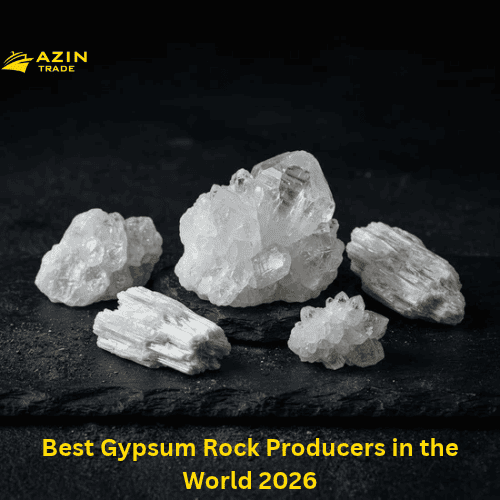
The best gypsum rock producers in the world play an important role in supplying natural gypsum for construction, cement manufacturing, plaster production, agriculture, and other industrial applications. Natural gypsum, also known as gypsum rock, is extracted from deposits around the world and processed into different grades, sizes, and specifications according to the requirements of industrial buyers.
In 2026, the international gypsum market includes specialized mining companies, natural gypsum exporters, and large integrated building-material manufacturers. Countries such as the United States, Iran, Oman, Spain, China, and several European and Asian markets remain important parts of the global gypsum supply chain.
According to the U.S. Geological Survey, U.S. crude gypsum production alone was estimated at approximately 20 million metric tons in 2025. Global gypsum production is distributed across numerous producing countries, while international trade is particularly important for countries with large deposits and efficient port infrastructure.
This guide examines the best gypsum rock producers in the world based on factors such as natural gypsum mining activity, production capacity, export presence, processing capabilities, geographic reach, and relevance to international bulk buyers.Important: There is no universally accepted official ranking of companies based exclusively on raw gypsum rock production. Therefore, this article should be viewed as an industry guide rather than an official ranking by production volume.
How We Selected the Best Gypsum Rock Producers in the World
The best gypsum rock producers in the world cannot be identified simply by looking at the size of a company’s finished gypsum-board business.
Natural gypsum rock and finished gypsum products are different parts of the same value chain.
For this guide, companies were considered based on several factors:
- Natural gypsum mining activity
- Access to gypsum deposits
- Production and processing capabilities
- Bulk supply capacity
- International export activity
- Port and logistics infrastructure
- Geographic market reach
- Importance in the global gypsum supply chain
- Experience serving industrial customers
This approach is particularly important for buyers searching for bulk natural gypsum rock, because a company with a very large gypsum-board business is not necessarily a major exporter of raw gypsum.
Top 10 Gypsum Rock Producers and Suppliers in 2026
| Company | Country | Main Activity |
|---|---|---|
| Grupo Torralba | Spain | Natural gypsum mining and export |
| Knauf Group | Germany | Gypsum mining and gypsum products |
| Saint-Gobain / British Gypsum | France / UK | Gypsum mining and building products |
| Kunooz Gypsum | Oman | Natural gypsum mining and export |
| Fassa Bortolo | Italy | Gypsum quarrying and processing |
| National Gypsum Company | USA | Gypsum mining and building products |
| American Gypsum | USA | Gypsum mining and wallboard |
| USG / CGC | USA / Canada | Gypsum mining and building products |
| BNBM | China | Gypsum-based building materials |
| Global Mining Company | Oman | Natural gypsum mining and export |
The companies below represent different parts of the international gypsum industry. Some focus directly on natural gypsum rock, while others operate integrated mining and manufacturing businesses.
1. Grupo Torralba – Spain
Grupo Torralba is an important European name when discussing natural gypsum mining and international gypsum exports.
Based in Spain, the company specializes in the extraction, processing, and international commercialization of natural crystalline gypsum. Its gypsum deposits are located in the Almería region, an area with significant natural gypsum resources.
The company produces natural gypsum in different crushed and screened sizes for industrial customers.
Typical product sizes can include:
- 0–70 mm
- 0–40 mm
- 0–10 mm
This flexibility is important because different industrial applications require different particle sizes.
Natural Gypsum for Industrial Applications
Grupo Torralba is particularly relevant to buyers searching for raw gypsum rather than finished gypsum boards.
Its natural gypsum can be used by customers involved in:
- Cement manufacturing
- Gypsum-product manufacturing
- Industrial processing
- Plaster production
- Bulk mineral supply
The company’s international shipping capabilities are another important part of its business model.
Spain is also one of the significant gypsum-producing countries in the global market. As a result, Spanish producers benefit from access to large natural gypsum deposits and established European shipping infrastructure.
For buyers comparing the best gypsum rock producers in the world, Grupo Torralba is therefore particularly relevant when natural gypsum export capability is the main requirement.
2. Knauf Group – Germany
Knauf Group is one of the world’s best-known gypsum and building-material companies.
Although the company is widely recognized for gypsum board, plasterboard, drywall systems, and construction products, its history is directly connected to natural gypsum mining.
Knauf was founded in 1932 after brothers Alfons and Karl Knauf secured mining rights for gypsum deposits in the Schengen area. The company established its first gypsum plant shortly afterward.
Today, gypsum remains one of the core areas of the Knauf business.
Knauf Gypsum Products and Operations
Knauf’s gypsum-related activities include:
- Natural gypsum
- Gypsum plaster
- Gypsum board
- Plasterboard
- Drywall systems
- Ceiling systems
- Floor systems
- Construction solutions
One of Knauf’s major advantages is vertical integration.
The company’s gypsum value chain can be viewed as:
Mining → Processing → Manufacturing → Distribution → Construction Systems
This integrated structure allows the company to connect raw-material resources with finished construction products.
Knauf is therefore relevant to the global gypsum market from both a raw-material and finished-product perspective.
For buyers researching the best gypsum rock producers in the world, Knauf is particularly important as an example of a large integrated gypsum business.
3. Saint-Gobain / British Gypsum – France and United Kingdom
Saint-Gobain is one of the world’s major building-material groups and has a substantial presence in the gypsum industry.
Through brands such as British Gypsum, the company operates gypsum mining and manufacturing activities in several markets.
British Gypsum has a particularly long history of natural gypsum mining in the United Kingdom.
British Gypsum and Natural Gypsum
Natural gypsum is an important raw material for products such as:
- Plaster
- Plasterboard
- Drywall systems
- Ceiling systems
- Interior construction products
Saint-Gobain’s gypsum activities extend beyond the UK, with gypsum-related manufacturing and mining operations in several international markets.
The company’s large downstream manufacturing network is important because it demonstrates how natural gypsum can be transformed into higher-value construction products.
Saint-Gobain is therefore relevant when comparing the best gypsum rock producers in the world, especially from the perspective of integrated mining and manufacturing.
4. Kunooz Gypsum – Oman
Kunooz Gypsum is one of the important natural gypsum producers and exporters in Oman.
The company operates in the Salalah region and has developed mining and processing operations designed to supply international industrial customers.
According to company information, its mining operations began in the early 2010s, followed by international export shipments.
Kunooz Gypsum Export Markets
Oman’s geographic position provides an important advantage for bulk gypsum exports.
Kunooz Gypsum has supplied markets including:
- India
- Bangladesh
- Vietnam
- Indonesia
- Philippines
- Japan
- Australia
- UAE
- Eastern Africa
- Southern Africa
The company also operates crushing and screening facilities for producing different gypsum sizes.
Its gypsum products can be used in applications such as:
- Cement production
- Plaster of Paris
- Gypsum board
- Glass manufacturing
- Fertilizer applications
Why Oman Matters
Oman has become one of the most important natural gypsum export hubs in the world.
Its deposits, combined with access to major maritime routes, make the country particularly attractive for bulk shipments to South Asia and Southeast Asia.
For this reason, Kunooz Gypsum is a relevant company for buyers comparing the best gypsum rock producers in the world for large-volume international supply.
5. Fassa Bortolo – Italy
Fassa Bortolo is an Italian building-material manufacturer with its own quarrying activities, including natural gypsum extraction.
The company has developed experience in underground gypsum mining and processes high-purity crystalline gypsum from underground deposits.
Fassa Bortolo Gypsum
Its gypsum raw materials are used in applications such as:
- Plasterboard
- Skim coats
- Joint fillers
- Insulation
- Restoration materials
- Premixed plasters
- Stucco
- Plaster moulds
The company has also emphasized quarry management and environmental remediation as part of its mining activities.
Its gypsum operations demonstrate an integrated approach in which mineral extraction, processing, manufacturing, and environmental management are connected.
For industrial buyers, high-purity gypsum can be especially important when the raw material is destined for applications where chemical consistency affects final product performance.
Consequently, Fassa Bortolo is another relevant name when evaluating the best gypsum rock producers in the world.
6. National Gypsum Company – United States
National Gypsum Company is one of the major gypsum-product manufacturers in the United States.
The company was established in 1925 and operates through brands including Gold Bond, ProForm, and PermaBASE.
Its product portfolio includes:
- Gypsum wallboard
- Gypsum products
- Joint compounds
- Cement-board products
- Construction systems
National Gypsum and Raw Gypsum
National Gypsum is particularly relevant to raw gypsum because its industrial operations include access to significant gypsum rock deposits.
Gypsum rock from its quarries supplies different industrial applications, including:
- Wallboard manufacturing
- Cement production
- Agricultural applications
This illustrates an important characteristic of the U.S. gypsum industry: natural gypsum can be supplied directly from quarries to manufacturers and other industrial users.
The United States is one of the world’s significant gypsum-producing countries. USGS estimated U.S. crude gypsum production at approximately 20 million metric tons in 2025.
National Gypsum is therefore an important participant in the North American gypsum supply chain and a company worth considering when researching the best gypsum rock producers in the world.
7. American Gypsum – United States
American Gypsum is another major U.S. company operating in the gypsum industry.
The company has manufactured and distributed gypsum wallboard products for decades and maintains an integrated relationship between gypsum mines and manufacturing facilities.
American Gypsum states that its mines are located close to its production plants and contain high-quality gypsum deposits.
American Gypsum Production
The company operates:
- Multiple gypsum manufacturing plants
- Several production lines
- Large-scale annual wallboard capacity
- Gypsum mining operations
Its natural gypsum is processed and converted into gypsum wallboard and other construction materials.
The company’s supply chain can be represented as:
Gypsum Deposit → Mining → Processing → Wallboard Manufacturing → Distribution
This type of vertical integration can help manufacturers maintain control over raw-material supply.
American Gypsum is therefore particularly relevant to the North American market and to buyers studying major integrated gypsum producers.
8. USG / CGC – United States and Canada
USG and its Canadian division CGC are major participants in the North American gypsum industry.
USG operates across the United States, Canada, and Latin America, while CGC is a major Canadian manufacturer of gypsum-based building materials.
One of the most significant raw-gypsum developments associated with the company is the Little Narrows gypsum quarry in Nova Scotia.
Little Narrows Gypsum Quarry
The Little Narrows project represents an important investment in raw gypsum supply for the North American market.
CGC announced a major investment to revitalize the quarry, with planned production capacity of up to approximately 2 million tonnes of raw gypsum per year once fully operational.
In September 2026, CGC announced the first shipment of gypsum rock from Little Narrows as the project entered operational commissioning.
The gypsum produced there is intended to supply CGC and USG manufacturing facilities in Eastern Canada and along the Eastern Seaboard.
This makes the operation particularly significant for the regional raw gypsum supply chain.
For this reason, USG/CGC deserves consideration among the best gypsum rock producers in the world, particularly when evaluating large-scale industrial supply in North America.
9. BNBM – China
Beijing New Building Materials Public Limited Company, commonly known as BNBM, is one of China’s largest building-material companies.
BNBM is part of China National Building Materials Group and is particularly well known for its gypsum-board manufacturing operations.
The company describes itself as the world’s largest gypsum-board industrial group, with a business scale of approximately 3.3 billion square meters.
BNBM Gypsum Products
Its product portfolio includes:
- Gypsum board
- Fire-resistant gypsum board
- Water-resistant gypsum board
- Multifunctional boards
- Joint compounds
- Gypsum binders
- Leveling materials
- Interior wall systems
- Ceiling systems
It is important to clarify that BNBM is more strongly associated with gypsum-board manufacturing than with the international export of raw gypsum rock.
Nevertheless, its enormous scale makes it an important company for understanding China’s gypsum industry and the wider global gypsum value chain.
Therefore, BNBM is included in this guide as a major gypsum-industry participant rather than as a specialist raw gypsum exporter.
10. Global Mining Company – Oman
Global Mining Company L.L.C. is an Omani gypsum producer based in Salalah.
The company focuses on natural gypsum production and is part of Oman’s growing mineral-export industry.
Oman has developed a strong position in international gypsum exports because of its geological resources and strategic location.
Oman’s Gypsum Export Advantage
Omani gypsum suppliers can serve markets across:
- India
- Bangladesh
- Vietnam
- Indonesia
- East Asia
- GCC countries
- Africa
The country’s location provides relatively efficient maritime access to several major industrial markets.
Oman is especially important for buyers who require large bulk shipments of natural gypsum.
As a result, Global Mining Company is relevant when comparing the best gypsum rock producers in the world, particularly for buyers evaluating Omani supply.
Natural Gypsum Rock vs. Gypsum Board
When searching for the best gypsum rock producers in the world, it is essential to understand the difference between raw gypsum and finished gypsum products.
Natural Gypsum Rock
Natural gypsum rock is extracted directly from mines and quarries.
It can be crushed, screened, sorted, and supplied in different particle sizes.
Common applications include:
- Cement manufacturing
- Plaster production
- Gypsum board manufacturing
- Agriculture
- Industrial processing
Gypsum Board
Gypsum board is a finished construction product manufactured using processed gypsum.
It is commonly used for:
- Interior walls
- Ceilings
- Drywall systems
- Fire-resistant construction
- Acoustic applications
A company can therefore be a very large gypsum-board manufacturer without being a major international exporter of raw gypsum rock.
This distinction is particularly important for importers looking for bulk mineral supplies.
What Makes High-Quality Gypsum Rock?
Production volume alone does not determine the suitability of a gypsum supplier.
Industrial buyers should also evaluate the technical characteristics of the material.
1. Gypsum Purity
The primary mineral in natural gypsum is calcium sulfate dihydrate:
CaSO₄·2H₂O
Higher-purity material can be preferable for applications with strict chemical requirements.
However, the appropriate purity depends on the intended application.
2. Moisture Content
Moisture can affect:
- Transportation costs
- Storage
- Handling
- Processing
- Final production efficiency
Therefore, moisture should be included in the supplier’s technical specification.
3. Particle Size
Gypsum rock can be supplied in different size ranges.
Examples include:
- 0–10 mm
- 0–40 mm
- 0–70 mm
The appropriate size depends on the customer’s processing equipment and application.
4. Chemical Composition
A professional Certificate of Analysis may include parameters such as:
- CaSO₄·2H₂O
- CaO
- SO₃
- SiO₂
- MgO
- Al₂O₃
- Fe₂O₃
- Chlorides
- Fluorides
- Insoluble matter
5. Consistency
For cement and plaster manufacturers, consistency can be just as important as the headline purity percentage.
A reliable supplier should be capable of maintaining relatively consistent physical and chemical specifications from shipment to shipment.
Major Gypsum-Producing Countries in 2026
Company-level production statistics are not consistently available for every producer worldwide.
Therefore, country-level production data can provide useful context when analyzing the global gypsum industry.
The United States remains a significant gypsum producer. USGS estimated approximately 20 million metric tons of crude gypsum production in 2025.
Oman is particularly important in international trade because of its large export volumes.
Spain is also an important gypsum-producing country and has developed a strong export-oriented gypsum industry.
Other significant gypsum-producing markets include countries in Asia, Europe, North America, and the Middle East.
Consequently, international gypsum buyers should evaluate both production capacity and export capacity.
A country may have substantial gypsum reserves but limited infrastructure for large-scale international shipments.
Why Oman and Spain Are Important for Bulk Gypsum Buyers
For companies purchasing natural gypsum in large quantities, production capacity is only one part of the purchasing decision.
Logistics can have an equally important impact on the final cost.
Important considerations include:
- Distance from mine to port
- Port loading capacity
- Bulk vessel availability
- Loading rate
- Product size
- Moisture
- Gypsum purity
- Annual production capacity
- Export infrastructure
- Ocean freight
- Destination port costs
Oman has developed a particularly important position in the international gypsum trade because large quantities of natural gypsum can be shipped by sea to Asian markets.
Spain also benefits from major natural gypsum deposits and access to Mediterranean shipping routes.
Therefore, buyers should compare suppliers based on landed cost, rather than looking only at the initial FOB quotation.
How to Choose a Gypsum Rock Supplier in 2026
Finding the best gypsum rock producers in the world is only the first step for an international buyer.
Before entering into a long-term supply agreement, buyers should conduct technical and commercial due diligence.
1. Request a Certificate of Analysis
Ask for a recent COA showing the chemical composition of the gypsum.
The analysis should match the material that will actually be shipped.
2. Verify the Mining Source
Determine whether the supplier:
- Owns the mine
- Operates the mine
- Purchases gypsum from another producer
- Acts as a trading company
Direct mining operations can provide greater traceability, although the commercial suitability of a supplier depends on the complete supply chain.
3. Confirm Available Production
Ask for realistic information about:
- Annual production
- Monthly availability
- Current stock
- Export allocation
- Maximum shipment size
This is especially important for buyers requiring thousands or tens of thousands of tonnes per shipment.
4. Confirm Particle Size
The buyer should specify the required size before requesting a quotation.
For example:
0–10 mm, 0–40 mm, or 0–70 mm
Different industrial processes require different specifications.
5. Check the Loading Port
The distance between the mine and loading port can have a significant effect on logistics.
The buyer should confirm:
- Port location
- Vessel restrictions
- Loading capacity
- Draft limitations
- Loading rate
- Bulk or container shipment options
6. Compare FOB, CFR, and CIF
A low FOB price does not necessarily represent the lowest total cost.
The buyer should calculate:
FOB Price + Ocean Freight + Insurance + Port Charges + Import Costs
This produces a more realistic comparison between suppliers.
7. Arrange Independent Inspection
For large shipments, independent inspection can help verify:
- Quantity
- Chemical composition
- Moisture
- Particle size
- Product quality
Independent laboratory testing can also reduce the risk of receiving material outside the agreed specification.
Bulk Gypsum Rock Export: What Buyers Should Know
Bulk gypsum rock is commonly transported by sea when the shipment size is large enough.
Depending on the origin and destination, suppliers may offer:
- Bulk vessel shipments
- Breakbulk shipments
- Containerized shipments
- Truck delivery
- Rail delivery
For international buyers, bulk vessel transportation can be particularly important because gypsum is a relatively high-volume mineral product.
The commercial value of the transaction therefore depends not only on the gypsum price but also on freight and handling costs.
This is why major natural gypsum export hubs with efficient ports can compete strongly in international markets.
Gypsum Rock Applications
Natural gypsum has several major industrial applications.
Cement Manufacturing
Gypsum is widely used in cement manufacturing to help regulate setting behavior.
This makes cement production one of the major industrial applications for natural gypsum.
Gypsum Board
Processed gypsum is used as the core material in gypsum wallboard and plasterboard.
These products are widely used in residential, commercial, and industrial construction.
Plaster
Gypsum can be processed into plaster and other construction compounds.
These materials are used for:
- Interior finishing
- Wall surfaces
- Ceiling systems
- Decorative applications
Agriculture
Agricultural gypsum can be used as a source of calcium and sulfur and as a soil amendment in appropriate agricultural applications.
Industrial Applications
Higher-purity gypsum can also be used in specialized industrial processes where consistent mineral quality is required.
Sustainability in the Gypsum Industry
The modern gypsum industry is increasingly focused on responsible resource management.
Major areas of attention include:
- Mine rehabilitation
- Resource efficiency
- Gypsum recycling
- Reduced transportation emissions
- Energy-efficient processing
- Responsible quarry management
- Reuse of gypsum waste
Quarry rehabilitation is particularly important because mining operations can alter landscapes and local ecosystems.
Integrated producers are therefore increasingly expected to manage extraction, processing, rehabilitation, and resource efficiency as part of their overall operations.
The Future of the Global Gypsum Rock Market
Demand for gypsum is closely connected to construction, cement manufacturing, infrastructure development, and agricultural applications.
At the same time, several trends are shaping the future of the market.
Growing Construction Demand
Urbanization and infrastructure development continue to create demand for construction materials, including gypsum-based products.
Growth of Drywall Construction
Drywall and lightweight construction systems remain important applications for processed gypsum.
Increasing Interest in Recycling
Gypsum recycling can reduce the need for virgin raw materials and support more efficient resource use.
Improved Mining Technology
Modern mining and processing technologies can improve resource efficiency and product consistency.
International Bulk Trade
Countries with large natural gypsum reserves and efficient ports are likely to remain important suppliers to markets that have limited domestic gypsum resources.
Frequently Asked Questions About Gypsum Rock Producers
Who are the best gypsum rock producers in the world in 2026?
There is no official global company ranking based exclusively on raw gypsum rock production. Important companies and producers discussed in this guide include Grupo Torralba, Knauf, Saint-Gobain/British Gypsum, Kunooz Gypsum, Fassa Bortolo, National Gypsum, American Gypsum, USG/CGC, BNBM, and Global Mining Company.
Which countries are major gypsum producers?
Major gypsum-producing countries include the United States, Iran, Oman, Spain, China, and several other countries across Europe and Asia. Production and export volumes vary by year.
Which country is important for bulk gypsum exports?
Oman is particularly important in the international bulk gypsum trade because of its large natural gypsum resources, export infrastructure, and geographic proximity to major Asian markets.
What is natural gypsum rock used for?
Natural gypsum rock is used mainly for cement manufacturing, gypsum board, plaster, agriculture, and various industrial applications.
What should I check before buying gypsum rock?
Buyers should check gypsum purity, chemical composition, moisture, particle size, available volume, mining source, loading port, inspection procedures, shipping terms, and total landed cost.
Is gypsum rock the same as gypsum board?
No. Gypsum rock is a naturally occurring mineral extracted from mines, while gypsum board is a manufactured construction product made using processed gypsum.
How is gypsum rock transported internationally?
Large quantities of gypsum rock are commonly transported by bulk vessels. Depending on the shipment size and destination, containerized, breakbulk, truck, or rail transportation may also be used.
Conclusion
The global gypsum industry in 2026 includes specialized natural gypsum mining companies, international exporters, and large integrated building-material manufacturers.
The best gypsum rock producers in the world are not necessarily the companies with the largest gypsum-board businesses. For buyers looking specifically for natural gypsum rock, factors such as mining capacity, mineral quality, available volume, processing capabilities, export infrastructure, and logistics are equally important.
Companies such as Grupo Torralba, Kunooz Gypsum, Global Mining Company, and Fassa Bortolo are particularly relevant when the focus is on natural gypsum extraction, quarrying, processing, or export.
At the same time, integrated groups such as Knauf, Saint-Gobain, National Gypsum, American Gypsum, and USG/CGC demonstrate how natural gypsum can be connected to large-scale manufacturing and construction-material supply chains.
BNBM represents another important part of the global market, although its primary strength is gypsum-board and building-material manufacturing rather than raw gypsum-rock exports.
For international buyers, choosing among the best gypsum rock producers in the world should ultimately involve more than comparing a quoted price. The buyer should evaluate purity, chemical composition, particle size, consistency, annual supply capacity, loading infrastructure, shipping costs, inspection procedures, and the supplier’s ability to meet specifications over the long term.
As international demand for cement, plaster, drywall, and other gypsum-based products continues, natural gypsum will remain an important industrial mineral in global construction and manufacturing.
For companies sourcing bulk gypsum internationally, a detailed comparison of quality, quantity, logistics, and landed cost is the most practical way to identify a suitable long-term supply partner.