
Cement Clinker Production Process: What’s New in 2026
Spend time around a cement plant and you’ll notice the smell, the heat, and the noise right away. The basic chemistry hasn’t changed. Limestone still needs heat above 1,400°C to become clinker. But almost everything around that core reaction looks different today.
Three pressures are driving the change: rising fuel costs, tighter emissions rules, and buyers who now ask hard questions about carbon footprints. This article walks through the cement clinker production process step by step, then digs into what’s genuinely new — alternative fuels, precalciner upgrades, carbon capture, and the software now running quietly behind most modern kilns. Our team at Azintrade works with plants and buyers navigating these exact changes, so we’ve kept this practical rather than academic.
A Quick Refresher: What Clinker Actually Is
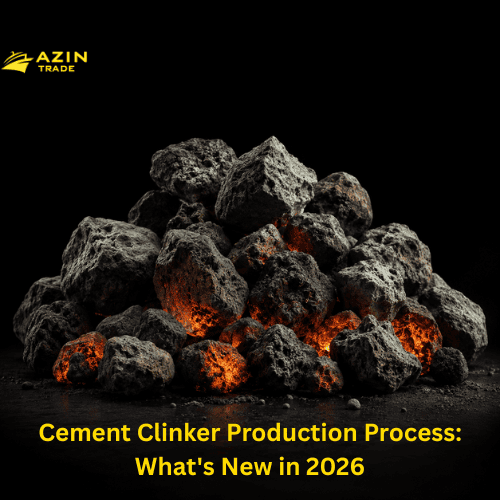
Clinker refers to the small, dark grey nodules that come out of a cement kiln after workers heat limestone, clay, and a few minor additives to extreme temperatures. It isn’t cement yet. It becomes cement once producers grind it with gypsum and, increasingly, other supplementary materials. Clinker does most of the heavy lifting in this process — both the chemistry that gives concrete its strength and, unfortunately, most of the carbon emissions. According to arXiv research on European industrial decarbonization, the dry clinker production process dominates roughly 80% of cement manufacturing worldwide, with kilns reaching temperatures that exceed 1,400°C.
That single fact explains a lot. Most of a plant’s environmental impact comes from clinker, not from grinding or blending afterward. This is why nearly every recent innovation targets the clinker stage specifically.
The Cement Clinker Production Process, Step by Step
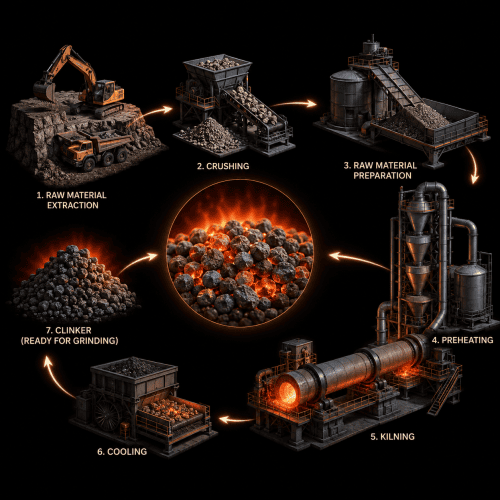
Before covering what’s changing, it helps to walk through the standard process. The innovations mostly bolt onto or replace specific stages rather than reinventing the whole line.
Raw Material Preparation
Workers quarry limestone, then crush it and blend it with smaller amounts of clay, iron ore, and sand to hit precise chemical ratios. This blended material, called “raw meal,” gets ground into a fine powder.
Preheating and Precalcination
The raw meal passes through a tower of cyclones. Hot exhaust gases from the kiln preheat the material before it reaches the burning zone, bringing it up to roughly 900°C using heat that would otherwise go to waste. From there, a precalciner vessel handles most of the chemical work. Roughly 90–95% of calcination — the breakdown of limestone into lime and CO2 — happens here rather than in the kiln itself. This design choice speeds up the process and shrinks the size, and cost, of the rotary kiln downstream.
Burning and Cooling
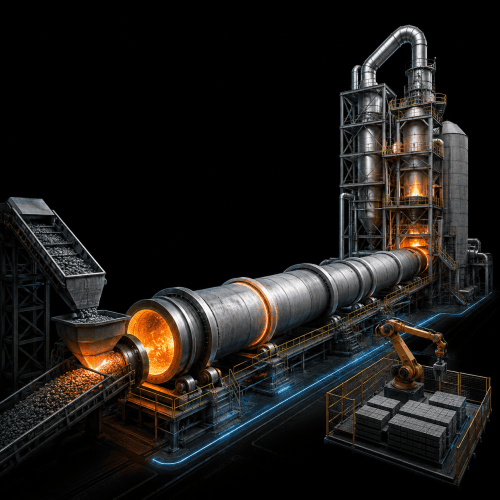
The material enters a long, slowly rotating cylindrical kiln, tilted slightly so gravity pulls it through. Temperatures inside the burning zone exceed 1,400°C. Here, the final reactions form the clinker minerals responsible for cement’s strength. Hot clinker then drops into a cooler, usually a grate cooler, where rapid airflow brings the temperature down fast. This step matters more than most people assume. Uneven or slow cooling affects both quality and grindability.
Storage and Grinding
Plants store cooled clinker in silos. Later, workers grind it with gypsum, and often other materials, to produce finished cement.
That’s the skeleton of the process. It hasn’t fundamentally changed. What has changed is the fuel that powers stage three, how much CO2 gets captured along the way, and how tightly plants now monitor and control the whole line.
What’s New in the Cement Clinker Production Process
Alternative and Waste-Derived Fuels
Fuel substitution marks the biggest practical shift in clinker production over the past several years. Traditionally, kilns ran almost entirely on coal or petcoke. Today, more plants blend in — or in some cases largely replace — alternative fuels: shredded tires, biomass, sorted municipal waste, and refuse-derived fuel. Project Drawdown’s cement research identifies alternative fuel use, ideally from renewable sources, as a standard lever plants now pull to cut both emissions and costs.
This shift matters for two reasons. First, it’s one of the fastest, cheapest ways to cut emissions without touching the kiln hardware itself. Second, peer-reviewed research published in Environmental Science & Technology found that while process innovations, supplementary materials, and carbon capture offer long-term emissions pathways, fuel substitution remains the most practical near-term strategy for cutting combustion-related emissions. In plain terms: a plant can start swapping fuel this year. Carbon capture retrofits take years and enormous capital.
Precalciner and Kiln Efficiency Upgrades
Precalciner technology itself isn’t new. But the versions plants install and retrofit in 2026 run far more sophisticated than what most facilities used a decade ago. Engineers now design precalciners to burn a wider range of fuel types, including lower-quality alternative fuels, without losing thermal efficiency. Many pair with improved tertiary air ducts and refractory linings, which extend equipment life and cut unplanned downtime. Plants chasing both cost and emissions targets often start here, since this stage already handles most of the calcination work.
Carbon Capture Moves From Pilot to Real Deployment
For years, the industry discussed carbon capture mostly in the future tense. That’s shifting. Some of the largest cement producers now run active capture projects. Heidelberg Materials’ CCUS program targets high-purity CO2 sequestration directly from the clinker production process, removing it at the source and storing it permanently in underground geological formations. The company has committed to offering near-zero-carbon concrete across its full product range by 2050, combining capture technology with continued fuel switching and expanded use of alternative materials.
The technical approaches vary. A PatSnap analysis of low-carbon cement patents tracks several methods now in deployment or pilot phases: post-combustion amine scrubbing, oxyfuel combustion, calcium looping with calcium oxide as a regenerable sorbent, and more experimental approaches like molten carbonate fuel cells and direct CO2 mineralization. Calcium looping has drawn particular attention. Early data suggests it captures a higher share of emitted CO2 than standard amine-based systems.
Here’s why this matters specifically for clinker: calcination itself, not fuel combustion, causes roughly 60% of a cement plant’s CO2 emissions. Research from ACS Publications confirms this chemical breakdown of limestone happens regardless of fuel choice. A plant running on 100% renewable electricity and zero fossil fuel still faces this large, unavoidable emissions source. Carbon capture currently stands as the only technology that addresses it directly.
Clinker Substitution and Alternative Binder Chemistry
A quieter but arguably more consequential trend focuses on using less clinker per ton of cement. LC3 cement leads this space. According to the PatSnap report on low-carbon technology, LC3 achieves around 50% clinker replacement while maintaining equivalent mechanical performance, and it requires no new kiln infrastructure. Existing plants can adopt it with comparatively modest retrofits. LC3 blends calcined clay and limestone with a much smaller share of traditional clinker. It has gained traction precisely because it skips the massive capital investment carbon capture demands.
Geopolymer concrete pushes further along the alternative-chemistry spectrum. Early data cited in the same PatSnap analysis suggests it produces roughly 43% less carbon than standard Portland cement per cubic metre, using an entirely different binding chemistry rather than reduced clinker content. It hasn’t reached mainstream commercial scale yet. Still, it signals where materials research is heading.
Electrification and Alternative Heating
One ambitious idea removes fuel combustion from the kiln entirely. A Nature Sustainability study on European cement decarbonization describes electric plasma and resistance-based heating as early-stage concepts that could achieve kiln temperatures without burning fuel. Real trade-offs come with this approach, including significantly higher power consumption even as combustion emissions drop. You won’t see this at scale in most plants in 2026. A handful of pilot projects are testing viability, and the approach represents one of the few ideas that could eventually eliminate the fuel-combustion share of clinker’s carbon footprint, not just capture it afterward.
Digital Monitoring and Process Control
The least visible but most widely adopted change involves software. Sensors throughout the kiln, precalciner, and cooler now feed real-time data into control systems. These systems adjust fuel mix, airflow, and feed rates automatically, rather than relying purely on operator judgment. This matters more than it sounds. Clinker quality reacts sensitively to small shifts in temperature and residence time. Plants with tighter digital control tend to report more consistent free-lime levels and fewer off-spec batches. That consistency directly affects how confidently a buyer can trust a supplier’s certificate of analysis. When evaluating suppliers, ask a simple but useful question: how does their kiln get monitored, and how often do they test output?
Why Calcination, Not Just Fuel, Is the Real Challenge
Switching to alternative fuels or renewable electricity feels like it should solve most of the emissions problem in clinker production. It doesn’t. Understanding why helps you evaluate a supplier’s sustainability claims critically instead of taking a marketing page at face value.
The PatSnap patent analysis makes this point directly: process calcination emissions make up roughly 60% of total emissions, and they dominate the source list. Fuel switching alone can’t touch them. Cutting this share requires either carbon capture technology or a fundamental shift toward alternative clinker chemistries.
This explains why supplementary cementitious materials keep coming up in serious industry discussions. Research from the World Economic Forum notes that clinker is the most carbon-intensive component of cement, responsible for roughly 90% of overall material emissions. Replacing a portion of it with less carbon-intensive supplementary materials directly tackles the largest source of process-related emissions. No commercialized solution yet fully replaces clinker at scale, though.
None of this should discourage you. It explains why the industry pursues several strategies at once — fuel switching, clinker substitution, and carbon capture — rather than betting everything on one fix. Each strategy addresses a different slice of the emissions problem.
Regional Differences in the Cement Clinker Production Process
Adoption of these newer methods isn’t uniform across the world. China alone accounts for roughly 55% of global cement production, according to the PatSnap dataset, and represents the largest single concentration of both manufacturing capacity and cement-related research.
Meanwhile, the Nature Sustainability study points out that implementing advanced decarbonization options still depends heavily on a small number of large industrial players with the technical and financial capacity to invest. A few individual carbon-neutral cement plants already exist. They combine modern equipment, high shares of alternative fuels, and carbon capture systems.
For buyers and traders, this matters practically. A clinker supplier’s access to modern process technology often correlates with plant size and ownership structure. Larger, better-capitalized producers typically lead on alternative fuels, precalciner upgrades, and early carbon capture. Smaller regional producers may still run on traditional fuel and process setups. Neither approach is inherently wrong for every buyer’s needs. Still, it’s a useful lens when comparing quotes, since a lower price sometimes reflects a plant that hasn’t made these investments yet.
What This Means for Buyers and Importers
If you source clinker rather than produce it, most of this technical detail boils down to a few practical questions worth asking any supplier.
Questions Worth Asking Before You Buy
- What fuel mix does the kiln run on, and has it changed recently? A shift toward alternative fuels can sometimes affect clinker consistency during the transition period.
- How does the plant monitor quality during production, not just at final shipment? Digital process control tends to produce more consistent output than manual adjustment alone.
- Does the plant have documented low-carbon or LC3-style production relevant to your end use? Not every buyer needs low-carbon clinker. For projects with sustainability requirements, contracts increasingly specify this directly.
- What’s the plant’s track record on free-lime consistency? This indicator reveals how well-controlled the burning and cooling stages actually are.
None of these questions require a chemistry background. They just require knowing that answers vary far more between suppliers today than they did a decade ago. The cement clinker production process has diverged into several distinct technical approaches rather than one standard method. Our team at Azintrade helps buyers work through exactly this kind of supplier evaluation when sourcing clinker internationally. The right questions early on save a lot of trouble later.
Looking Ahead
None of these technologies will fully replace the traditional rotary kiln overnight. Capital costs run too high and infrastructure sits too entrenched for that. Over the next several years, expect incremental layering instead: more plants blending in alternative fuels, more precalciner retrofits, a slow but steady rollout of carbon capture at the largest facilities, and growing commercial adoption of clinker-substitute products like LC3 where building codes allow it. Electrification and fully alternative binder chemistries like geopolymer concrete remain further out. They’re no longer purely theoretical, though — teams are piloting, testing, and in a few cases already commercializing them at small scale.
For anyone buying, selling, or trying to understand where this industry is headed, remember this: the cement clinker production process in 2026 isn’t one thing anymore. It spans a spectrum, from plants still running close to how they did twenty years ago to a small but growing group operating with genuinely new fuel sources, tighter digital control, and early-stage carbon capture. Knowing where a given supplier sits on that spectrum matters just as much as knowing their price per ton.
Disclaimer: Technical processes, emissions data, and adoption figures referenced in this article are based on current industry and academic reporting and may change as new research and plant data become available. Always confirm current production methods and specifications directly with individual suppliers.