
11 Clinker Suppliers in the World + Chart (2026)
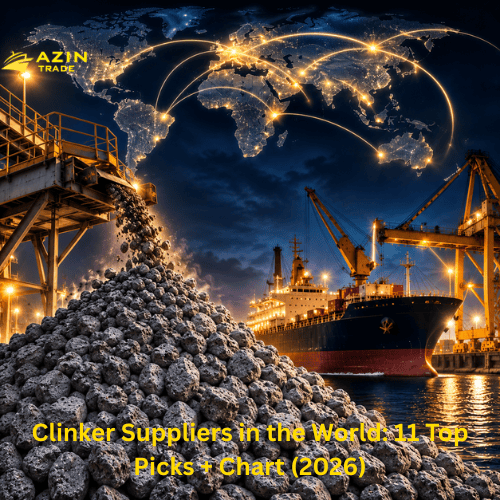
Clinker is the single most important intermediate product in the cement industry. It is the gray, marble-sized nodule produced by heating limestone and clay to around 1,450°C in a rotary kiln. It is then ground down with gypsum to make the Portland cement used in nearly every concrete structure on earth. Because clinker production is capital-intensive and energy-heavy, the global market is dominated by a relatively small number of producers and exporting countries. Below is a detailed, data-backed look at 11 of the most significant clinker suppliers in the world in 2026. It’s followed by a comparison chart and a breakdown of what buyers should know before sourcing.
Why Clinker Suppliers Matter So Much Right Now
Global clinker production is enormous and highly concentrated. China alone produces roughly 1,973 million tons of clinker annually. That single figure accounts for approximately 52% of the world’s total output. Its volume is so large that it exceeds the output of the second-largest producer by a factor of five. That producer, India, makes around 365 million tons a year. Meanwhile, Turkey ranks third globally, producing about 93 million tons and holding roughly a 2.5% share of world production.
This concentration matters for buyers. When a handful of countries and companies control most of global supply, risk rises quickly. Price swings, export policy changes, and energy-cost shocks in any one of them can ripple through the entire construction materials market. That is exactly why cement producers, ready-mix companies, and construction material traders spend so much time tracking supply. They watch which suppliers are expanding, which are restricting exports, and which offer the most reliable long-term partnerships.
What Clinker Actually Is
It’s also worth understanding what clinker actually is and why it commands such attention in global trade. Unlike finished cement, which is a relatively stable, low-reactivity powder, clinker is the semi-finished intermediate product. These are hard, marble-like nodules that must still be ground with gypsum and other additives before they become usable cement. Because of this two-stage process, clinker is cheaper to produce in bulk at a centralized kiln. It can then ship internationally for final grinding closer to the end market. That model — kiln in one country, grinding mill in another — largely explains the trade flow. Most global clinker moves from lower-cost producing regions like China, Vietnam, and Egypt toward grinding facilities in the Middle East, Africa, and parts of Europe.
Why Freight Costs Drive the Whole Market
The economics of this trade also explain why freight costs matter so much. Clinker is a heavy, dense, low-value-per-ton commodity. As a result, shipping costs make up a much larger share of the landed price than they would for a lighter, higher-value good. Consequently, a supplier with a slightly higher factory price but a shorter, cheaper shipping route can often win the deal. This happens once freight is factored into the total landed cost. It’s a major reason buyers increasingly look at regional suppliers and trading hubs. They no longer default to the single lowest quoted factory price.
Below, we cover 11 major players that shape the global clinker trade today. The list is a mix of multinational cement conglomerates, national champions, and export-focused regional suppliers.
1. China National Building Material (CNBM)
China National Building Material is one of the largest cement and clinker producers on the planet, built through decades of state-backed consolidation of China’s domestic cement sector. CNBM is not a single factory but a sprawling holding company. It controls dozens of subsidiary cement and clinker plants across China, with an annual production capacity reported in the hundreds of millions of tons. Beyond cement and clinker, the group is also active in gypsum board and glass fiber. This gives it a diversified building-materials footprint that few competitors can match.
For international buyers, CNBM’s scale means extremely competitive pricing on bulk orders. However, sourcing from Chinese state-linked conglomerates also means navigating longer shipping distances to markets outside Asia. It also means dealing with domestic policy shifts, such as energy-use restrictions during periods of high electricity demand, that can affect kiln output with limited advance notice.
2. Anhui Conch Cement
Anhui Conch is China’s largest publicly traded cement company and one of the most efficient clinker producers in the world by cost per ton. The company is Asia’s largest clinker exporter, with over 400 million tons of annual capacity and cost-leading kilns. Its 2024 revenue reached approximately US$25.40 billion, with a net profit margin around 17.8%. That reflects just how efficiently the company runs its production lines relative to peers.
Conch has increasingly looked beyond China for growth. It has been commissioning grinding units in Indonesia and diversifying into renewable power to offset rising domestic energy costs. For buyers, Conch represents one of the lowest-cost, highest-volume sourcing options in the world. Still, the company’s fortunes remain tightly tied to the health of China’s domestic construction demand.
3. Holcim
Holcim, headquartered in Switzerland, is one of the most geographically diversified building-materials companies in the world. It operates in roughly 70 countries. The company produces cement, aggregates, ready-mix concrete, and a growing line of lower-carbon clinker alternatives under its ECOPlanet brand. Holcim’s flagship low-carbon offerings include ECOPlanet clinker, Susteno, and Holcim MaxCem. In addition, the company has been actively acquiring regional grinding operations in Europe and launching a carbon-capture pilot project in Germany.
Holcim’s client list reads like a who’s-who of global construction, including major contractors such as Vinci, Skanska, and China State Construction. Its strength lies in sustainability credentials and reliability rather than rock-bottom pricing. That makes it a preferred partner for public infrastructure projects with strict carbon-reduction requirements.
4. Heidelberg Materials
Heidelberg Materials, a German multinational, is one of the world’s oldest and most established cement and clinker producers. It operates in around 50 countries, with a particularly strong presence in Europe, Africa, and Asia. Like Holcim, the company has invested heavily in decarbonization technology. This positions it to win contracts from public buyers who now weigh carbon intensity alongside price.
Heidelberg Materials tends to be strongest in mature European markets where regulatory pressure on emissions is highest. It has built a reputation for consistent quality control across its international plant network — an important consideration for buyers who need certified clinker for specialized cement blends.
5. UltraTech Cement
UltraTech Cement, part of India’s Aditya Birla Group, is India’s largest cement producer and one of the top clinker suppliers globally by volume. The company operates 24 integrated plants and 33 grinding units. It manufactures grey cement, white cement, and ready-mix concrete using advanced technologies including carbon capture. With India producing roughly 365 million tons of clinker annually — the second-highest national output in the world — UltraTech benefits from enormous domestic scale. At the same time, it is steadily expanding its export reach into the Middle East and Africa.
UltraTech’s advantage for international buyers is its combination of large-scale capacity and relatively lower production costs than European suppliers. It also sits close to fast-growing South Asian and Gulf markets.
6. Dangote Cement
Dangote Cement is the dominant clinker and cement producer across Sub-Saharan Africa. The company runs vertically integrated supply chains, moving Nigerian limestone reserves all the way through to seaborne clinker exports. It also holds an annual production capacity of roughly 51.6 million tonnes, making it Africa’s largest cement producer by a wide margin.
For buyers focused on African markets, Dangote offers a level of regional infrastructure and logistics integration that few outside competitors can match. The company has continued expanding kiln capacity and export terminals. This serves growing construction demand across West and Central Africa.
7. CRH plc
CRH, headquartered in Dublin, Ireland, is a vertically integrated building-materials group with a significant presence in Europe and North America. The company produces ready-mix concrete, cement, and aggregates. It has become one of the most active acquirers in the industry, absorbing regional producers to expand its distribution network across the United States in particular.
CRH has been a leading player in U.S. capacity additions, particularly in Texas and the Midwest, closely followed by Brazilian entrant Votorantim. This makes CRH one of the more relevant suppliers for buyers sourcing clinker or finished cement. Its supply feeds North American infrastructure projects benefiting from federal infrastructure spending.
8. Cemex
Cemex, based in Mexico, is one of the most globally recognized cement brands. Its footprint spans North and South America, Europe, Africa, and the Middle East. The company reported sales of roughly US$14.5 billion in 2021. It has built a reputation for combining traditional cement manufacturing with digital tools for logistics and customer ordering.
Cemex has also been active in U.S. capacity expansion, particularly in Texas. This positions it well to serve both domestic American demand and export markets across the Americas. Buyers working across multiple continents often favor Cemex specifically for its consistent quality standards across such a wide geographic footprint.
9. Vietnam’s Clinker Export Sector
Vietnam is not a single company but a national export powerhouse that deserves inclusion on any serious list of global clinker suppliers. It consistently ranks among the largest clinker exporters in the world, supplying over 10 million tons annually. Historically, the country has exported clinker worth around $492 million in trade value. That makes it one of the top exporting nations by value as well as volume.
Vietnamese producers such as Thai Pride Cement and Asia Cement Trading supply both grey and white clinker to buyers across Asia, the Middle East, and beyond. For international traders, Vietnam offers a strong balance of competitive pricing and established port infrastructure. It also has a track record of reliable bulk shipping — which is why so many trading companies, including several based in the Gulf, partner directly with Vietnamese manufacturers.
10. Egypt
Egypt has emerged as one of the single largest clinker exporters by trade value in recent years. In 2025, it held the top spot with $479 million in clinker exports. That put it ahead of long-established exporters like Vietnam and Thailand in terms of pure export value. Egypt’s geographic position also gives it a major logistical advantage. Shipments can reach European, African, and Middle Eastern buyers relatively quickly through Mediterranean and Red Sea ports, including transit routes tied to the Suez Canal.
Egyptian clinker exports have grown alongside the country’s broader industrial expansion. The sector also benefits from access to domestic limestone reserves and relatively low energy costs compared with European producers.
11. UAE-Based Trading and Re-Export Hubs
The United Arab Emirates does not produce clinker at the same domestic scale as China, India, or Egypt. Still, it plays an outsized role in the global trade as a logistics and re-export hub. The UAE re-exports clinker across Asia and Africa, leveraging its world-class ports and free-zone trading infrastructure. This moves product sourced from Vietnam, Turkey, and other producers on to buyers who need faster delivery windows or smaller, more flexible order sizes than a direct factory relationship would allow.
Trading companies based in the UAE and neighboring Gulf states, including firms in Oman, have built businesses specifically around partnering with top manufacturers in Vietnam. They provide both white and grey clinker for international construction needs. For buyers who want a single point of contact rather than negotiating directly with an overseas factory, these Gulf-based trading hubs offer a practical middle ground between price and convenience.
Comparison Chart: 11 Clinker Suppliers at a Glance
| # | Supplier | Base / Region | Primary Strength | Best Fit For |
|---|---|---|---|---|
| 1 | China National Building Material (CNBM) | China | Massive scale, diversified materials portfolio | High-volume bulk buyers prioritizing price |
| 2 | Anhui Conch Cement | China | Lowest cost per ton, 400M+ ton export capacity | Large-volume Asian and African buyers |
| 3 | Holcim | Switzerland | Low-carbon clinker lines, 70-country reach | Public infrastructure with carbon requirements |
| 4 | Heidelberg Materials | Germany | Strong European/African quality standards | Buyers needing certified, consistent quality |
| 5 | UltraTech Cement | India | Large integrated capacity, Middle East/Africa reach | South Asian and Gulf-region buyers |
| 6 | Dangote Cement | Nigeria | Vertically integrated African supply chain | Buyers sourcing for Sub-Saharan Africa |
| 7 | CRH plc | Ireland | Strong U.S. distribution network | North American infrastructure projects |
| 8 | Cemex | Mexico | Broad multi-continent footprint | Buyers needing consistency across regions |
| 9 | Vietnam Export Sector | Vietnam | High export volume, competitive pricing | Asia and Middle East traders |
| 10 | Egypt | Egypt | Highest export value in 2025, Suez access | European, African, Middle Eastern buyers |
| 11 | UAE Trading Hubs | UAE | Re-export flexibility, single point of contact | Buyers wanting simplified logistics |
How to Choose the Right Clinker Supplier
Selecting a clinker supplier is rarely just about price per ton. A few factors consistently separate a good sourcing decision from a costly mistake.
Production scale versus order flexibility. Mega-producers like CNBM and Anhui Conch offer the best bulk pricing. But they are built for enormous, predictable orders. Smaller or mid-sized buyers often get better service and more flexible shipping schedules from regional traders or Gulf-based re-export hubs.
Quality consistency. Clinker quality affects the strength and durability of the finished cement. Buyers should always request mill test certificates. Where possible, they should also seek third-party quality verification rather than relying solely on supplier claims.
Logistics and shipping routes. Geography matters enormously in this industry, since clinker is heavy, low-margin-per-ton cargo. Freight costs can quickly erase any savings from a lower factory price. Egypt’s Mediterranean and Red Sea access, Vietnam’s established Asia-Pacific shipping lanes, and UAE re-export flexibility all exist precisely because freight economics are so central to this trade.
Sustainability credentials. More governments are attaching carbon requirements to public infrastructure tenders. As a result, suppliers like Holcim and Heidelberg Materials that invested early in low-carbon clinker technology are increasingly winning contracts that competitors on price alone cannot.
Export policy stability. Because clinker trade is so concentrated, buyers should pay attention to domestic energy policy and export restrictions in top-producing countries. China’s periodic energy-rationing policies, for example, have previously affected kiln output with little warning. That’s a real risk factor for buyers relying heavily on Chinese supply.
The Bigger Picture for 2026
The clinker market remains defined by extreme concentration at the top. China’s roughly 52% share of global output dwarfs every other country combined. At the same time, the middle tier of the market — Vietnam, Egypt, Turkey, the UAE, and India — is becoming increasingly important. Buyers are turning to these countries specifically to diversify away from total dependence on Chinese supply. Their reasons range from pricing leverage to geopolitical risk management to faster access to specific regional markets.

A Market Splitting Into Two Tiers
Meanwhile, the largest multinational players — Holcim, Heidelberg Materials, CRH, and Cemex — are competing less on raw volume. Instead, they compete on sustainability credentials, carbon-capture technology, and long-term contracts with governments and major contractors who increasingly factor emissions into procurement decisions. This split is likely to define the clinker trade for the remainder of the decade. On one side sits a high-volume, price-driven tier led by Chinese and South Asian producers. On the other sits a premium, carbon-conscious tier led by European multinationals.
For buyers navigating this landscape, the most successful sourcing strategies in 2026 tend to combine two things. First, a primary high-volume supplier covers baseline pricing. Second, a more flexible trading partner — often based in a logistics hub like the UAE — fills gaps, handles smaller orders, and provides a buffer against the export-policy shifts that periodically disrupt the world’s most concentrated commodity markets.
Frequently Asked Questions
Production, Exports, and Pricing
Which country is the largest clinker producer in the world? China remains the largest clinker producer by a wide margin, accounting for roughly 52% of global output. India is a distant second, followed by Turkey in third place.
Which country exports the most clinker by trade value? Export value and production volume are not the same thing. While China dominates production, Egypt has recently ranked as the top exporter by trade value. Vietnam and Thailand also consistently rank among the largest exporters historically.
What is the difference between grey clinker and white clinker? Grey clinker is the standard type used for most construction cement and is produced from common limestone and clay. The white variety, by contrast, is made from purer raw materials with lower iron content, producing a lighter-colored cement used for architectural and decorative applications. It typically costs more, too, due to stricter raw material requirements and lower production yields per kiln cycle.
How much does clinker typically cost per ton? Clinker pricing varies significantly by region, energy costs, and shipping distance. It also fluctuates with global energy markets, since kiln firing is extremely energy-intensive. Buyers should always request current quotes directly from suppliers rather than relying on historical pricing, since energy cost volatility can shift prices meaningfully within a single quarter.
Sourcing Strategy
Is it better to buy directly from a producer or through a trading company? It depends on order size and how much logistics support a buyer needs. Direct producer relationships usually offer the best per-ton pricing for large, predictable orders. Trading companies and re-export hubs, such as those based in the UAE and Oman, tend to offer more flexibility for smaller or irregular orders, along with simplified logistics and a single point of contact.
Why do so many buyers source clinker from more than one country? Diversifying across two or more supplier countries reduces exposure to any single country’s export restrictions, energy policy changes, or shipping disruptions. It also gives buyers negotiating leverage, since they are not entirely dependent on one factory’s pricing and availability.
Looking to source clinker for your next project? Understanding where each supplier’s strengths lie — scale, sustainability, regional access, or logistics flexibility — is the first step toward building a resilient, cost-effective supply chain.