
How White Clinker Is Made: Production Process Explained
White clinker plays a central role in white cement production. Although manufacturers follow many of the same basic steps that they use to produce conventional grey clinker, the white clinker production process requires much stricter control over raw materials, chemical composition, kiln operation, fuel selection, cooling, and contamination.
The main challenge comes from color control. In particular, manufacturers must minimize iron and other coloring compounds throughout the production process. Even a small amount of contamination can affect the final color and reduce the brightness of the white cement.
Today, white clinker supports many applications in modern construction. For example, manufacturers use it to produce white cement for architectural concrete, decorative surfaces, building façades, precast products, terrazzo, tile grout, and other premium construction materials.
Therefore, understanding how white clinker is made can help cement manufacturers, exporters, importers, construction companies, and buyers evaluate production quality and product performance.
This guide explains the complete white clinker production process. It covers everything from raw material selection and quarrying to crushing, grinding, kiln firing, cooling, storage, and final white cement production.
What Is White Clinker?
White clinker is an intermediate material that manufacturers produce by heating a carefully prepared mixture of raw materials at extremely high temperatures inside a cement kiln.
Afterward, manufacturers grind the clinker with gypsum and, depending on the product specification, other permitted materials to produce white cement.
The raw materials must contain the correct proportions of calcium, silica, alumina, and other chemical components. Therefore, manufacturers carefully select and analyze every material before production begins.
During the high-temperature firing stage, the raw materials undergo a series of complex chemical reactions. As a result, they form new mineral phases that determine many of the final properties of the cement.
The main difference between white clinker and conventional grey clinker involves the amount of coloring compounds in the raw materials.
For example, conventional grey clinker usually contains more iron-bearing materials. In contrast, white clinker producers use raw materials with very low iron content.
Consequently, manufacturers need more precise production controls when they make white clinker.
Why Is White Clinker White?
The bright color of white clinker mainly comes from the low concentration of iron and other coloring compounds in the raw materials.
Iron oxide plays a particularly important role. When manufacturers use raw materials with higher iron content, the final clinker usually develops a darker appearance.
Therefore, producers carefully control the entire production process to protect the desired white color.
Several factors influence the final whiteness, including:
- Limestone purity
- Iron oxide content
- Manganese content
- Clay or kaolin quality
- Fuel ash
- Combustion conditions
- Kiln operation
- Clinker cooling
- Material handling
- Contamination control
In addition, manufacturers must prevent contamination during storage and transportation. Even small amounts of grey clinker or iron-containing materials can affect the final product.
As a result, high-quality white clinker production requires strict control from the quarry to the finished cement.
White Clinker vs. Grey Clinker
White clinker and grey clinker follow similar basic manufacturing principles. However, the two products have several important differences.
| Feature | White Clinker | Grey Clinker |
|---|---|---|
| Raw material purity | Very high | Standard industrial quality |
| Iron content | Very low | Generally higher |
| Appearance | White or light-colored | Grey |
| Production cost | Generally higher | Generally lower |
| Contamination control | Extremely strict | Less restrictive |
| Fuel requirements | Low-ash fuels often preferred | Wider fuel options |
| Main applications | Architectural and decorative | General construction |
The most important difference involves color control. White clinker manufacturers must carefully manage iron, fuel ash, and contamination.
Therefore, although both products require high-temperature kiln processing, white clinker production usually demands more specialized raw materials and tighter quality control.
Raw Materials Used to Make White Clinker
Raw material selection represents the first major stage in understanding how white clinker is made.
The quality of these materials directly affects the clinker color, chemical composition, mineral formation, strength development, and final cement performance.
Manufacturers typically use high-purity limestone as the primary calcium source. In addition, they may use kaolin, white clay, silica sand, and other low-iron materials to provide silica and alumina.
However, the exact raw material combination depends on the geology of the quarry and the required chemical composition of the final clinker.
High-Purity Limestone
Limestone provides most of the calcium oxide required for clinker production.
For white clinker manufacturing, producers need limestone with a high calcium carbonate content and very low levels of coloring impurities.
High-quality limestone typically offers:
- High calcium carbonate content
- Low iron oxide
- Low manganese
- Low organic impurities
- Consistent chemical composition
First, manufacturers extract the limestone from carefully selected areas of the quarry. Then, they transport it to the crushing and preparation area.
Because limestone chemistry can vary across a quarry, producers regularly collect samples and perform laboratory tests.
As a result, they can identify the areas that provide the most suitable raw material for white clinker production.
Moreover, careful quarry management helps manufacturers maintain a consistent supply of low-iron limestone.
Kaolin and White Clay
Kaolin and white clay can provide important sources of silica and alumina.
Traditional cement raw materials often contain iron-bearing minerals. However, white clinker production requires alternative materials with much lower iron content.
Therefore, manufacturers often consider kaolin when they need a low-iron source of silica and alumina.
In addition, kaolin can support the required chemical balance of the raw mix.
However, high-quality kaolin does not exist in every region. Consequently, transportation costs and local availability can significantly affect production economics.
Silica Sources
Silica plays an essential role in clinker formation and contributes to the development of the mineral phases that provide cement strength.
Depending on the chemical composition of the available raw materials, manufacturers may use:
- High-purity silica sand
- Selected white sand
- Quartz-rich materials
- Other low-iron silica sources
The production team must carefully control the silica source. Otherwise, variations in raw material chemistry can affect kiln operation and clinker quality.
Therefore, manufacturers regularly test these materials before adding them to the raw mix.
Alumina Sources
Alumina contributes to clinker mineral formation and influences the behavior of the raw material mixture during kiln firing.
However, white clinker producers must also ensure that the alumina source contains very little iron and other coloring impurities.
For this reason, manufacturers often use kaolin or other carefully selected low-iron materials.
Ultimately, the producer chooses the alumina source according to the chemical composition of the raw materials and the desired properties of the finished clinker.
Step 1: Quarrying and Raw Material Extraction
The white clinker manufacturing process begins with quarrying.
First, workers and engineers identify suitable areas that contain high-purity limestone. Then, the quarry team extracts the material through controlled blasting or mechanical excavation.
Quarry management plays a particularly important role in white clinker production. The manufacturer needs a consistent supply of low-iron raw materials throughout the year.
Before extraction begins, technicians collect samples and analyze them in the laboratory.
The results help the production team determine whether the limestone meets the required chemical specifications.
Modern cement plants may also use geological mapping and digital quarry management systems. These technologies help operators identify areas with the most suitable mineral composition.
After extraction, trucks transport the limestone to the crushing plant.
At the same time, suppliers deliver other materials, such as kaolin, white clay, and silica sand, to the production facility.
The plant then stores each material separately to prevent contamination.
Step 2: Crushing the Raw Materials
Freshly extracted limestone usually contains large rocks. Therefore, the material must pass through a crushing system before manufacturers can grind and mix it.
The crushing equipment reduces large rocks into smaller pieces.
Depending on the plant design, manufacturers may use different types of crushers.
The main objective is simple: the plant needs a consistent feed material for the next production stages.
In addition, crushing improves the efficiency of raw material grinding.
However, white clinker plants must pay special attention to contamination during this stage.
For example, equipment that previously handled iron-rich materials could introduce unwanted contamination into the production process.
Therefore, manufacturers carefully inspect and maintain crushing equipment.
Step 3: Raw Material Proportioning
After crushing, the production team carefully proportions the raw materials according to the required clinker chemistry.
This stage plays a critical role because the raw mix determines which mineral phases will form inside the kiln.
The raw mix may contain:
- Limestone
- Kaolin or white clay
- Silica materials
- Alumina-bearing materials
- Corrective materials
First, laboratory technicians analyze each material.
Then, process engineers calculate the correct proportions.
Finally, automated feeding systems deliver the materials to the grinding system.
This careful approach helps manufacturers maintain the desired balance between calcium, silica, alumina, and other components.
As a result, the plant can produce a raw mix that supports both clinker quality and whiteness.
Step 4: Raw Material Grinding
Next, the plant grinds the proportioned raw materials into a fine powder.
This stage serves two important purposes. First, it reduces particle size. Second, it improves the homogeneity of the raw mixture.
Depending on the plant design, manufacturers may use:
- Vertical roller mills
- Ball mills
- Specialized grinding systems
During grinding, the equipment reduces the particle size and increases the surface area of the material.
Consequently, the particles can react more efficiently during the high-temperature kiln process.
If the raw materials contain moisture, the grinding system can also remove part of that moisture.
After grinding, the plant produces a fine powder known as raw meal.
Step 5: Raw Meal Homogenization
After grinding, the raw meal needs thorough homogenization.
The main purpose of homogenization is to maintain a consistent chemical composition before the raw meal enters the kiln.
This step becomes particularly important in white clinker production because chemical variations can affect both clinker quality and color.
Modern plants commonly use large blending or homogenization silos.
The system introduces air into the stored raw meal and creates controlled movement.
As a result, the plant reduces chemical variations and provides the kiln with a more stable feed.
A homogeneous raw meal helps manufacturers achieve:
- Stable kiln operation
- Consistent clinker mineralogy
- Uniform whiteness
- Predictable cement performance
Therefore, effective homogenization provides a strong foundation for the next production stages.
Step 6: Preheating the Raw Meal
Before the raw meal enters the main kiln, the plant usually preheats it.
Modern cement plants use multi-stage cyclone preheaters to recover heat from hot gases leaving the kiln.
The raw meal moves through the cyclone system while hot gases travel in the opposite direction.
As a result, the raw meal temperature increases before it reaches the rotary kiln.
This process improves thermal efficiency and reduces overall fuel consumption.
Furthermore, some modern systems begin the calcination process before the raw meal enters the main kiln.
Therefore, preheating and pre-calcination help manufacturers improve production efficiency.
Step 7: Calcination
Calcination represents one of the most important chemical stages in clinker production.
During this stage, the calcium carbonate in limestone breaks down into calcium oxide and carbon dioxide.
The basic chemical reaction is:
CaCO3 → CaO + CO2
The calcium oxide then becomes available for the chemical reactions that form the clinker minerals.
Modern plants often use pre-calciner systems. These systems allow a significant portion of the calcination process to occur before the raw meal enters the main burning zone.
As a result, the kiln can focus more effectively on the high-temperature clinker formation process.
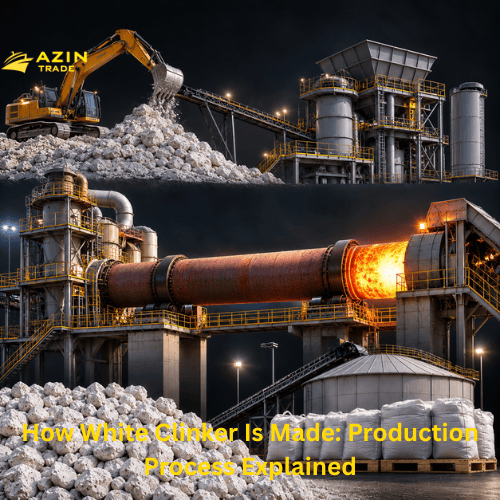
Step 8: Clinker Formation in the Rotary Kiln
After preheating and calcination, the raw meal enters the rotary kiln.
The rotary kiln consists of a long, slightly inclined cylindrical structure that rotates continuously.
As the kiln rotates, the raw material slowly moves toward the hottest section.
The burning zone can reach temperatures of approximately 1,400 to 1,450 degrees Celsius.
At these extremely high temperatures, complex chemical reactions take place.
The raw materials combine and form the main clinker minerals, including:
- Alite, or C3S
- Belite, or C2S
- Tricalcium aluminate, or C3A
- Tetracalcium aluminoferrite, or C4AF
However, white clinker production requires careful control of iron-bearing compounds.
Therefore, manufacturers select low-iron raw materials and carefully manage kiln conditions.
The production team must also maintain a stable flame and consistent temperature.
Otherwise, the kiln may produce clinker with inconsistent mineral composition or color.
Why Kiln Control Is Critical for White Clinker
Kiln operation has a major influence on final white clinker quality.
Important operating parameters include:
- Burning temperature
- Material residence time
- Flame shape
- Fuel type
- Oxygen concentration
- Kiln rotation speed
- Raw meal feed rate
- Cooling conditions
If the kiln operates below the required temperature, the raw material may not form the desired clinker minerals completely.
On the other hand, excessive burning can affect clinker grindability.
Therefore, operators must maintain a careful balance.
In addition, stable kiln operation helps manufacturers maintain consistent color and chemical composition.
Fuel Selection in White Clinker Production
Fuel selection also plays an important role in white clinker manufacturing.
Conventional cement plants commonly use coal and other fossil fuels. However, white clinker producers must consider the composition of fuel ash as well as energy efficiency.
For example, fuel ash containing iron can introduce unwanted coloring compounds into the clinker.
Therefore, manufacturers often prefer fuels with low ash content when the production process requires high whiteness.
Depending on local conditions, producers may use natural gas or other low-ash fuels.
The final choice depends on:
- Fuel availability
- Energy prices
- Plant technology
- Environmental regulations
- Required clinker whiteness
- Local infrastructure
In addition, operators must carefully control combustion to maintain a stable and efficient flame.
Step 9: Clinker Cooling
After the clinker leaves the burning zone, the plant must cool it quickly and efficiently.
Clinker cooling serves two major purposes.
First, it helps stabilize the clinker mineral structure.
Second, it allows the plant to recover heat and improve energy efficiency.
Modern clinker coolers recover heat from the hot material and return that energy to the combustion process.
Consequently, the plant can reduce fuel consumption.
For white clinker, controlled cooling can also influence the final mineral structure and product characteristics.
Therefore, manufacturers carefully optimize the cooling system.
Why Cooling Is Important for White Clinker
Cooling affects several important properties, including:
- Clinker mineralogy
- Cement strength development
- Grindability
- Color
- Energy efficiency
A well-designed cooling system allows the manufacturer to recover valuable heat while maintaining stable clinker quality.
Therefore, cooling represents an essential part of the overall white clinker production process.
Step 10: White Clinker Storage
Once the clinker reaches the required temperature, the plant transports it to storage facilities.
Manufacturers generally store white clinker in enclosed silos or protected storage areas.
Proper storage helps prevent:
- Dust contamination
- Mixing with grey clinker
- Moisture exposure
- Foreign material contamination
Because manufacturers need to maintain consistent whiteness, they must keep white clinker separate from conventional grey clinker.
In addition, storage equipment should remain clean and dry.
As a result, careful storage helps protect the quality of the clinker before final grinding.
Step 11: Clinker Grinding and White Cement Production
White clinker usually serves as an intermediate product rather than the final product.
Therefore, manufacturers grind it together with gypsum to produce white cement.
During grinding, the equipment reduces the clinker into a fine powder.
The manufacturer adds gypsum to regulate the cement setting time.
Depending on the product specification, the producer may also add other permitted mineral components.
After grinding, the quality control team tests the finished cement.
Common tests include:
- Whiteness
- Fineness
- Setting time
- Compressive strength
- Chemical composition
- Soundness
Finally, the plant packs the finished cement into bags or loads it into bulk transportation systems.
Quality Control in White Clinker Manufacturing
Quality control plays an essential role throughout the entire white clinker production process.
Unlike conventional grey cement, white clinker requires particularly strict control over color and contamination.
Therefore, manufacturers test raw materials, raw meal, clinker, and finished cement at different stages.
Common laboratory tests include:
- X-ray fluorescence analysis
- X-ray diffraction analysis
- Whiteness measurement
- Particle size analysis
- Free lime testing
- Strength testing
- Setting time testing
Continuous testing allows operators to identify variations early.
As a result, the production team can adjust the raw mix or process conditions before quality problems become serious.
Chemical Composition
Manufacturers must maintain the chemical composition of the raw meal and clinker within the required specifications.
Important compounds include:
- Calcium oxide
- Silicon dioxide
- Aluminum oxide
- Iron oxide
- Magnesium oxide
- Sulfur compounds
- Alkalis
Among these compounds, iron oxide requires particular attention.
Therefore, producers carefully monitor iron levels from raw material extraction through final clinker production.
Whiteness Testing
Whiteness represents one of the most important quality indicators for white clinker and white cement.
Manufacturers use standardized methods and specialized instruments to evaluate the final color.
Higher whiteness generally provides greater value in architectural and decorative applications.
However, whiteness alone does not determine overall product quality.
The final cement must also meet the required mechanical, chemical, and physical specifications.
Therefore, manufacturers need to balance color performance with strength, fineness, setting time, and other technical properties.
The Main Challenges of White Clinker Production
White clinker production presents several challenges.
The main issues include raw material availability, energy consumption, production costs, contamination risks, and quality consistency.
However, modern technology helps manufacturers address many of these challenges.
Limited Raw Material Availability
High-purity limestone and low-iron clay do not exist in every region.
Therefore, manufacturers may need to locate their production facilities close to specialized mineral deposits.
This requirement can increase transportation costs.
Moreover, limited access to suitable raw materials can restrict the number of locations where companies can establish white clinker plants.
Higher Production Costs
White clinker production often costs more than conventional grey clinker production.
Several factors contribute to the higher cost, including:
- Specialized raw materials
- Higher-quality fuels
- Strict quality control
- Specialized equipment
- Higher energy requirements
- Contamination prevention
Consequently, the final price of white cement can exceed the price of ordinary grey cement.
However, premium architectural and decorative applications often justify the higher production cost.
Contamination Risk
Contamination represents one of the biggest challenges in white clinker manufacturing.
For example, iron-containing materials can reduce clinker whiteness.
Therefore, manufacturers need strict control over:
- Raw material handling
- Conveyor systems
- Storage areas
- Grinding equipment
- Kiln systems
- Clinker storage
In some cases, manufacturers may use dedicated equipment for white clinker production.
This approach reduces the risk of cross-contamination.
Energy Consumption
Clinker production requires significant amounts of energy because the kiln must operate at extremely high temperatures.
Therefore, manufacturers continuously search for ways to improve energy efficiency.
Common strategies include:
- Heat recovery systems
- Efficient burners
- Modern kiln technology
- Improved clinker coolers
- Energy-efficient grinding systems
As a result, better energy efficiency can reduce both production costs and environmental impact.
Environmental Considerations
White clinker manufacturing generates carbon dioxide emissions, just like conventional cement production.
These emissions mainly come from two sources.
First, fuel combustion produces carbon dioxide.
Second, limestone calcination releases carbon dioxide when calcium carbonate decomposes.
Therefore, manufacturers are increasingly exploring methods to reduce the environmental impact of cement production.
These methods include:
- Improving energy efficiency
- Increasing heat recovery
- Optimizing kiln operation
- Using lower-carbon fuels
- Improving grinding efficiency
- Using renewable electricity
- Developing lower-carbon cement technologies
However, white clinker production creates an additional challenge.
Manufacturers must carefully evaluate alternative fuels because their ash content could affect clinker color.
Therefore, producers must balance environmental improvements with strict product quality requirements.
Where Is White Clinker Used?
White clinker mainly serves as the raw material for white cement production.
White cement supports many applications where appearance and design matter.
For example, construction companies use white cement for:
- Architectural concrete
- Decorative concrete
- Precast elements
- Building façades
- Terrazzo
- Tile grout
- Mortar
- Landscaping products
- Decorative paving
- Swimming pool finishes
- Interior design applications
In addition, manufacturers can combine white cement with pigments to create colored concrete products.
Because white cement provides a bright base, it can help manufacturers achieve more consistent and attractive colors.
Therefore, white clinker remains an important material for premium construction applications.
Why White Clinker Is Important for Export Markets
White clinker has an important role in international construction material markets.
Countries without local white cement production facilities can import white clinker and grind it locally.
As a result, importers can produce white cement closer to their target customers.
In some markets, this approach can provide logistical and commercial advantages.
Several factors influence international white clinker trade, including:
- Production capacity
- Raw material availability
- Energy prices
- Shipping costs
- Port infrastructure
- Import regulations
- Product quality
- Market demand
For exporters, consistent quality remains essential.
International buyers may evaluate chemical composition, whiteness, strength development, grindability, and product consistency before signing long-term supply agreements.
Therefore, suppliers that maintain stable quality can gain a competitive advantage in international markets.
How White Clinker Is Shipped
Manufacturers can transport white clinker using several methods.
For large international shipments, bulk vessels provide an efficient transportation solution.
Specialized loading systems transfer clinker from storage facilities into ships.
For smaller shipments, exporters may use:
- Bulk trucks
- Containers
- Specialized bags
- Flexible intermediate bulk containers
The best transportation method depends on shipment volume, destination, infrastructure, and customer requirements.
During transportation, exporters must protect the clinker from moisture and contamination.
In addition, loading equipment and storage facilities should remain clean.
As a result, reliable logistics can improve the competitiveness of white clinker suppliers.
Factors That Determine White Clinker Quality
Several factors determine the final quality of white clinker.
The most important factors include:
- Raw material purity
- Iron oxide content
- Raw meal homogeneity
- Kiln temperature control
- Fuel quality
- Burning conditions
- Clinker cooling rate
- Storage conditions
- Contamination prevention
- Grinding performance
All of these factors work together.
For example, high-quality limestone cannot compensate for poor kiln operation.
Similarly, advanced kiln technology cannot completely solve problems caused by contaminated raw materials.
Therefore, manufacturers must control the entire production chain to achieve consistently high-quality white clinker.
Future Trends in White Clinker Manufacturing
Modern manufacturers are increasingly adopting advanced process-control systems.
These systems allow operators to monitor production conditions in real time.
Furthermore, artificial intelligence and machine learning may help manufacturers predict changes in raw material chemistry and optimize kiln operation.
Other important trends include:
- More efficient kiln systems
- Advanced combustion technology
- Improved heat recovery
- Digital quality control
- Automated raw material analysis
- Lower-carbon fuels
- Improved clinker cooling
- More efficient grinding technology
As environmental regulations become stricter, manufacturers will need to reduce carbon emissions while maintaining high product quality.
Therefore, future white clinker plants will likely combine advanced technology with more efficient energy management.
Frequently Asked Questions About White Clinker
What Is White Clinker Made Of?
White clinker mainly comes from high-purity limestone combined with carefully selected sources of silica and alumina.
Manufacturers may also use kaolin, white clay, and low-iron silica materials.
The exact combination depends on the required chemical composition and the quality of locally available raw materials.
How Is White Clinker Different From Grey Clinker?
The primary difference involves the concentration of coloring compounds.
White clinker contains very low levels of iron and other impurities that can darken the final product.
Therefore, manufacturers use stricter raw material selection and contamination controls when producing white clinker.
How Hot Is the Kiln When Making White Clinker?
The burning zone of a clinker kiln typically reaches approximately 1,400 to 1,450 degrees Celsius.
However, the exact operating conditions depend on the kiln design, raw material composition, production capacity, and required clinker properties.
Why Is White Clinker More Expensive?
White clinker often costs more because manufacturers need high-purity raw materials, specialized production conditions, strict quality control, and careful contamination prevention.
In addition, some plants use higher-quality low-ash fuels to protect clinker whiteness.
Therefore, the overall production cost can exceed that of conventional grey clinker.
What Is White Clinker Used For?
White clinker mainly serves as the primary material for white cement production.
After grinding with gypsum, manufacturers can use the resulting white cement for architectural concrete, decorative construction, façades, terrazzo, precast products, tile grout, landscaping, and other premium applications.
Can White Clinker Be Exported?
Yes, companies can export white clinker to international markets.
Large shipments typically travel by bulk vessel, while smaller quantities may move through containers, trucks, or specialized packaging.
However, exporters must protect the product from moisture and contamination during transportation.
What Makes White Clinker White?
The low concentration of iron and other coloring impurities primarily gives white clinker its bright appearance.
However, raw material selection alone does not guarantee high whiteness.
Fuel quality, kiln operation, cooling, storage, and contamination control also influence the final color.
Conclusion: Understanding How White Clinker Is Made
Understanding how white clinker is made requires a complete view of the production process.
The journey begins with high-purity limestone and carefully selected low-iron sources of silica and alumina.
First, manufacturers extract and crush the raw materials.
Next, they proportion, grind, and homogenize the materials before sending the raw meal through preheating and calcination.
Afterward, the raw meal enters a high-temperature rotary kiln.
Inside the kiln, chemical reactions form the main clinker minerals.
However, white clinker production requires especially strict control over iron and other coloring compounds.
Therefore, manufacturers must carefully manage raw material quality, fuel selection, kiln operation, cooling, storage, and contamination.
After cooling, the plant stores the clinker under controlled conditions.
Finally, manufacturers grind the clinker with gypsum to produce white cement.
Although white clinker production can require more specialized technology and higher production costs than conventional grey clinker, the final material provides significant value in architectural and decorative construction.
Moreover, growing demand for premium building materials continues to support the global market for white cement and white clinker.
For manufacturers and exporters, long-term success depends on several factors. These include high-quality raw materials, efficient production technology, strict quality control, reliable logistics, and effective environmental management.
Ultimately, every stage of the process contributes to the final product.
From the purity of limestone in the quarry to the temperature inside the rotary kiln and the efficiency of the cooling system, each step affects clinker quality, whiteness, and performance.
Therefore, by controlling the entire production chain, manufacturers can produce high-quality white clinker that meets the demanding requirements of modern construction and international markets.