
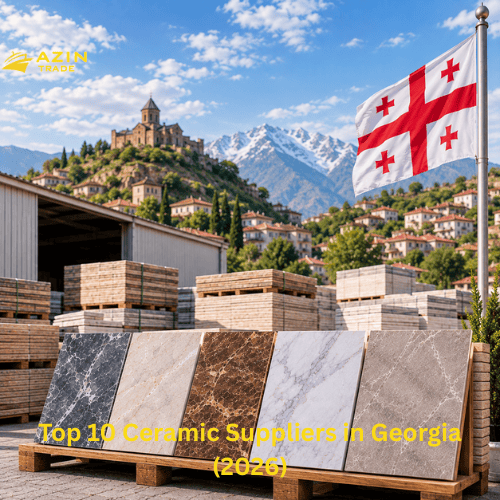
Top 10 Ceramic Suppliers in Georgia (2026)
Georgia’s ceramic tile market runs almost entirely on imports, and one supplier clearly leads the pack. Iran accounts for roughly 32% of Georgia’s ceramic tile imports, ahead of Turkey at 26% and China at 16%, according to GeoSilkroad, Georgia’s state investment promotion platform. Therefore, any serious look at ceramic suppliers in Georgia has to start with that number, since it reshapes assumptions many buyers bring from other regional markets where Turkey or China typically lead instead. This guide breaks down the ten countries most likely to supply Georgia’s ceramic tile market, how the country’s trade agreements shape competition, and what buyers should know before sourcing.
A quick methodology note first. Georgia does not publish a single, continuously updated ranking of named ceramic tile companies. Instead, this guide ranks the top ceramic suppliers in Georgia by country of origin, using the most specific trade data available, supplemented by documented export relationships where named companies are verifiably active in the region.
Georgia’s Ceramic Tile Market at a Glance: Setting the Stage for Top Suppliers
Georgia sits at the crossroads of Europe and Asia, and that position shapes almost everything about its ceramic tile trade. Unlike landlocked neighbors such as Armenia and Tajikistan, Georgia has direct Black Sea access through the ports of Poti and Batumi. As a result, Georgia can receive ceramic tile shipments by sea as well as by land, giving it more supplier flexibility than most of its regional neighbors.
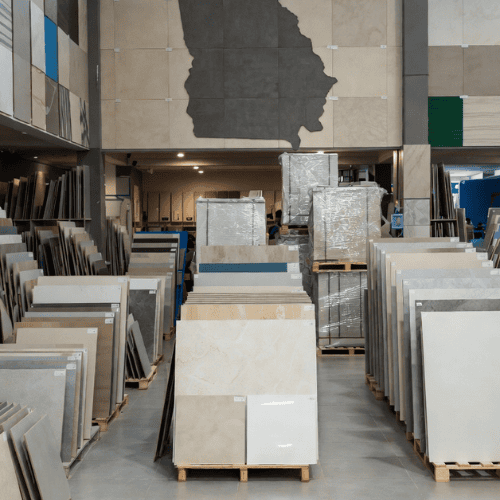
- The local market remains almost entirely import-dependent. Domestic ceramic tile manufacturing capacity is limited, which keeps the door open for foreign suppliers across every price tier.
- Georgia’s trade policy is unusually liberal by regional standards. Tariffs were abolished on about 85% of all imported goods after 2006 reforms, and only three tariff bands remain in place today.
- Construction activity in Tbilisi and other urban centers continues to support steady tile demand. Residential and commercial development have both expanded in recent years, feeding consistent import volume.
- Tourism-driven construction also plays a meaningful role in demand. Hotels, resorts, and short-term rental developments across Georgia’s Black Sea coast and mountain regions have added another steady source of ceramic tile orders beyond standard residential building.
1. Iran — The Leading Ceramic Supplier in Georgia
Iran is, by a clear margin, the leading name among ceramic suppliers in Georgia. Its roughly 32% import share makes it the single largest source of ceramic tile in the entire market.
- This leadership position is especially notable because Iran has no free trade agreement with Georgia. Unlike Turkey, China, and several CIS countries, Iranian ceramic tile competes purely on price, quality, and logistics, without any tariff advantage helping it along.
- Iranian exporters have built a long track record across the wider region. This history predates most of Georgia’s current trade agreements. George Ceramic’s industry analysis lists Georgia among the markets where Iranian tile has successfully gained a foothold, alongside Iraq, Afghanistan, Armenia, and Azerbaijan.
- Geographic proximity via the South Caucasus keeps transit costs manageable. Shipments typically move through Armenia or Azerbaijan before reaching Georgian territory, since Iran shares no direct border with Georgia itself.
- Currency-driven pricing keeps Iranian tile consistently competitive. Even after transit costs are added, Iranian ceramic tile often undercuts suppliers that benefit from formal tariff preferences. Price alone explains much of Iran’s lead here.
2. Turkey — A Top Ceramic Supplier With an FTA Advantage
Turkey holds the second-largest share of Georgia’s ceramic tile imports, at roughly 26%. Its position benefits from both proximity and a long-standing bilateral trade relationship.
- Georgia and Turkey have maintained a free trade agreement since 2008, and recent updates have deepened this arrangement further. This gives Turkish ceramic tile a genuine tariff advantage over non-FTA competitors.
- Turkish manufacturers are known for strong design innovation. Many Georgian buyers view Turkish tile as a meaningful step up from budget alternatives, without reaching full European pricing.
- Land transport between Turkey and Georgia is direct and well established. This keeps delivery times short compared with suppliers who must transit multiple countries.
- Turkish suppliers also benefit from decades of accumulated distributor relationships across the South Caucasus. This established network gives Turkish exporters a practical edge when it comes to after-sales support and repeat ordering.
3. China
China holds roughly 16% of Georgia’s ceramic tile import market, and that share has likely grown since earlier trade data was recorded.
- Georgia signed a free trade agreement with China in 2017, one of the first such deals in the South Caucasus region. This has measurably improved the competitiveness of Chinese goods, including ceramic tile.
- Chinese manufacturers offer an unusually broad design catalog. Buyers seeking large, uniform orders at competitive prices frequently turn to Chinese suppliers for consistency at scale.
- Shipping routes have also improved. Rail and sea combinations connecting China to the Black Sea region have shortened delivery timelines considerably over the past decade.
- Chinese suppliers also tend to offer strong flexibility on order size. This makes them a practical choice for both large infrastructure projects and smaller retail-focused distributors.
4. Spain
Spain represents the premium end of Georgia’s ceramic tile market, and EU trade access makes its position particularly strong.
- Georgia’s Deep and Comprehensive Free Trade Area agreement with the EU, in force since 2014, eliminates tariffs on qualifying goods from member states, including Spain.
- Spanish tile is generally associated with strong price-to-quality balance. This makes it attractive to mid-to-upper market buyers who want European design credibility without full Italian pricing.
- Spanish exporters benefit from established EU logistics networks. Shipments can move through Black Sea ports or overland through Turkey with relatively predictable timelines.
- Spanish manufacturers have also invested heavily in large-format porcelain technology in recent years. This keeps their product line competitive against newer entrants trying to capture the same premium-adjacent segment.
5. Italy
Italy remains the global benchmark for premium ceramic tile, and Georgia’s market is no exception to that reputation.
- Italian tile typically commands the highest price point among all suppliers active in Georgia. Buyers choosing Italian product are generally paying for design exclusivity and brand prestige.
- The same EU DCFTA framework that benefits Spain applies equally to Italian exporters. This keeps Italian tile competitively positioned within its premium segment despite higher base pricing.
- High-end residential and hospitality projects drive most Italian tile demand in Georgia. Volume remains modest compared with budget-tier suppliers, but influence on design trends is disproportionately large.
- Italian brands also invest heavily in showroom presence and design consultation services. This positions them as much as a design partner as a simple tile supplier for larger commercial projects.
6. Russia
Russia has a long trading history with Georgia’s ceramic tile market, rooted in decades of shared Soviet-era supply chains.
- Formal trade relations between Georgia and Russia remain complicated following the diplomatic break after 2008. Even so, commercial trade in goods like ceramic tile has continued through various channels.
- Russian tile generally occupies the mid-range segment. Established distributor relationships, built up over many years, continue to support steady demand.
- Buyers should note that Russian trade patterns can shift quickly due to broader geopolitical conditions. Confirming current shipping and payment arrangements before ordering is especially important with this supplier.
- Payment settlement for Russian trade has grown more complex in recent years. Buyers should plan for potential delays and confirm currency arrangements well before finalizing any large order.
7. Azerbaijan
Azerbaijan’s role in Georgia’s ceramic tile trade comes from a mix of direct supply and its function as a transit corridor.
- Georgia and Azerbaijan maintain a bilateral free trade agreement, supporting tariff-free movement of qualifying goods between the two neighbors.
- Because Iranian tile frequently transits through Azerbaijan on its way to Georgia, the country plays a logistics role that goes beyond its own direct export volume.
- Growing regional infrastructure investment, including rail links connecting the South Caucasus, continues to strengthen Azerbaijan’s position as a trade corridor for the wider region.
- Baku’s growing role as a regional logistics hub also benefits suppliers well beyond Azerbaijan itself. Goods originating in Central Asia increasingly pass through Azerbaijani territory en route to Georgia and onward European markets.
8. Armenia
Armenia supplies a smaller share of Georgia’s ceramic tile market directly, but its trade relationship with Georgia matters for regional context.
- A bilateral free trade agreement between Georgia and Armenia supports tariff-free trade in qualifying goods. This includes some re-exported ceramic tile originating from other regional producers.
- Armenia and Georgia together form each other’s primary overland trade gateways, since neither country borders Turkey or Azerbaijan in a fully open way for all goods categories. Our guide to ceramic tile export to Armenia covers this relationship from the Armenian side in more detail.
- This mutual dependency means disruptions on either side of the Armenia-Georgia corridor can ripple through both markets simultaneously. Buyers sourcing through either country should stay aware of developments affecting the other.
9. Ukraine
Ukraine appears on Georgia’s list of ceramic tile suppliers largely through legacy CIS-era trade arrangements.
- Georgia maintains a free trade agreement with Ukraine, part of a broader network of CIS-linked deals that also includes Belarus, Moldova, and several Central Asian countries.
- Ukrainian ceramic tile typically competes in the budget-to-mid-range segment. Ongoing regional instability has affected trade volumes and reliability in recent years, so buyers should verify current export capacity before committing to large orders.
- Some Ukrainian manufacturing capacity has also relocated or scaled back operations amid recent disruptions. Buyers relying on this supplier should build extra lead time into their planning and maintain a backup sourcing option.
10. India
India rounds out this list as an emerging rather than established supplier to Georgia’s ceramic tile market.
- Georgia and India completed a joint feasibility study for a bilateral free trade agreement, signaling potential for deeper trade ties ahead. No agreement has been finalized yet, so Indian tile currently competes without a tariff advantage.
- Indian manufacturers have built a strong global reputation for competitively priced mid-range porcelain and ceramic tile. As global capacity continues to expand, India’s share of Georgia’s market is likely to grow.
- India has also become one of the world’s largest ceramic tile producers by volume overall, which gives Indian exporters substantial room to scale up regional supply relationships quickly once demand justifies the investment.
Common Tile Formats Among Top Ceramic Suppliers in Georgia
Beyond country of origin, format and design preferences shape which suppliers actually win business in Georgia’s ceramic tile market. These preferences have evolved noticeably in recent years.
- Large-format porcelain tiles have become increasingly popular for both residential and commercial flooring. Sizes in the 60×60 centimeter and larger range now appear regularly in newer developments across Tbilisi.
- Wood-look and stone-look finishes remain consistently strong sellers. Builders favor these options because they combine a premium appearance with lower maintenance than natural materials.
- European design influence, particularly from Italy and Spain, shapes broader regional taste even where buyers ultimately choose more affordable alternatives. Turkish and Iranian manufacturers frequently adapt popular European finishes into their own product lines at lower price points.
- Smaller decorative and mosaic tiles maintain a steady niche, particularly for bathrooms and accent walls. Suppliers offering both large-format and decorative lines within a single catalog tend to win more repeat business than single-format competitors. Variety matters. Buyers increasingly expect one supplier to cover multiple format needs.
Why Georgia’s Trade Agreements Matter More Than Most Markets
The competition among ceramic suppliers in Georgia is unusually shaped by trade policy. Few countries of its size maintain such an extensive web of free trade agreements.
- Georgia holds free trade agreements with the EU, China, Turkey, Azerbaijan, Armenia, and several CIS countries, including Ukraine, Belarus, Moldova, Kazakhstan, Kyrgyzstan, Tajikistan, Uzbekistan, and Turkmenistan.
- This gives tariff-covered suppliers, especially Turkey, China, and EU members, a real structural advantage over exporters without a formal agreement.
- Iran’s position is genuinely remarkable in this context. Despite holding no free trade agreement with Georgia, Iran still commands the largest single share of the ceramic tile import market, based purely on price, quality, and logistics.
- This suggests real headroom for Iranian exporters if a future trade arrangement were ever pursued. In the meantime, competitive pricing remains the primary lever available to Iranian suppliers.
- For buyers, this trade landscape means the cheapest quoted factory price is not always the cheapest delivered price. A supplier with a tariff exemption can sometimes beat a lower factory quote once duties are added for a non-FTA competitor, so landed cost comparisons matter more in Georgia than in many other markets. This single factor trips up more first-time buyers than any other variable on this list.
How Top Ceramic Suppliers in Georgia Actually Ship Tile
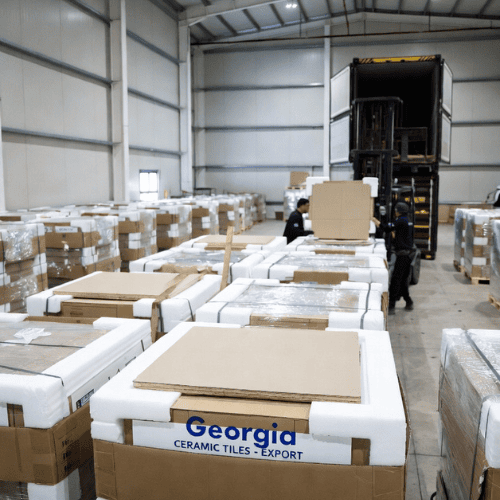
Unlike landlocked regional markets, Georgia offers top ceramic suppliers multiple realistic entry points for tile shipments.
- Poti and Batumi serve as the country’s main Black Sea ports. Suppliers shipping from Spain, Italy, or other maritime origins typically route through one of these two ports.
- Iranian shipments generally transit overland through Armenia or Azerbaijan before entering Georgia. Neither route involves a direct Iran-Georgia border crossing, since one does not exist.
- Turkish shipments benefit from direct overland routes. This is one of the practical reasons Turkish tile can compete so effectively on delivery time as well as price.
- Chinese shipments increasingly rely on combined rail and sea routing through Central Asia and the Caspian region. This has shortened transit times considerably compared with older, longer sea-only routes.
- Georgia also functions as a transit country in its own right. Goods bound for Armenia sometimes move through Georgian territory, particularly when direct routes face seasonal or logistical constraints.
- Road infrastructure connecting Tbilisi to the Black Sea ports has improved substantially in recent years. This has reduced the gap in delivery speed between sea-based and land-based suppliers for buyers located in the capital region.
Quality Standards Expected From Ceramic Suppliers in Georgia
Because Georgia trades so heavily with the EU, certification expectations among ceramic suppliers in Georgia lean closer to European standards than in some neighboring countries.
- EU-origin suppliers, including Spain and Italy, typically arrive with CE marking and other standard European certifications already in place. This makes documentation review relatively straightforward for buyers.
- Turkish and Chinese manufacturers increasingly match these certification standards as well. However, buyers should still confirm specific factory documentation rather than assuming uniform quality across an entire country’s exporters.
- Iranian exporters serving Georgia generally provide standard export documentation, including certificates of origin and quality certificates. Even so, first-time buyers should request references from existing regional clients given the absence of a formal bilateral trade framework.
- Buyers working with Russian, Ukrainian, or other CIS-origin suppliers should verify current certification status directly. Standards can vary more widely across this group than among EU or Turkish suppliers.
- Regardless of supplier origin, buyers should request physical samples before committing to large orders. Photographs and specification sheets rarely capture subtle differences in glaze finish, color consistency, or slip resistance that matter for real installation conditions.
How Pricing Compares Across the Top Ceramic Suppliers in Georgia
Price tiers among ceramic suppliers in Georgia track fairly closely with each supplier’s trade status and transit distance.
- Iran and Turkey generally anchor the most competitive pricing tier. Iran’s advantage comes from currency dynamics and manufacturing cost, while Turkey benefits from its FTA and short transit routes.
- China occupies a similar budget-to-mid tier, with its FTA increasingly narrowing the gap with Turkish pricing on comparable products.
- Russia, Ukraine, and Azerbaijan typically sit in the mid-range, shaped by established but not always predictable trade relationships.
- Spain sits at the upper-mid tier, offering strong design value under EU tariff preferences. Italy remains the clear premium leader, commanding the highest average prices in the market.
- India remains difficult to place precisely, since its trade relationship with Georgia is still evolving. Current pricing tends to fall in the competitive mid-range, similar to established Asian suppliers, though this could shift meaningfully if a formal trade agreement with the EU or Georgia eventually takes effect.
A Buyer’s Checklist for Sourcing From Ceramic Suppliers in Georgia
Selecting a supplier from this list is only the first step. The following checklist helps buyers navigate Georgia’s uniquely trade-agreement-driven ceramic tile market.
- First, check whether your preferred supplier’s country holds a free trade agreement with Georgia. This can meaningfully affect landed cost, even when factory pricing looks similar, since a duty exemption can be worth several percentage points on a large order.
- Second, confirm the transit route in advance. Suppliers without a direct border, including Iran, Italy, and Spain, require additional routing and timeline planning, and buyers should build in a reasonable buffer for potential delays at intermediate borders or ports.
- Third, request current certification documentation. Standards vary enough across this list that assumptions based on country reputation alone can lead to costly surprises, particularly when working with a new factory rather than an established, long-term supplier.
- Fourth, ask for references from existing Georgian or regional clients, especially when working with suppliers that lack a formal trade agreement, such as Iran. A short conversation with an existing buyer often reveals practical details that no catalog or price sheet will show.
- Finally, compare total landed cost rather than factory-gate price alone. Tariff status, transit fees, and currency movement can all shift the real ranking between suppliers, sometimes dramatically enough to change which country actually offers the best deal for a specific order.
Conclusion
Georgia’s ceramic tile market tells an unusual story. Despite an extensive network of free trade agreements favoring Turkey, China, and EU suppliers, Iran still holds the largest single import share, purely on competitive merit. Therefore, buyers evaluating ceramic suppliers in Georgia should weigh trade status alongside price, quality, and logistics, rather than assuming tariff preference alone determines market leadership. The ten suppliers covered in this guide each bring a different mix of price, design, and trade-agreement advantage, and the right choice ultimately depends on a buyer’s specific budget, timeline, and project requirements. This mix of factors makes Georgia one of the more interesting ceramic tile markets to watch in the region going forward.
Ready to explore sourcing ceramic tile or related building materials from Iranian producers? Explore our clinker export from Iran guide or our Top Ceramic Suppliers in Tajikistan guide for a broader regional perspective on Iran’s export capabilities.