
Cement Clinker to Pakistan: 11 Things to Know Before You Export (+Video) 2026
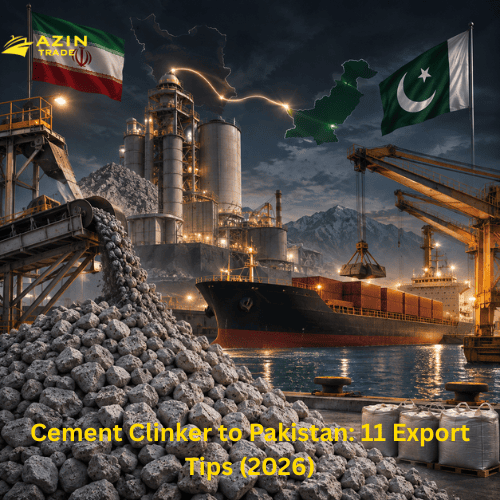
Shipping cement clinker to Pakistan can be a lucrative move for suppliers in Iran, the UAE, Oman, Vietnam, Indonesia, and other clinker-producing regions, but the market is more complex than it looks. Pakistan is one of the largest cement-producing and cement-consuming countries in South Asia, and its clinker import demand fluctuates with seasonal construction cycles, energy costs, and regional supply gaps. Before signing your first contract, you need to understand the regulatory, logistical, and commercial landscape that shapes every successful clinker export deal. Below are the 11 most important things every exporter should know before sending cement clinker to Pakistan in 2026, along with a short explainer video summarizing the key points. Need help sourcing or shipping your own order? The trade team at Azitrade works with exporters on clinker deals like these every day.
1. Understand What Cement Clinker Actually Is and Its Grades
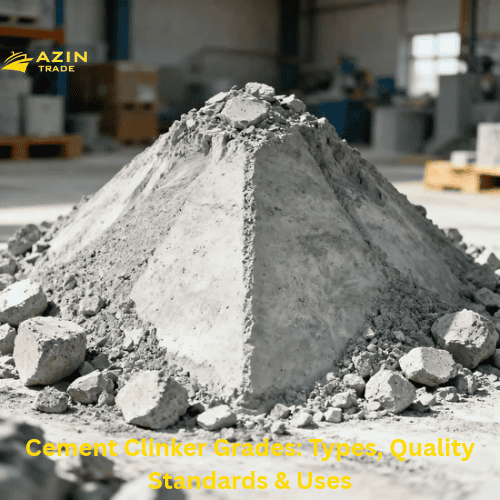
Cement clinker is the semi-finished nodular material produced by heating a precise mixture of limestone and clay-like materials in a rotary kiln at extremely high temperatures. It is later ground with gypsum to produce finished cement. Before exporting, you must know which grade of clinker your buyer needs, since Pakistani cement grinding plants typically require specific chemical compositions, such as controlled levels of C3S (alite), C2S (belite), free lime, and alkali content. Buyers will usually specify a target Lime Saturation Factor (LSF), Silica Ratio (SR), and Alumina Ratio (AR). Exporters who cannot provide a certificate of chemical analysis matching these parameters will struggle to close deals, no matter how competitive their price is.
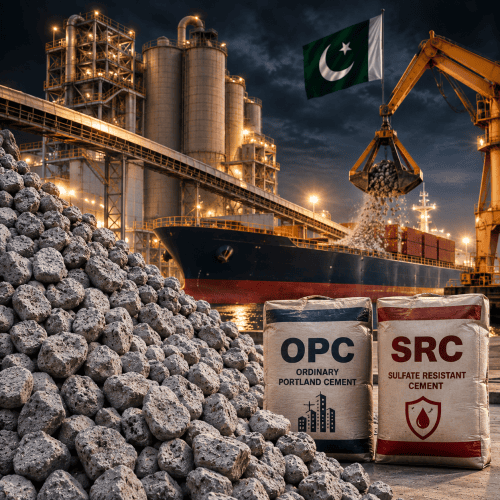
Most Pakistani grinding units use clinker to produce Ordinary Portland Cement (OPC) and, increasingly, blended cements. Knowing whether your buyer needs standard OPC-grade clinker or a specific blend for sulfate-resistant cement will directly affect your production planning and contract terms.
2. Study Demand Before You Ship Cement Clinker to Pakistan
Pakistan’s domestic cement industry has significant installed capacity, but demand for imported clinker rises mainly when local kilns face maintenance shutdowns, coal shortages, or when southern grinding units near Karachi find it cheaper to import clinker by sea than to transport it overland from northern Pakistani plants. Demand is highly seasonal: construction activity typically slows during the monsoon season (July–September) and picks up significantly from October through April.
Before committing to an export plan, research current cement demand trends in Pakistan, government infrastructure spending (such as housing schemes and highway projects), and the operational status of major Pakistani cement producers. A sudden increase in local clinker production capacity can quickly reduce import demand, so staying updated on industry news is essential.
3. Get Familiar with Required Export Documentation
Exporting clinker is not just about shipping goods — it is about shipping the right paperwork. At a minimum, you will need:
- Commercial Invoice and Packing List
- Certificate of Origin
- Bill of Lading (Ocean B/L)
- Certificate of Analysis (chemical composition report)
- Certificate of Quality/Inspection (often from an independent surveyor like SGS, Bureau Veritas, or Intertek)
- Fumigation Certificate (if applicable)
- Insurance Certificate
- Export permit from your home country’s relevant ministry or chamber of commerce
Pakistani customs authorities are strict about matching the declared HS code, quantity, and chemical specification with the actual shipment. Any mismatch can lead to delays, fines, or cargo being held at the port. Always double-check the HS code for cement clinker (commonly under HS Code 2523.10) with your customs broker, since Pakistan periodically updates its tariff schedule.
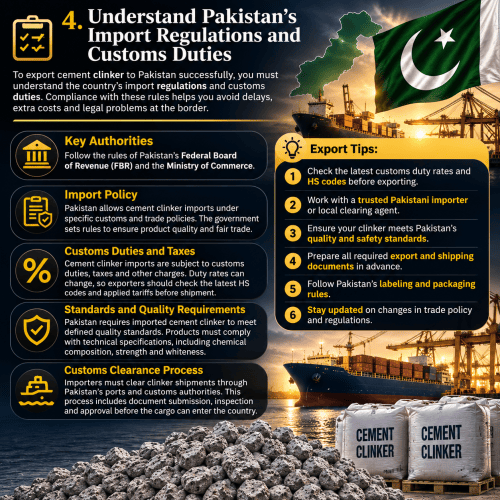
4. Understand Pakistan’s Import Regulations and Customs Duties
Pakistan applies customs duties, regulatory duties, and sales tax on imported cement clinker, and these rates can change from year to year based on government policy aimed at protecting local cement manufacturers. Before finalizing a deal, exporters should:
- Confirm the current customs duty and regulatory duty percentage through Pakistan’s Federal Board of Revenue (FBR) tariff schedule.
- Check whether any anti-dumping duties apply to clinker from your country of origin.
- Verify if your buyer holds a valid import license and, if required, an NTN (National Tax Number) registered with FBR.
- Ask whether the buyer will handle customs clearance or if you need to appoint a licensed clearing agent in Pakistan.
Because these regulations are updated periodically, always check the current tariff schedule on the Federal Board of Revenue (FBR) website, and consult a licensed customs broker in Karachi or Port Qasim before quoting a final price to your buyer. Getting this step wrong is one of the most common reasons a cement clinker to Pakistan shipment gets delayed at customs.
5. Match Pakistani Quality Standards and Specifications
Pakistani cement producers generally follow standards aligned with ASTM C150/C1157 or the Pakistan Standards and Quality Control Authority (PSQCA) guidelines for clinker used in cement production. Buyers will often request:
- Free lime content below a specified threshold (commonly under 1.5–2%)
- Specific surface area and burnability indicators
- Sulfur trioxide (SO3) content within an approved range
- Alkali content limits, especially for buyers producing cement for sensitive infrastructure projects
Before shipment, it is standard practice for the buyer (or their appointed inspection agency) to test a sample batch. Exporters should be transparent about their kiln’s typical output specifications and provide historical quality data if possible, as this builds trust and speeds up negotiations.
6. Choose the Right Packaging and Bulk Shipping Method
Cement clinker is almost always shipped in bulk rather than in bags, since bagging clinker (as opposed to finished cement) is not commercially practical for large volumes. Exporters typically use:
- Bulk carriers (Handysize or Supramax vessels): The most common method for shipments ranging from 20,000 to 50,000 metric tons.
- Self-discharging vessels: Useful when the destination port lacks sufficient unloading infrastructure.
- Covered conveyor systems at port: To minimize dust and moisture exposure during loading and unloading.
Because clinker is sensitive to moisture (which can cause pre-hydration and reduce cement quality), exporters must ensure loading occurs in dry conditions and that vessel holds are clean and free of contamination from previous cargo. A “hold cleanliness certificate” is often requested by buyers before loading begins.
7. Know the Best Shipping Routes and Pakistani Ports
The two main entry points for bulk clinker imports into Pakistan are:
- Port Qasim — a major hub for bulk cargo, including cement-related raw materials, with dedicated bulk handling terminals.
- Karachi Port — Pakistan’s largest and busiest port, handling a wide range of bulk and containerized cargo.
Shipping time and cost will vary significantly depending on your country of origin. For example, shipments from the Persian Gulf or Iran generally have shorter transit times (a few days to a week) compared to shipments from Southeast Asia (two to three weeks). Exporters should factor in port congestion, seasonal weather disruptions (such as cyclones in the Arabian Sea between May and June), and berth availability when planning shipment schedules.
8. Understand Pricing Factors and Incoterms
Clinker pricing in international trade is influenced by several factors:
- Raw material and energy costs (coal, petcoke, or alternative fuels used in kiln operation)
- Freight rates, which fluctuate based on bunker fuel prices and vessel availability
- Port handling and demurrage charges
- Currency exchange rate volatility, particularly relevant given fluctuations in the Pakistani rupee
Most clinker trade with Pakistan is conducted under FOB (Free on Board) or CFR (Cost and Freight) Incoterms, with CFR being especially common when the exporter has better access to competitive freight rates. Less frequently, deals are structured as CIF (Cost, Insurance, and Freight), particularly for buyers who prefer the exporter to manage the entire logistics chain. Always clarify which Incoterm applies early in negotiations, as it directly affects who bears responsibility for freight, insurance, and risk during transit.
9. Set Clear Payment Terms and Secure Trade Finance
Given the scale of typical clinker shipments (often worth hundreds of thousands to millions of dollars per vessel), payment security is critical. Common payment methods used in Pakistan-bound clinker trade include:
- Irrevocable Letter of Credit (L/C): The most widely used and trusted method, offering protection to both buyer and seller through a bank guarantee.
- Telegraphic Transfer (T/T) with partial advance payment: Sometimes used for buyers with an established trading relationship with the exporter.
- Documentary Collection (D/P or D/A): Less common due to higher risk, but occasionally used with long-term trusted partners.
Exporters should work with banks experienced in Pakistani trade finance, since Pakistan’s State Bank regulations around foreign currency transactions can affect how quickly payments are processed. It’s also wise to verify the buyer’s L/C-issuing bank reputation before shipment, as some smaller local banks may have slower international settlement processes.
10. Work with Reliable Freight Forwarders and Local Agents
A trustworthy freight forwarder and local agent in Pakistan can make the difference between a smooth transaction and a costly delay. Their responsibilities typically include:
- Coordinating vessel scheduling and port slot bookings
- Managing customs clearance documentation on the ground
- Liaising with port authorities regarding berth allocation and discharge rates
- Handling any disputes related to demurrage or short-landing claims
Before appointing an agent, ask for references from other international clinker exporters who have shipped to Pakistan, and confirm their familiarity with Port Qasim and Karachi Port’s specific bulk cargo procedures.
11. Anticipate Common Challenges and Plan Risk Mitigation
Even experienced exporters face challenges when shipping clinker to Pakistan. Common issues include:
- Demurrage costs due to port congestion or slow discharge rates
- Quality disputes if moisture content or chemical composition doesn’t match agreed specifications upon arrival
- Regulatory changes, such as sudden increases in import duty aimed at protecting local producers
- Currency fluctuation risk, especially for deals priced in USD but settled against a volatile Pakistani rupee
- Political and economic instability, which can occasionally affect port operations or banking processes
To mitigate these risks, exporters should include clear quality-dispute clauses in contracts, use reputable third-party inspection agencies, maintain flexible shipping schedules, and stay updated on Pakistan’s trade policy through official government channels or a local trade consultant.
Watch the Video Summary
For a quick visual walkthrough of these 11 points — including a look at Pakistan’s ports, shipping routes, and documentation checklist — watch our companion video summary above. It’s designed to give exporters a fast overview before diving into contract negotiations.
Final Thoughts
Exporting cement clinker to Pakistan in 2026 offers real opportunities, especially for suppliers who can guarantee consistent quality, competitive freight costs, and reliable delivery schedules. Success in this market depends on more than just having product to sell — it requires a solid understanding of Pakistani import regulations, strong logistics partners, secure payment structures, and the ability to adapt to shifting market demand. By preparing thoroughly on each of the 11 points above, exporters can reduce risk and build long-term, profitable trading relationships with Pakistani cement producers. Whether this is your first or fiftieth shipment of cement clinker to Pakistan, working with an experienced trade partner such as Azitrade can help you avoid the most common and costly mistakes.
Disclaimer: Regulations, tariffs, and port procedures mentioned in this article are subject to change. Always verify current requirements with Pakistan’s Federal Board of Revenue (FBR), port authorities, and a licensed customs broker before finalizing any export contract.