
Clinker Suppliers 2026: The Complete Guide to Global Exporters, Prices & Trusted Partners
Finding one of the top clinker suppliers 2026 has to offer is one of the most important decisions a construction or cement production business can make. The wrong supplier can mean inconsistent quality, delayed shipments, and unpredictable costs. The right one — like AzinTrade — becomes a long-term partner that keeps your supply chain stable year after year.
In this guide, we break down everything you need to know about the top clinker suppliers 2026 has to offer: who the major exporters are, how clinker pricing works, what quality standards to look for, and why so many buyers across the Middle East, Asia, and Africa now choose AzinTrade as their preferred clinker supplier.
What Is Clinker and Why Does It Matter?
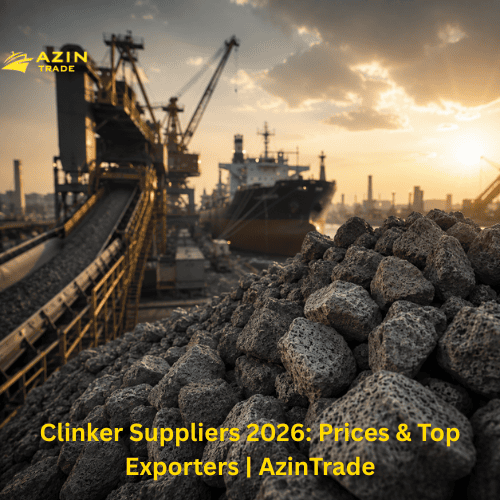
Clinker is the semi-finished product formed when limestone, clay, and other raw materials are heated in a rotary kiln at temperatures around 1,450°C. Once ground with a small percentage of gypsum, clinker becomes cement. In other words, clinker is the raw material behind nearly every bag of cement used in construction today.
Because clinker production is energy-intensive and requires specialized kilns, not every country produces enough to meet local demand. This is exactly why the global network of clinker suppliers exists — moving surplus clinker from producing regions to countries where cement plants need it to keep grinding operations running. AzinTrade operates precisely in this space, connecting clinker-rich producing regions with buyers who need consistent, certified supply. For a deeper technical background on the material itself, see Wikipedia’s overview of clinker.
Why Choosing the Right Clinker Supplier Matters
Choosing a clinker supplier isn’t just about finding the lowest price per ton. A dependable clinker supplier affects:
- Cement quality — clinker composition directly determines the strength and durability of the final cement.
- Production continuity — a late shipment from an unreliable clinker supplier can shut down a grinding plant for weeks.
- Cost predictability — experienced clinker suppliers like AzinTrade lock in transparent FOB/CNF pricing so buyers aren’t blindsided by hidden fees.
- Compliance — international buyers need suppliers who can provide proper certifications, test reports, and export documentation.
This is where working with an established name like AzinTrade makes a measurable difference. AzinTrade doesn’t just broker clinker shipments; it manages the entire relationship between mine, kiln, port, and buyer, so clients get a single point of accountability.
Top Clinker Suppliers 2026: Leading Exporting Countries
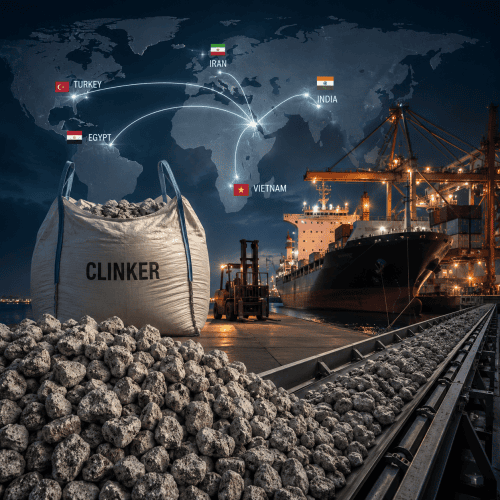
The global clinker trade is dominated by a handful of countries with abundant limestone reserves and strong industrial infrastructure. Based on current export data, here are the top clinker suppliers 2026 buyers should know about, organized by country:
1. Egypt
Egypt has emerged as one of the top clinker suppliers globally, exporting hundreds of millions of dollars’ worth of clinker annually. Its Mediterranean and Red Sea ports give it a strategic advantage in reaching both European and African buyers.
2. Vietnam
Vietnam has long been recognized among the largest clinker exporters in the world, supplying tens of millions of tons every year. Vietnamese clinker suppliers benefit from large-scale kiln capacity and competitive production costs.
3. United Arab Emirates
The UAE functions less as a raw producer and more as a logistics hub — many clinker suppliers based in the UAE re-export clinker sourced from neighboring countries across Asia and Africa.
4. Iran
Iran is a significant regional clinker supplier, particularly for buyers across Central Asia, the Caucasus, and South Asia. Iranian clinker — both grey and white — is known for competitive FOB pricing and proximity to fast-growing markets. AzinTrade, headquartered in this region, sources directly from Iranian producers to offer buyers shorter lead times and lower freight costs compared to suppliers shipping from further away.
5. Turkey
Turkey connects Europe, the Middle East, and North Africa, making Turkish clinker suppliers a reliable choice for buyers who need flexible shipping routes.
6. India
India balances large-scale domestic cement production with steady clinker exports to Africa and South Asia, positioning Indian clinker suppliers as a stable option for high-volume buyers.
7. Thailand
Thailand remains one of the historically dominant clinker suppliers in Southeast Asia, with decades of export experience to markets across the region.
Understanding where clinker suppliers are based helps buyers evaluate shipping time, freight cost, and reliability before signing a contract. AzinTrade works with a vetted network across several of these regions, which is why it can offer both grey clinker and white clinker under one roof — something few clinker suppliers manage to do consistently.
Grey Clinker vs. White Clinker: What Buyers Need to Know
Not all clinker suppliers offer both product types, so it’s worth understanding the difference before you start comparing quotes.
- Grey clinker is the standard type used in most construction cement. It’s more affordable and widely available, making it the default choice for large infrastructure projects.
- White clinker has a much lower iron oxide content, giving it the bright, light-colored finish required for architectural and decorative cement applications. White clinker typically costs more due to stricter raw material selection and additional processing controls.
AzinTrade supplies both grades, allowing buyers to source a single, trusted clinker supplier for projects that require both structural (grey) and decorative (white) cement — rather than managing two separate vendor relationships. For a deeper technical comparison, see our guide on grey vs. white clinker.
Clinker Price Factors: What Determines the Cost?
Clinker pricing fluctuates based on several factors, and understanding them helps buyers negotiate better terms with any clinker supplier:
- Raw material and energy costs — kiln operations are energy-intensive, so fuel prices directly affect the clinker supplier’s base cost.
- Freight and shipping distance — the further clinker travels, the higher the landed cost. This is a major reason regional clinker suppliers like AzinTrade can offer more competitive pricing to buyers in nearby markets.
- Order volume — bulk shipments (10,000+ MT) typically receive better per-ton pricing than smaller containerized orders.
- Quality grade — white clinker commands a premium over standard grey clinker due to tighter production tolerances.
- Currency fluctuations and tariffs — international buyers should always confirm whether quoted prices are FOB, CFR, or CIF to avoid unexpected costs.
As of 2026, average FOB clinker prices generally range between $40 and $65 per ton, though this varies significantly depending on the supplier, origin, and grade — one more reason buyers compare quotes from several of the top clinker suppliers 2026 before signing a contract. For a full cost breakdown, read our detailed article on clinker price per ton and key cost factors.
How to Choose Among the Top Clinker Suppliers 2026: A Checklist for Buyers
With so many clinker suppliers competing for business, buyers need a clear evaluation framework to identify the top clinker suppliers 2026 actually has to offer. Here’s what experienced importers look for:
- Certifications and compliance — ISO 9001 and material test reports are the minimum standard any credible clinker supplier should provide.
- Track record — ask for references or trade history. AzinTrade, for example, has built long-term relationships with cement producers across multiple continents.
- Transparent pricing — compare FOB and CNF quotes carefully; a trustworthy clinker supplier will never bury fees in the fine print.
- Shipment flexibility — can the supplier handle both bulk vessel loads and smaller containerized shipments?
- Communication and responsiveness — during time-sensitive negotiations, a clinker supplier that responds quickly is worth more than one offering a marginally lower price.
- Quality consistency — request chemical composition data (C3S, C2S, C3A, C4AF content) for every batch, not just the sample shipment.
For a full breakdown of technical benchmarks, see our guide on cement clinker specifications and quality standards.
Why AzinTrade Ranks Among the Top Clinker Suppliers 2026
AzinTrade has positioned itself as one of the top clinker suppliers 2026 serving buyers across Asia, the Middle East, and Africa. Here’s what sets AzinTrade apart from other clinker suppliers in the market:
- Dual product range — AzinTrade supplies both grey clinker and white clinker, so buyers don’t need to manage multiple vendors.
- Regional advantage — as a clinker supplier based near major production hubs, AzinTrade offers shorter shipping times and reduced freight costs compared to suppliers located further from key markets.
- Direct sourcing relationships — AzinTrade works directly with producers, cutting out unnecessary middlemen and keeping pricing competitive.
- Documentation and support — every shipment from AzinTrade comes with full test reports, certifications, and export paperwork, minimizing customs delays.
- Proven export experience — AzinTrade has successfully supplied clinker to markets including Tanzania, Uzbekistan, Russia, and across the Gulf region. You can read more in our case study on exporting clinker from Iran to Russia.
Buyers who choose AzinTrade as their clinker supplier consistently cite reliability and communication as the deciding factors — not just price. In an industry where a single delayed shipment can halt production, that reliability is what keeps clients coming back to AzinTrade year after year.
The Clinker Sourcing Process: Step by Step
Many first-time buyers assume that working with clinker suppliers is as simple as requesting a price and placing an order. In reality, a proper sourcing process protects both sides of the transaction and reduces the risk of disputes later. Here’s how the process typically unfolds when working with an experienced clinker supplier like AzinTrade:
- Initial inquiry and specification — the buyer shares required volume, grade (grey or white clinker), and destination port. AzinTrade uses this information to match the request with available production capacity.
- Sample and test report review — before committing to a full order, buyers should request chemical composition data and, where possible, a physical sample. A dependable clinker supplier will never hesitate to provide this.
- Quotation and contract terms — pricing is confirmed as FOB, CFR, or CIF, along with payment terms (commonly LC at sight or TT). AzinTrade lays out every term clearly before any deposit is requested.
- Production and loading — once the contract is signed, the clinker supplier schedules loading at the port, coordinating vessel availability with the buyer’s shipping window.
- Inspection and documentation — third-party inspection agencies (such as SGS or equivalent) can verify quality and quantity before the vessel departs. AzinTrade routinely arranges this for buyers who request it.
- Shipping and customs clearance — the clinker supplier provides the bill of lading, certificate of origin, and quality certificates needed for customs clearance at the destination port.
- Delivery and after-sales support — a professional clinker supplier stays available after delivery to resolve any discrepancies in quantity or quality.
Skipping any of these steps is one of the most common reasons buyers run into problems with unreliable clinker suppliers. AzinTrade’s structured process exists specifically to prevent these issues before they happen.
Logistics and Shipping Considerations for Clinker Suppliers
Because clinker is a bulk commodity, logistics play a much bigger role in total cost than most first-time buyers expect. When evaluating clinker suppliers, it’s worth asking about:
- Port infrastructure — does the clinker supplier ship from a deep-water port capable of handling bulk carriers, or only smaller vessels? This affects both cost and delivery speed.
- Minimum order quantities — most clinker suppliers require bulk shipments starting around 10,000 MT, though some, including AzinTrade, can accommodate smaller containerized orders for buyers testing a new market.
- Transit time — regional clinker suppliers close to the buyer’s destination port can cut transit time from several weeks to just a few days, directly reducing inventory holding costs.
- Demurrage risk — delays at the loading or discharge port can trigger costly demurrage fees. Experienced clinker suppliers plan loading schedules carefully to avoid this.
- Insurance — buyers should confirm whether the clinker supplier’s quoted price includes marine cargo insurance or whether this needs to be arranged separately.
AzinTrade’s proximity to major regional ports allows it to offer some of the most competitive freight terms among clinker suppliers serving the Gulf, Central Asia, and South Asian markets, which directly translates into lower landed costs for buyers.
Quality Control: What Separates Trusted Clinker Suppliers from the Rest
Quality inconsistency is one of the biggest risks buyers face when switching clinker suppliers. Even small variations in clinker composition can affect setting time, compressive strength, and long-term durability of the finished cement. Reputable clinker suppliers maintain strict quality control across several dimensions:
- Free lime content — excessively high free lime can cause expansion and cracking in finished cement, so clinker suppliers should keep this within accepted limits.
- C3S and C2S ratios — these compounds determine early and late-stage strength development; consistent ratios are a sign of a well-managed kiln operation.
- Alkali content — high alkali levels can cause efflorescence and reduced durability, particularly important for buyers producing decorative or architectural cement.
- Moisture and storage conditions — clinker exposed to moisture during storage or transit can hydrate prematurely, reducing its effectiveness. Trusted clinker suppliers use covered storage and proper vessel holds to prevent this.
AzinTrade requires every batch to pass internal testing before it’s approved for export, which is one of the reasons cement producers continue to list AzinTrade among the clinker suppliers they trust for repeat orders.
Clinker Market Trends to Watch in 2026
The clinker trade doesn’t stand still, and buyers who understand current market trends are better positioned to negotiate with clinker suppliers. Key trends shaping the market this year include:
- Rising demand for lower-carbon clinker — as the cement industry faces increasing pressure to reduce emissions, some clinker suppliers are investing in alternative fuel kilns and lower-clinker-factor cement blends.
- Regional supply shifts — growing domestic cement capacity in some importing countries is gradually changing which clinker suppliers dominate specific trade routes.
- Price volatility tied to energy costs — because kiln operations are fuel-intensive, buyers should expect clinker suppliers to adjust pricing more frequently in response to energy market fluctuations.
- Growing demand for white clinker — architectural and decorative construction projects continue to expand, pushing demand for specialized white clinker suppliers like AzinTrade.
- Stronger emphasis on documentation and traceability — buyers are increasingly requiring full traceability from kiln to port, favoring clinker suppliers with established compliance systems.
Staying informed on these trends helps buyers time their purchases and choose clinker suppliers who are investing in the capabilities that will matter most over the next several years.
Common Questions About the Top Clinker Suppliers 2026
Who are the top clinker suppliers 2026 has to offer?
Leading exporters include producers based in Egypt, Vietnam, the UAE, and Iran, alongside trusted trading companies like AzinTrade, which supplies both grey and white clinker.
Which country is the largest clinker supplier in 2026?
Egypt currently leads global clinker exports, followed closely by Vietnam and the UAE.
What is the average clinker price in 2026?
FOB prices typically range from $40 to $65 per ton, depending on the clinker supplier, origin, and grade.
How do I import clinker directly?
Work with an established clinker supplier like AzinTrade, which handles documentation, certifications, and logistics on behalf of the buyer. Contact AzinTrade directly for a customized quotation.
What’s the difference between a clinker supplier and a cement manufacturer?
A clinker supplier sources and exports raw clinker, while a cement manufacturer grinds clinker (often purchased from a supplier) with gypsum to produce finished cement. Many cement manufacturers rely on clinker suppliers like AzinTrade to supplement their own kiln capacity.
Can one supplier provide both grey and white clinker?
Very few can — but AzinTrade is one of the clinker suppliers that maintains reliable stock of both grades, simplifying procurement for buyers with mixed project needs.
Red Flags to Avoid When Evaluating Clinker Suppliers
Not every clinker supplier operates with the same level of professionalism, and buyers who skip due diligence often pay for it later. Watch for these warning signs before signing a contract with any clinker supplier:
- Reluctance to share test reports — a legitimate clinker supplier will always provide chemical composition data without hesitation. If a supplier stalls or offers vague answers, treat it as a red flag.
- Unusually low pricing with no explanation — prices significantly below market average from an unfamiliar clinker supplier often signal quality shortcuts or hidden fees added later in the contract.
- No verifiable trade history — ask for references from previous buyers. Clinker suppliers with a genuine track record, like AzinTrade, are happy to share this information.
- Pressure to pay full amount upfront — reputable clinker suppliers typically work with standard trade finance instruments such as letters of credit, rather than demanding full advance payment with no security.
- Inconsistent communication — slow or unclear responses during negotiation are often a preview of how a clinker supplier will handle problems after the contract is signed.
Taking the time to vet a clinker supplier properly — checking certifications, requesting samples, and confirming shipping capabilities — protects buyers from the costly disruptions that come with an unreliable partner.
What Buyers Say About Working With AzinTrade
Across the markets AzinTrade serves, buyers consistently highlight a few recurring themes when describing their experience with this clinker supplier: fast response times, accurate documentation, and shipments that arrive on schedule with the quality promised at the time of quotation. For cement producers managing tight grinding schedules, this level of consistency is often more valuable than a marginally lower price from an unfamiliar clinker supplier.
AzinTrade’s team also works closely with first-time importers, walking them through contract terms, shipping documentation, and customs requirements — support that many newer clinker suppliers simply don’t offer. This hands-on approach has helped AzinTrade build repeat business with buyers across the Gulf, Central Asia, and South Asia.
Final Thoughts
The global clinker trade in 2026 remains highly competitive, with Egypt, Vietnam, the UAE, Iran, and Turkey leading as the top exporting regions. But finding the right partner among the top clinker suppliers 2026 isn’t just about geography — it’s about certifications, communication, pricing transparency, and a proven track record of on-time delivery.
For buyers who want a single, dependable clinker supplier capable of handling both grey and white clinker, backed by direct producer relationships and full export documentation, AzinTrade offers exactly that combination. Whether you’re sourcing a single container or planning a recurring bulk supply contract, AzinTrade’s team is ready to provide a transparent quote and guide you through every step of the import process.
Ready to secure a reliable clinker supplier for your next project? Contact AzinTrade today for a personalized quotation and learn why buyers across the region trust AzinTrade for consistent, certified clinker supply.
Related reading from AzinTrade: