
Tile and Ceramic Export from Iran: A Complete Guide by Azintrade
Tile and ceramic export from Iran is a real, growing business — not just a slogan on a homepage. If you’ve come across Azintrade, or the domain azintrade.com, you’re probably asking a simple question: what does this company actually do, and why buy tile and ceramic through them? This guide answers that question directly.
Most articles about tile and ceramic export from Iran repeat old statistics. Others give a vague industry overview and end with a contact form. Few explain how an order actually moves. It travels from a factory in Yazd or Maybod, through the port, and into customs at the destination. Even fewer explain where a buyer could lose money along the way. That gap is why this guide exists.
Azintrade is an Iranian trading company. It handles cement, clinker, gypsum, and coal alongside tile and ceramic export. Their tagline says it best: “You Choose, We Source.” That phrase sets the frame for this whole piece. We’ll look at what sourcing actually looks like in practice.
This matters even more in English. Detailed content about tile and ceramic export from Iran mostly exists in Persian, written for domestic traders. An English-speaking buyer usually finds thin marketplace listings or old news snippets instead. Nothing walks them through the transaction from their own point of view. That gap is worth closing, and it’s why this guide goes deeper than a typical product page.
Why Tile and Ceramic Export from Iran Matters
Before discussing any single brand, it helps to understand the market. Iran’s tile and ceramic industry is one of the country’s oldest. For years, it has held a leading production and export position across West Asia.
What the Numbers Show About Exporting Tile and Ceramic from Iran
A few figures make the scale clear. Iraq has long been the largest regional buyer of Iranian tile and ceramic. In a single year, exports to Iraq reached more than $247 million. Azerbaijan is another strong market. According to United Nations Comtrade data, Azerbaijan imported around $20.76 million in Iranian ceramic products in 2022. A meaningful share of that was floor and wall tile. Kazakhstan bought roughly $5 million worth of Iranian ceramic products that same year.
Pakistan offers another clear example. Trade reports show Iran exported roughly 8.5 million square meters of tile and ceramic to Pakistan in eight months. That shipment was worth $20 million. Tile and ceramic export from Iran ranks as the country’s second-largest export item to Pakistan, right after bitumen and oil. That’s not a small number. Pakistan’s annual tile and ceramic demand sits near 100 million square meters, and domestic production covers only part of it.
Iran’s Tile and Ceramic Producers Guild Association publishes official export statistics every year. It’s a solid reference for anyone tracking the industry’s real trajectory, not just secondhand claims.
Total production capacity tells its own story too. Iran can produce hundreds of millions of square meters of tile every year. Most of that capacity sits in a handful of provinces, especially Yazd, where clusters of factories compete on price and design. That concentration makes it easier for a trading company to compare multiple factories quickly, instead of chasing quotes from scattered, isolated producers.
Why Non-Oil Status Gives Buyers More Confidence
Tile and ceramic fall into Iran’s “non-oil export” category. Policymakers have prioritized this segment of the economy for years. That usually means more regulatory stability and stronger export support. Foreign buyers benefit too: sudden regulatory shifts hit this product category less often than many others.
The Real Challenge Behind Tile and Ceramic Export from Iran
Here I want to get more critical. Industry experts estimate Iran’s tile production capacity at around 373 million square meters per year. Manufacturers could capture a far larger share of the global market if they used that capacity properly. But the industry has repeatedly faced oversupply crises. Media reports show that in one recent year, warehouses across the country held more than 150 million square meters of unsold tile and ceramic. Many factories ran at less than half capacity.
Oversupply Is an Untapped Opportunity
That oversupply is actually an opportunity for exporters, not a problem. A factory sitting on excess inventory has a stronger incentive to sell abroad. It’s often more willing to negotiate on price or offer flexible order sizes than a factory running at full capacity with a long domestic waiting list. But most foreign buyers never hear this. Nobody on the export side explains it in a format they can actually use for decision-making.
The Branding Gap Most Competitors Ignore
Scan the first page of Google results for tile and ceramic export from Iran, and a pattern emerges quickly. Most pages are old news articles with years-old statistics. Others are company pages with one generic paragraph about “Iran’s proud tile industry,” followed by a contact form. Almost none explain the ordering process. Few mention required documentation. Fewer still describe how to verify quality before a bulk order. That gap leaves interested foreign buyers stuck, or pushed toward Turkish and Chinese suppliers with clearer websites.
Azintrade’s Role in Tile and Ceramic Export from Iran
Azintrade (azintrade.com) positions itself as a trading partner in construction materials, not just a seller. The company covers mineral and non-mineral products from Iran: cement, clinker, gypsum, coal, tile, and ceramic. That range matters on its own. A buyer who needs both cement and tile for a project doesn’t need to juggle multiple suppliers.
Why Product Range Is a Real Competitive Advantage
On large construction projects, coordinating several suppliers from different countries carries a hidden cost. It eats time and adds logistics risk. One company can supply base materials like cement and clinker alongside finished goods like tile and ceramic. That setup makes project management far simpler for the buyer. Most competitor pages miss this point entirely. They stay narrowly focused on tile alone.
A More Transparent Approach to Export
The second differentiator is process transparency. Most competitors skip the export process altogether. Any brand that wants credibility in this market, Azintrade included, needs to do the opposite. It must clarify every step for the buyer: factory selection, quality checks, and final delivery. The next section breaks down those steps in more detail than most competing articles offer.
How Tile and Ceramic Export from Iran Works: Step by Step
Let’s treat this section as an actual roadmap, not a generic checklist.
Step 1: Factory Selection and Quality Control
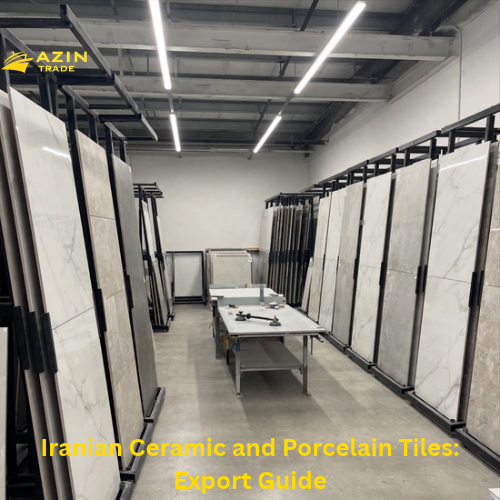
Iranian tile and ceramic carry competitive pricing. Good raw clay and relatively low energy costs make that possible. But final quality still depends on the specific factory. A serious trading company inspects dimensions, grading, water absorption, and glaze consistency before signing any contract. Foreign buyers usually can’t visit the factory in person. So the Iranian side must handle this inspection and share a transparent report.
Step 2: Licenses and the Correct HS Code
Exporting tile and ceramic from Iran requires a valid business card and permits from the Ministry of Industry, Mine and Trade. Getting the right Harmonized System (HS) code matters just as much. Tile and ceramic mostly fall under HS chapter 6907. Floor and wall tiles with low water absorption typically use code 690721. Ceramic flooring blocks fall under code 690490. A wrong code can delay customs clearance. It can also cause incorrect duty calculations at the destination — a detail most articles skip entirely.
Step 3: Packaging and Insurance
Tile and ceramic are fragile goods. Poor packaging causes most shipping damage for this product category. Standard pallets, reinforced cartons, and full cargo insurance form a non-negotiable part of proper export. They’re not optional extras to cut for savings.
Container loading capacity deserves attention too. A 20-foot or 40-foot container holds a specific square-meter amount, depending on tile dimensions. That number directly shapes per-unit shipping cost. A professional trading company should share this calculation upfront. That way, buyers avoid surprises in the final price.
Step 4: Incoterms and Shipping
Shipping terms depend on the agreement between both parties. FOB means delivery at the origin port. CIF means delivery includes freight and insurance to the destination port. First-time buyers often prefer CIF. It shows the final landed cost in advance.
Step 5: Payment and Settlement
This step matters most to international buyers. It’s covered in detail in the FAQ section below, because payment is almost always the number one question a foreign buyer asks.
Quality Standards for Tile and Ceramic Export
Existing content on tile and ceramic export from Iran stays silent on technical standards far too often. Many pages just say “high quality” without explaining how anyone measures it. A few specific benchmarks let buyers actually compare options.
Grading System
Iranian factories inspect and grade tile after firing. They check dimensional consistency, surface flatness, and glaze color uniformity. First grade suits façade and floor projects where visual quality matters most. Second and third grade sell at lower prices for less visually sensitive applications. Buyers should always confirm which grade their order includes. Don’t assume the whole shipment is first grade.
Water Absorption and Abrasion Resistance
Water absorption coefficient determines whether a tile suits indoor use or outdoor façades and flooring. Tiles with very low water absorption, under 0.5%, resist freezing and moisture better. That makes them suitable for colder climates or exterior façades. Abrasion resistance matters for high-traffic commercial flooring. Ask for this spec on the technical sheet.
Certificates of Compliance
Products meeting Iran’s national tile standard, or comparable international standards, usually ship with a matching certificate. Requesting this certificate is standard practice in any professional transaction. No credible supplier should hesitate to provide one.
Best Markets for Iranian Tile and Ceramic Export
Iraq remains the largest market, based on the statistics above. High demand for infrastructure reconstruction, combined with close geography, keeps shipping costs low. Azerbaijan and Armenia rank next. Shared borders and stable trade relations support that position. Pakistan and Turkmenistan also show strong construction demand that local production can’t fully meet. The UAE works as a regional trade hub too, offering a route to redistribute Iranian tile toward more distant markets.
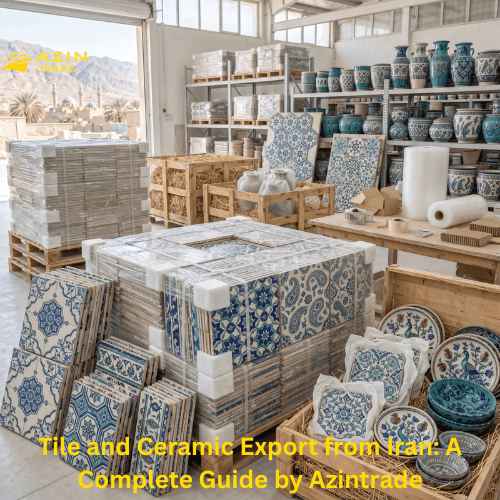
Regional taste in design and color deserves attention when choosing a target market. Northern neighbors like Azerbaijan and Armenia often favor brighter, modern designs. Some Middle Eastern markets lean toward traditional patterns and warmer tones instead. Factories with a wide design range gain a real edge across multiple markets at once. That’s exactly why access to several factories beats dependence on one manufacturer.
Shipping route affects total landed cost more than most first-time buyers expect. Land routes to Iraq, Azerbaijan, Armenia, and Turkmenistan run faster and cheaper than sea freight. That’s one reason these markets stay dominant for Iranian tile, despite competition from Turkish and Chinese producers with bigger marketing budgets. Buyers further away, in Africa or parts of Asia, usually rely on sea freight through southern Iranian ports or re-export through UAE hubs. That route adds a few days but stays practical.
Currency and pricing habits differ by market too. Buyers in Iraq and neighboring markets often negotiate in cash-heavy, relationship-based deals built over years. Buyers further afield tend to expect formal quotations, fixed specifications, and a documented paper trail from the first email. A trading company that can flex between both styles, rather than forcing one process on every buyer, tends to close more deals across a wider range of markets.
FAQ: Tile and Ceramic Export from Iran
Can I still buy tile and ceramic from Iran despite sanctions?
Yes. Tile and ceramic count as non-oil construction materials. Exports of this category to most neighboring and regional countries have continued steadily for years. International restrictions mostly hit banking and currency transfer, not the goods themselves. Agree on the payment method and transfer route clearly with your supplier in advance. Also check your own country’s rules on importing Iranian-origin goods, since these vary widely.
What’s the minimum order quantity for tile and ceramic export?
This number isn’t fixed. It depends on the manufacturing factory and the specific product. Export orders usually get calculated by container, not by carton count. Negotiate directly with a trading company that has access to multiple factories. That approach gives more flexibility on order volume than working with one manufacturer.
How do I verify quality before a bulk order?
Request a physical sample before finalizing the order. Compare its specs, water absorption, abrasion resistance, and exact dimensions, against your own requirements. Treat any trading company that avoids sending samples or sharing a quality control report as a red flag.
What’s the HS code for tile and ceramic?
These products mostly fall under HS chapter 6907. Specific subcodes like 690721 or 690490 apply depending on tile type: floor, wall, low or high water absorption. Determine the exact code based on the finished product’s technical specs.
Who pays for shipping and insurance?
That depends on the agreed Incoterms. Under FOB, the buyer covers these costs. Under CIF, the seller covers freight and insurance to the destination port. Nail this down in writing before signing the contract to avoid disputes later.
How does Iranian tile compare with Turkish or Chinese alternatives?
Good raw clay and lower energy costs let Iranian tile price more competitively than Turkish or Russian equivalents. First-grade quality doesn’t drop noticeably either. The real difference sits in marketing and international branding. Turkish and Chinese manufacturers usually provide clearer catalogs, samples, and technical information online.
How long does delivery take for an export order?
Delivery time depends on order volume, factory-to-port distance, and the final destination. It generally includes production time, packaging, origin customs clearance, and sea or land freight. Ask for a precise schedule once you confirm destination and order volume.
Can I get a product sample before a bulk order?
Yes. Sending a sample before the final order counts as standard practice in tile and ceramic export. Request one before committing to a large-volume purchase.
Does Azintrade export products besides tile and ceramic?
Yes. Azintrade also exports cement, including white cement, clinker, gypsum, and coal. Large construction projects needing several material types can source everything from one supplier, a point raised earlier in this guide.
What language does the sales team use?
International buyers make up the primary export audience, so expect initial communication in English. Arabic support often helps for Middle Eastern markets too. Clarify this with the sales team before negotiations start. That avoids misunderstandings when exchanging documents and technical specs.
Can I get a virtual factory tour before ordering?
Often, yes. Export trading companies can share photo or video reports of the production line and warehouse instead of an in-person visit, which costs foreign buyers time and money. Request this report before making any financial commitment.
Does Azintrade offer after-sales support once the shipment arrives?
A reliable exporter doesn’t disappear after the container leaves the port. Ask upfront how the company handles damaged shipments, missing documentation, or disputes over grading. Get this policy in writing before the first order, not after a problem shows up.
How do I compare prices between different Iranian suppliers?
Always compare like for like. Ask each supplier for the same grade, the same dimensions, and the same Incoterm. A lower quoted price often hides a lower grade or an FOB term that shifts freight cost onto you. Request a full landed-cost breakdown before deciding.
A Critical Look at Content on Tile and Ceramic Export from Iran
Let me speak as a writer and critic here, not just a source of statistics. Existing English-language content on tile and ceramic export from Iran falls into two camps. Short news pieces just republish old statistics. Company pages repeat generic lines like “Iran is the largest exporter in West Asia,” without sourcing the claim or telling the buyer what to do next. Neither answers the real question buyers have: how do I make this purchase with confidence?
Tone causes a second problem, maybe a bigger one. Most content reads either overly formal, like a government circular, or so promotional that no number or source backs it up. Professional buyers, Iranian or foreign, trust content that shows real numbers with sources and an honest account of risk. Praise alone doesn’t build that trust. That’s why this guide points out where the industry genuinely struggles, like oversupply and weak international branding, alongside its strengths.
If I graded this guide myself, I’d highlight its precision on practical steps, the actual tariff code, and technical standards. It also answers real buyer concerns like payment and sanctions directly, something most competitors skip or cover superficially. Its weakness: Azintrade sells multiple products (cement, gypsum, clinker, and tile), so a dedicated, visually rich product page for tile and ceramic is still missing. Adding one would improve the buyer’s experience and signal stronger category specialization to Google. Even a well-written guide like this one can’t fully replace what a strong product page does. A guide persuades a buyer, but the final decision usually comes down to the product page and the portfolio behind it.
One more honest note: no article, however detailed, replaces direct conversation with a real supplier. Numbers and processes explained here give you a framework for asking the right questions. The actual answers, on price, lead time, and available stock, will always depend on the specific factory and the specific week you reach out.
Conclusion: The Future of Tile and Ceramic Export from Iran
Iran’s tile and ceramic export industry has real capacity and real numbers behind it, not just a slogan. Iraq, Azerbaijan, Pakistan, and Turkmenistan show steady, long-standing demand for this product. Most buyers miss clear answers to practical concerns like payment, quality, and delivery time. Azintrade focuses on several construction materials, including tile and ceramic, and that positions the company to fill this transparent, intermediary role. That transparency needs to carry through every stage, from first contact to final delivery. Looking for a supplier who explains this process step by step? Start at azintrade.com.
Sources and data used in this article:
- Official tile and ceramic export statistics, Iran Tile and Ceramic Producers Guild Association (ircps.ir)
- Bilateral trade data between Iran and Azerbaijan, Kazakhstan, and the UAE, based on UN Comtrade, via tradingeconomics.com
- HS code classification reference for tile and ceramic products, searates.com/reference/hs-hts-codes