
Exporting Construction Stone to Kyrgyzstan: A Complete Guide for Buyers, Importers, and Contractors
Exporting Construction Stone to Kyrgyzstan is becoming an increasingly important opportunity for Iranian stone suppliers, trading companies, contractors, and international buyers who are looking for reliable building materials for Central Asia’s growing construction market. Iran has a strong position in natural stone production, especially in travertine, marble, granite, limestone, and onyx. Kyrgyzstan, on the other hand, is a developing construction market with rising demand for durable, decorative, and cost-effective stone products.
But let’s not decorate the truth with cheap optimism. Exporting stone to Kyrgyzstan is not simply about loading a few slabs on a truck and waiting for profit to arrive. The market has potential, yes, but it also has hard realities: long land transportation routes, customs documentation, quality expectations, packaging risks, price-sensitive buyers, currency issues, and competition from other suppliers. Companies that ignore these details usually learn the lesson in the most expensive way possible.
At AzinTrade, we approach Exporting Construction Stone to Kyrgyzstan as a serious commercial operation, not a lucky transaction. This guide explains the market demand, suitable stone types, logistics routes, documentation, pricing, packaging, risks, buyer expectations, and practical strategies for successful stone export from Iran to Kyrgyzstan.
Why Kyrgyzstan Is an Attractive Market for Iranian Construction Stone
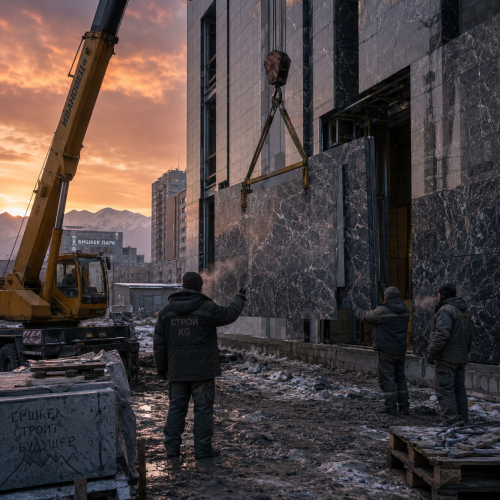
Kyrgyzstan is located in Central Asia and has close commercial connections with neighboring countries such as Kazakhstan, Uzbekistan, Tajikistan, and China. Its construction sector has been growing gradually, especially in urban centers like Bishkek, Osh, Jalal-Abad, and Karakol. Residential buildings, commercial complexes, hotels, villas, government buildings, and public infrastructure projects all create demand for construction materials.
Natural stone is particularly attractive in Kyrgyzstan because it offers durability, visual appeal, and long-term value. In a country where climate conditions can be harsh, cheap and weak materials do not always survive well. This makes quality construction stone a practical choice, not just a luxury finish.
The Role of Urban Development in Stone Demand
The capital city, Bishkek, is the most important construction market in Kyrgyzstan. New apartment buildings, business centers, shopping areas, hotels, restaurants, and private houses are constantly changing the architectural landscape. Many developers and property owners want materials that look prestigious but remain affordable compared to European alternatives.
This is where Iranian stone can compete effectively. Iran has large reserves, competitive production costs, experienced factories, and a wide range of colors and finishes. If handled correctly, Iranian construction stone can offer Kyrgyz buyers a combination of beauty, durability, and reasonable pricing.
Why Iranian Stone Has Export Potential in Kyrgyzstan
Iran is one of the well-known natural stone producers in the region. Iranian stone is already exported to many countries because of several advantages:
- Wide variety of travertine, marble, granite, limestone, and onyx
- Competitive prices compared to many European suppliers
- Strong quarrying and processing capacity
- Suitable colors for modern and classical architecture
- Ability to supply both slabs and cut-to-size products
- Experience in regional land transportation
- Geographic accessibility to Central Asian markets
However, having good stone is not enough. The market does not reward suppliers just because they exist. Kyrgyz buyers need consistency, proper packaging, clear documentation, and dependable communication. A supplier who fails in these areas will lose trust quickly.
Understanding the Kyrgyzstan Construction Stone Market
Before Exporting Construction Stone to Kyrgyzstan, exporters must understand how the local market actually behaves. Many sellers make the mistake of assuming all foreign markets want the same products. That is lazy thinking, and lazy thinking burns money.
Kyrgyzstan’s stone demand is influenced by climate, purchasing power, construction style, import regulations, and competition. Buyers are usually careful with price, but they also understand that extremely cheap stone often creates problems during installation and long-term use.
Main Buyers of Construction Stone in Kyrgyzstan
The main customer groups for imported construction stone include:
- Construction companies
- Real estate developers
- Stone distributors and wholesalers
- Interior designers and architects
- Hotel and commercial project owners
- Private villa owners
- Government and municipal projects
- Contractors working on facades, flooring, stairs, and landscaping
Each buyer group has different priorities. Developers usually focus on price, delivery time, and consistency. Architects care more about color, texture, finish, and design compatibility. Contractors care about accurate sizing, easy installation, and low breakage. Distributors care about marketability and profit margin.
A serious exporter should not sell the same way to all of them. That is amateur behavior disguised as confidence.
What Kyrgyz Buyers Usually Look For
Kyrgyz buyers generally look for stone products that offer:
- Competitive pricing
- Stable quality across the full shipment
- Resistance to cold weather and freeze-thaw cycles
- Attractive appearance for facades and interiors
- Accurate cutting and finishing
- Low breakage during transportation
- Reliable supply for repeated orders
- Clear packing lists and documentation
- Flexible order quantities
- Honest communication about lead time
The word “honest” matters. Many deals fail not because the product is bad, but because the supplier promises what they cannot deliver. In international trade, exaggeration is not marketing; it is a future dispute.
Best Types of Iranian Construction Stone for Export to Kyrgyzstan
Iran produces many types of natural stone, but not all of them are equally suitable for Kyrgyzstan. The right stone depends on the project type, budget, climate exposure, installation location, and buyer preference.
Travertine for Facades and Exterior Walls
Travertine is one of the most popular Iranian stones for export. It is especially suitable for building facades, exterior walls, and decorative cladding. Iranian travertine is known for its warm colors, natural texture, and good workability.
For Kyrgyzstan, travertine can be a strong option because many buildings require exterior materials with a natural and elegant appearance. Beige, cream, white, silver, and walnut travertine are commonly preferred for residential and commercial facades.
Advantages of Travertine for Kyrgyzstan
Travertine offers several advantages:
- Attractive natural appearance
- Good insulation properties
- Suitable for exterior facades
- Available in many colors and patterns
- Easier to cut and process than harder stones
- Competitive price compared to some imported alternatives
- Strong demand in modern and classical architecture
However, exporters must pay attention to stone density, porosity, filling quality, and surface finishing. Poorly filled travertine can absorb water and suffer damage in cold climates. Again, nature is not sentimental. If water enters weak stone and freezes, the result is cracking, complaints, and unpaid invoices.
Marble for Interior Flooring and Luxury Projects
Iranian marble is another strong candidate for Exporting Construction Stone to Kyrgyzstan. Marble is often used in interior flooring, wall cladding, stairs, lobbies, hotels, offices, and luxury residential projects.
Kyrgyz buyers may be interested in marble because it creates a premium look at a price that can be more accessible than European marble. White, cream, beige, gray, and patterned marbles are suitable for many interior design styles.
Where Marble Works Best
Marble is commonly used for:
- Hotel lobbies
- Apartment entrance halls
- Interior floors
- Staircases
- Decorative walls
- Bathroom walls and floors
- Office buildings
- Luxury villas
- Commercial interiors
Marble should be exported with proper finishing and accurate calibration. If thickness varies or polishing is inconsistent, installation problems will appear quickly. Installers do not forgive factory mistakes; they simply blame the supplier, and usually they are right.
Granite for Stairs, Flooring, and High-Traffic Areas
Granite is one of the most durable natural stones and is suitable for heavy-use areas. In Kyrgyzstan, granite can be used for stairs, flooring, sidewalks, public buildings, exterior paving, and commercial projects.
Because Kyrgyzstan experiences cold winters, granite’s strength and low water absorption make it a practical choice. It is especially useful where durability matters more than decorative softness.
Benefits of Granite in Kyrgyz Construction Projects
Granite offers:
- High compressive strength
- Low water absorption
- Resistance to abrasion
- Strong performance in cold climates
- Long service life
- Suitable for public and commercial use
- Good resistance to heavy foot traffic
The downside is weight and transportation cost. Granite is heavy, and freight costs can make or break the deal. Exporters must calculate the final landed price carefully, not just the factory price. Many traders make beautiful quotations that collapse the moment logistics are added.
Limestone for Cost-Effective Construction Uses
Limestone can be useful for certain interior and decorative applications, especially when buyers need a softer appearance and lower cost. However, limestone must be selected carefully for Kyrgyzstan because not all limestone is suitable for harsh outdoor conditions.
It may work better for interior cladding, decorative walls, and controlled environments rather than exposed exterior surfaces.
Onyx for Premium Decorative Projects
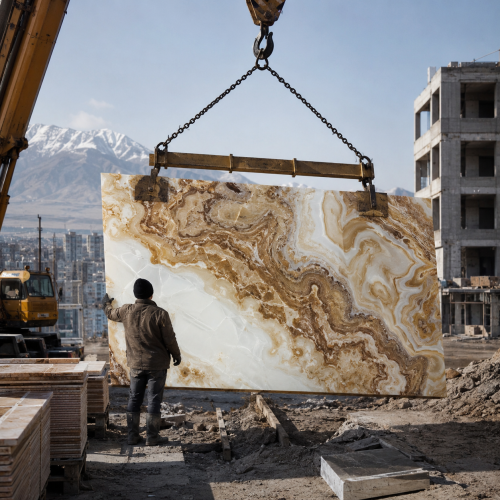
Iranian onyx is a high-value stone used in luxury design. It is not a mass-market product, but it can be attractive for hotels, restaurants, villas, showrooms, and special architectural projects in Kyrgyzstan.
Onyx can be used for:
- Backlit walls
- Reception desks
- Decorative panels
- Luxury bathrooms
- Feature walls
- High-end interior design
Because onyx is expensive and fragile, packaging and handling must be extremely careful. Selling onyx like ordinary stone is a good way to lose both product and reputation.
Key Applications of Construction Stone in Kyrgyzstan
The use of imported stone in Kyrgyzstan depends heavily on project type. Understanding applications helps exporters prepare the right product mix and marketing message.
Building Facades
Facades are one of the most important uses of Iranian travertine and limestone. Developers want exterior surfaces that look modern, respectable, and durable. Travertine is especially attractive because it offers a natural appearance and a broad range of colors.
For facade projects, exporters should provide:
- Consistent color sorting
- Proper thickness
- Suitable surface finish
- Accurate dimensions
- Strong packaging
- Technical support for installation recommendations
Interior Flooring
Marble, granite, and some limestones are used in interior floors. Buyers usually care about polish quality, color matching, thickness tolerance, and surface smoothness.
For flooring, inconsistent thickness is a serious problem. It creates installation delays, uneven surfaces, and extra labor costs. Nobody wants to pay for the exporter’s poor quality control.
Stairs and Staircases
Granite and marble are commonly used for stairs. Stairs require strong, precisely cut stone because they experience constant pressure and foot traffic.
Important requirements include:
- Anti-slip finishing when needed
- Accurate edge processing
- Consistent thickness
- High strength
- Durable polishing
- Proper packing to protect edges
Wall Cladding
Interior and exterior wall cladding can use travertine, marble, limestone, and onyx. Decorative wall cladding is becoming more popular in commercial spaces and private properties.
Landscaping and Outdoor Paving
Granite and selected durable stones can be used for landscaping, courtyards, walkways, and outdoor paving. For these applications, frost resistance and abrasion resistance are critical.
Logistics of Exporting Construction Stone from Iran to Kyrgyzstan
Logistics is where many export dreams go to die. The product may be excellent, the buyer may be serious, and the price may be attractive. But if transportation is poorly managed, the entire deal becomes a slow-moving disaster.
Main Transportation Methods
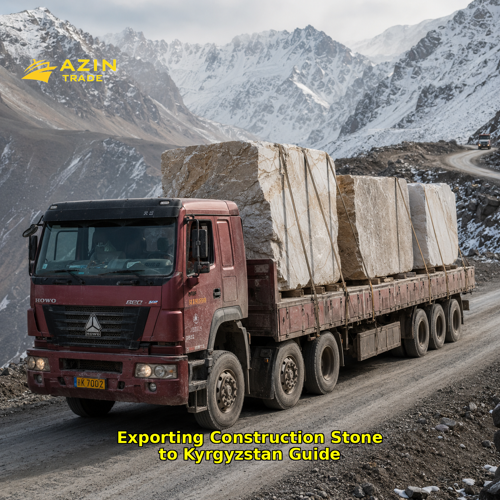
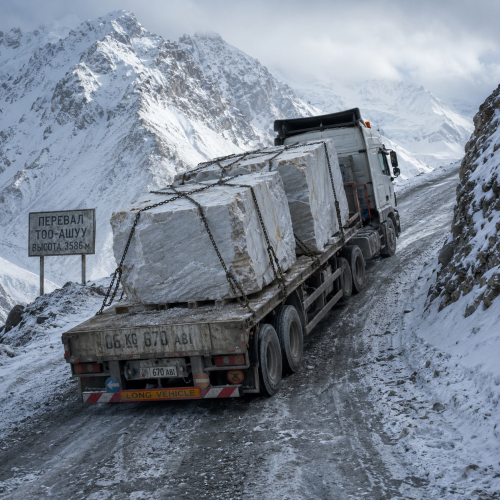
Construction stone can be exported from Iran to Kyrgyzstan mainly by land transportation. Depending on shipment size, budget, and delivery timeline, exporters may use truck transport, rail transport, or multimodal transport.
Road Transportation
Road transportation is commonly used because it offers flexibility and direct delivery. Trucks can carry slabs, tiles, cut-to-size products, and packaged stone to warehouses or project sites.
Advantages of Road Transport
- More flexible delivery
- Suitable for medium-size orders
- Direct shipment to buyer location
- Easier tracking compared to some rail routes
- Faster for urgent orders
Disadvantages of Road Transport
- Higher cost for heavy cargo
- Border delays
- Fuel price fluctuations
- Risk of road damage
- Dependence on driver reliability
- Possible transit complications
Rail Transportation
Rail can be useful for larger volumes, especially heavy stone cargo. It may reduce cost per ton in some cases, but it can also involve longer transit times and more complex handling.
Advantages of Rail Transport
- Suitable for bulk shipments
- Potentially lower cost for large volumes
- Better for heavy cargo
- Less affected by road restrictions
Disadvantages of Rail Transport
- Less flexible
- Longer transit time
- More handling points
- Higher risk of delay in terminals
- More complicated coordination
Common Transit Routes
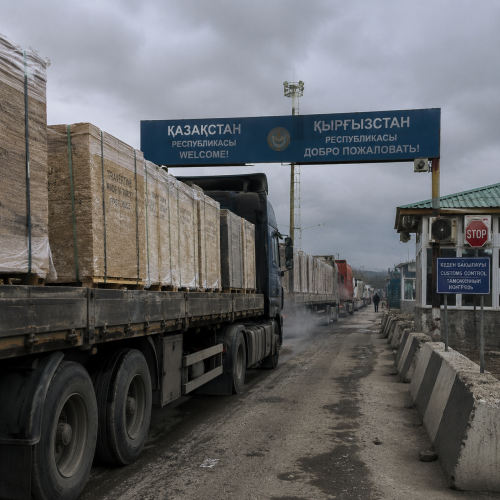
The route from Iran to Kyrgyzstan often involves crossing through Central Asian countries. Depending on commercial conditions and available corridors, shipments may pass through countries such as Turkmenistan, Uzbekistan, or Kazakhstan before reaching Kyrgyzstan.
Exporters must confirm the most practical route before each shipment because border conditions, transit rules, fuel prices, and regional transport capacity can change. Pretending routes are always stable is how inexperienced traders get trapped.
Packaging Standards for Stone Export to Kyrgyzstan
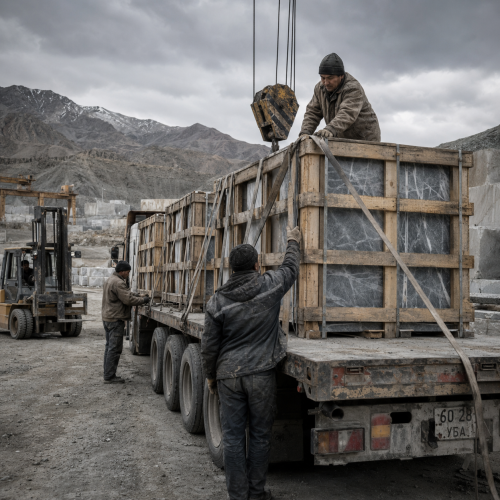
Stone is heavy, fragile at edges, and unforgiving during transport. Packaging is not a formality; it is insurance against stupidity. If the packaging fails, the buyer will not care how beautiful the stone looked in your factory.
Why Packaging Matters
Long-distance land transportation exposes stone to vibration, impact, pressure, moisture, and repeated handling. Poor packaging can cause:
- Broken slabs
- Chipped edges
- Surface scratches
- Cracked tiles
- Moisture stains
- Collapsed pallets
- Customer complaints
- Insurance disputes
- Loss of repeat orders
Recommended Packaging Methods
For Exporting Construction Stone to Kyrgyzstan, exporters should use strong and export-grade packaging.
Wooden Crates
Wooden crates are suitable for tiles, cut-to-size stone, and smaller pieces. They must be strong enough to handle weight and movement.
A-Frame Packaging
A-frame structures are commonly used for slabs because they keep stone upright and reduce pressure damage. This is especially important for marble, travertine, and onyx slabs.
Reinforced Pallets
Heavy-duty pallets should be used for tile shipments and cut-to-size orders. Weak pallets are a false economy. They save a small amount at the factory and create large losses during unloading.
Edge Protection
Edges are the most vulnerable part of stone products. Foam, plastic corners, cardboard, or rubber protection can reduce chipping.
Moisture Protection
Depending on the stone type, moisture protection may be necessary. Some stones can stain or absorb humidity during transit.
Required Documents for Exporting Construction Stone to Kyrgyzstan
Documentation is not exciting, but it is where shipments either move or rot at customs. A missing document can cost more than a damaged pallet.
Commercial Invoice
The commercial invoice must include buyer and seller details, product description, quantity, unit price, total value, currency, delivery terms, and payment terms.
Packing List
The packing list should clearly show:
- Number of crates or pallets
- Net weight
- Gross weight
- Dimensions
- Product type
- Quantity per package
- Marking numbers
Certificate of Origin
A certificate of origin confirms that the stone is produced in Iran. It may be required for customs clearance and duty calculation.
Bill of Lading or CMR
For road transport, CMR documentation is usually used. For rail or multimodal shipping, other transport documents may apply.
Customs Declaration
Export customs declaration is required on the Iranian side, and import declaration is needed in Kyrgyzstan.
Technical Documents
Depending on buyer and project requirements, exporters may provide:
- Test reports
- Water absorption data
- Compressive strength results
- Abrasion resistance information
- Stone specifications
- Product photos
- Quality certificates
Phytosanitary Certificate for Wooden Packaging
If wooden packaging is used, some destinations may require treatment certification to prevent pest transfer. Exporters should verify current requirements before shipment.
Customs and Import Considerations in Kyrgyzstan
Kyrgyzstan is a member of the Eurasian Economic Union, which affects customs procedures, import standards, and trade regulations. Importers should check tariff codes, duties, VAT, and applicable requirements before confirming an order.
HS Codes for Construction Stone
Natural stone products may fall under different HS codes depending on whether they are blocks, slabs, tiles, or finished products. Incorrect HS code classification can create customs issues, unexpected duties, and delays.
Common stone-related categories may include:
- Marble and travertine
- Granite
- Worked monumental or building stone
- Tiles and slabs
- Limestone and other calcareous stones
AzinTrade recommends verifying HS codes for each shipment before issuing final documents.
Import Duties and Taxes
Import costs can include customs duties, VAT, customs service fees, transit charges, and local clearance expenses. The buyer and seller must clearly agree who pays which cost under the selected Incoterms.
Incoterms for Exporting Stone to Kyrgyzstan
Incoterms define responsibilities between buyer and seller. If you ignore them, you are basically inviting conflict.
EXW – Ex Works
Under EXW, the buyer takes responsibility from the seller’s premises. This is simple for the seller but less attractive for buyers who want full logistics support.
FCA – Free Carrier
FCA can be practical when the seller delivers the goods to a named carrier or terminal. It gives more structure than EXW.
CPT – Carriage Paid To
Under CPT, the seller pays freight to a named destination, but risk transfers earlier. This must be explained clearly to the buyer.
DAP – Delivered at Place
DAP is attractive to buyers because the seller handles transport to the destination. However, it increases responsibility and risk for the exporter. Pricing must include realistic transport and transit costs.
Pricing Strategy for the Kyrgyzstan Market
Pricing is not just a number. It is a battlefield. Buyers want a low price, competitors want your customer, transport companies want their margin, and customs costs are waiting quietly in the background.
Factors Affecting Stone Export Price
The final price depends on:
- Stone type
- Grade and quality
- Thickness
- Size and finish
- Quantity
- Packaging type
- Loading method
- Transportation cost
- Insurance
- Customs and transit fees
- Currency exchange rate
- Payment method
- Delivery terms
Factory Price vs. Landed Cost
Many inexperienced exporters quote only the factory price and then wonder why the buyer disappears. Serious buyers care about landed cost — the total cost of receiving the product at their warehouse or project site.
Landed cost may include:
- Product price
- Packaging
- Inland transport in Iran
- Export customs costs
- International freight
- Transit costs
- Insurance
- Import clearance
- Duties and taxes
- Local delivery in Kyrgyzstan
Competing with Turkey, China, and Local Suppliers
Iranian stone exporters may face competition from Turkish, Chinese, and regional suppliers. Competing only on price is dangerous. There will always be someone willing to sell cheaper, especially if they are also willing to reduce quality.
A better strategy is to compete on:
- Product consistency
- Reliable communication
- Better packaging
- Faster response time
- Transparent documentation
- Flexible order preparation
- Technical support
- Repeat supply capability
Quality Control Before Shipment
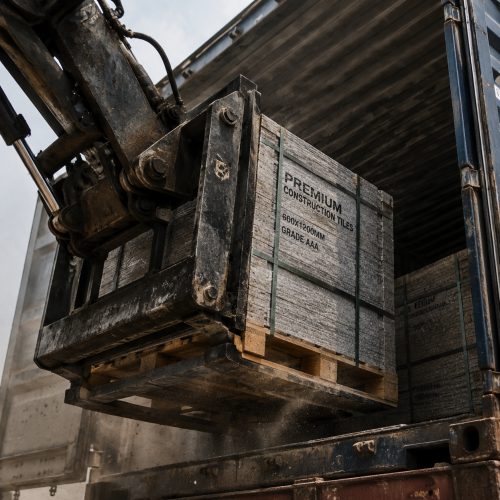
Quality control is not something you do after the buyer complains. It must happen before packaging.
Key Quality Checks
Before shipping, exporters should check:
- Color consistency
- Surface finish
- Thickness tolerance
- Cutting accuracy
- Edge condition
- Cracks and repairs
- Filling quality in travertine
- Polishing quality
- Quantity and labeling
- Packaging strength
Pre-Shipment Photos and Videos
Sending photos and videos before shipment helps reduce disputes. It also shows professionalism. But do not manipulate images. Buyers are not fools, even if sellers sometimes treat them that way.
Recommended visual records include:
- Slab photos
- Close-up surface images
- Thickness measurement
- Packaging process
- Final loaded cargo
- Truck/container seal if applicable
Payment Methods and Risk Reduction
Payment risk is one of the ugliest parts of international trade. Everyone smiles during negotiation. The truth appears when money is due.
Common Payment Options
Payment methods may include:
- Advance payment
- Partial advance and balance before shipment
- Letter of credit
- Escrow arrangement
- Bank transfer
- Payment against documents
Recommended Payment Structure
For new buyers, a safer structure is usually:
- Advance deposit before production or reservation
- Balance payment before loading or before document release
- Clear written agreement on quality, quantity, delivery terms, and claims
Exporters should avoid shipping full cargo on weak promises. Hope is not a payment method.
Common Mistakes in Exporting Construction Stone to Kyrgyzstan
Many exporters fail not because the market is impossible, but because they repeat predictable mistakes.
Mistake 1: Selling Low-Grade Stone as Premium
This may work once. It will not create a business. Kyrgyz buyers talk to each other, especially distributors and contractors. A damaged reputation travels faster than cargo.
Mistake 2: Weak Packaging
Saving money on packaging is one of the dumbest ways to increase risk. Broken stone destroys profit and trust.
Mistake 3: Poor Documentation
Wrong invoices, unclear packing lists, missing certificates, and HS code mistakes can delay clearance and increase costs.
Mistake 4: Unrealistic Delivery Promises
Do not promise delivery dates you cannot control. Borders, weather, customs, and transport availability can cause delays.
Mistake 5: Ignoring Climate Suitability
Not every beautiful stone is suitable for exterior use in Kyrgyzstan. Climate should guide product selection.
Mistake 6: No After-Sales Communication
After shipment, many sellers disappear. That is short-term thinking. Serious exporters stay available until the buyer receives and checks the cargo.
How AzinTrade Supports Construction Stone Export to Kyrgyzstan
AzinTrade helps buyers and partners manage the process of Exporting Construction Stone to Kyrgyzstan with a practical and transparent approach. Instead of making unrealistic promises, AzinTrade focuses on product selection, supplier coordination, quality control, export documentation, packaging supervision, and logistics planning.
Product Sourcing
AzinTrade can help identify suitable Iranian stone based on project requirements, including color, thickness, finish, quantity, budget, and application.
Quality Coordination
Before shipment, quality checks can help reduce the risk of mismatch, breakage, and buyer dissatisfaction.
Export Documentation Support
Correct documentation supports smoother customs clearance and reduces avoidable delays.
Logistics Planning
AzinTrade can coordinate with transport providers to find practical routes and shipping methods from Iran to Kyrgyzstan.
Communication with Buyers
Clear communication is essential. Buyers need updates, not excuses. AzinTrade understands that silence during shipment creates suspicion, and suspicion kills business relationships.
FAQ About Exporting Construction Stone to Kyrgyzstan
What is the best Iranian stone for export to Kyrgyzstan?
Travertine, marble, and granite are among the best options. Travertine is popular for facades, marble is suitable for interiors, and granite is strong for stairs, flooring, and high-traffic areas.
Is Iranian travertine suitable for Kyrgyzstan’s climate?
Yes, selected Iranian travertine can be suitable, especially for facades. However, density, filling quality, water absorption, and surface finishing must be checked carefully.
How is construction stone shipped from Iran to Kyrgyzstan?
Most shipments are transported by road, rail, or multimodal routes through Central Asian transit corridors. The best method depends on volume, budget, destination, and delivery timeline.
What documents are needed for exporting stone to Kyrgyzstan?
Common documents include commercial invoice, packing list, certificate of origin, transport documents, customs declaration, and sometimes technical certificates or test reports.
What are the main risks in exporting stone to Kyrgyzstan?
The main risks include breakage during transport, customs delays, poor documentation, payment issues, quality disputes, and unrealistic pricing.
Can AzinTrade supply cut-to-size stone for Kyrgyzstan projects?
Yes, cut-to-size stone can be supplied based on project drawings and technical specifications, provided that measurements, tolerances, finish type, and packaging requirements are confirmed in advance.
Which cities in Kyrgyzstan have demand for construction stone?
Bishkek is the main market, but Osh, Jalal-Abad, Karakol, and other developing urban areas may also have demand for construction stone.
How can buyers reduce risk when importing stone from Iran?
Buyers should request product photos, technical details, clear quotations, packaging information, shipment updates, and proper documents before confirming an order.
Final Thoughts on Exporting Construction Stone to Kyrgyzstan
Exporting Construction Stone to Kyrgyzstan is a promising opportunity for Iranian suppliers, but only for those who treat it seriously. The market rewards consistency, quality, correct documentation, and reliable logistics. It punishes carelessness, weak packaging, false promises, and poor communication.
Iranian stone has strong potential in Kyrgyzstan because it offers variety, beauty, durability, and competitive pricing. Travertine, marble, granite, limestone, and onyx can all find their place in different construction and interior design projects. But the exporter must understand the buyer’s needs, climate conditions, customs process, and total landed cost.
At AzinTrade, we believe successful trade is not built on slogans. It is built on details, discipline, and realistic execution. If you are looking for a reliable partner for construction stone sourcing, export coordination, and trade support between Iran and Kyrgyzstan, AzinTrade is ready to help.
Contact AzinTrade today to discuss construction stone export opportunities, product availability, pricing, and logistics solutions for Kyrgyzstan.
Start Working with azintrade Today
If you are tired of unreliable suppliers, inconsistent quality, and unexpected delivery problems, it’s time to upgrade.
Start your next shipment with azintrade —
the supplier that values your business, your deadlines, and your success.
Contact azintrade now and build a strong, stable, and profitable supply chain for ceramic and porcelain tiles in Azerbaijan.
✅ For expert consultation and product orders, click here.