
What Is Clinker?
clinker is An Ultra‑Long, High‑Clarity, Deep‑Technical, and Professionally Structured Guide (Extended 2026 Edition)**
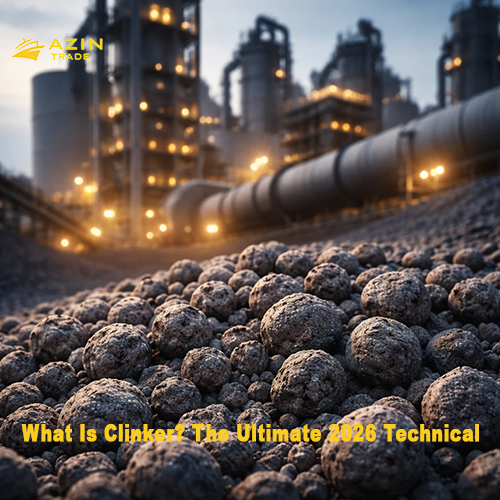
Clinker is the grey nodular material produced during the high‑temperature transformation of raw minerals inside a rotary cement kiln.
But if you think that definition explains anything, you’re underestimating how complicated — and unforgiving — clinker really is.
This guide will explain clinker the way it deserves:
honest, technical, complete, and without the usual industrial sugar‑coating.
Table of Contents
- Introduction: Why Clinker Actually Matters
- True Definition of Clinker
- Historical Evolution of Clinker Production
- Fundamental Chemistry of Clinker
- The Four Major Mineral Phases
- Secondary and Minor Phases
- Oxide Composition and Its Industrial Consequences
- Raw Materials: Sources, Variability, and Industrial Control
- The Critical Role of Chemical Modules (LSF, SM, AM)
- Raw Meal Preparation and Homogenization
- Preheater Operation and Heat Exchange
- Precalciner Chemistry and Fuel Behavior
- Rotary Kiln: Design, Zones, and Operating Principles
- Thermochemical Transformations (Temperature Step-by-Step)
- Sintering and Liquid Phase Formation
- Clinker Cooler: Principles, Designs, and Efficiency
- Clinker Microstructure: Growth, Morphology, and Crystallization
- Types of Clinker (With Real Industrial Meaning)
- Clinker Storage, Handling, and Aging
- Clinker Quality Indicators
- Analytical Techniques: XRF, XRD, SEM, Microscopy
- Combustion Systems and Flame Engineering
- Kiln Modeling and Simulation
- Common Operational Problems (Ring, Snowman, Red Spot…)
- Coating Behavior and Stability
- Alkali, Sulfur, Chloride Cycles
- Energy Consumption and Optimization Opportunities
- Alternative Fuels and Their Impact on Clinker
- Environmental Footprint (CO₂, NOx, SOx, Dust)
- Global Economic Factors Influencing Clinker
- Comparison Tables (Clinker vs Cement and More)
- Frequently Asked Questions
- Final Thoughts — Unfiltered and Realistic
1. Introduction: Why Clinker Actually Matters
Clinker is the core product of the cement industry:
95% of everything we call “cement” originates from these stubborn grey nodules.
Yet clinker is:
- expensive
- energy‑intensive
- chemically unstable
- difficult to control
- environmentally problematic
- operationally sensitive
Factories may pretend it’s a simple material, but every engineer knows the truth:
Clinker is where budgets break, where emissions rise, and where engineering skill actually matters.
2. True Definition of Clinker
Clinker consists of 3–25 mm hard nodules formed when finely ground raw meal is heated to ~1450°C in a rotary kiln. During this process, the materials undergo:
- drying
- calcination
- solid‑state reactions
- melting
- recrystallization
Clinker is not “just heated limestone.”
It is a precisely engineered, high‑temperature ceramic product.
3. Historical Evolution of Clinker Production
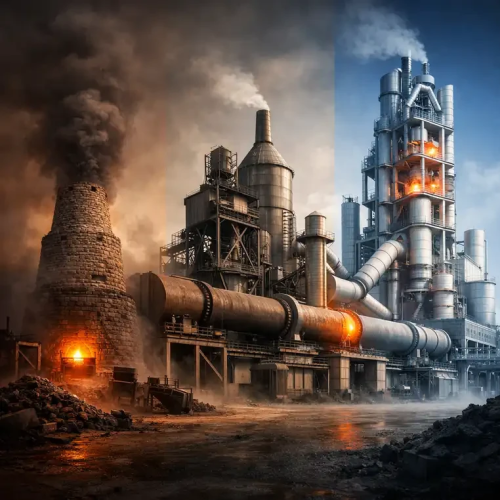
Early kilns were simple vertical shafts.
Modern plants use:
- multi‑stage preheaters
- precalciners
- long dry kilns
- high‑efficiency coolers
- advanced combustion systems
The complexity increased, but the industry still pretends it’s straightforward.
4. Fundamental Chemistry of Clinker
Clinker chemistry revolves around four major oxides:
- CaO (calcium oxide)
- SiO₂ (silica)
- Al₂O₃ (alumina)
- Fe₂O₃ (iron oxide)
These combine to create:
- silicates
- aluminates
- ferrites
Everything else (alkalis, MgO, SO₃, Cl, trace metals) influences stability, melt behavior, or emission problems.
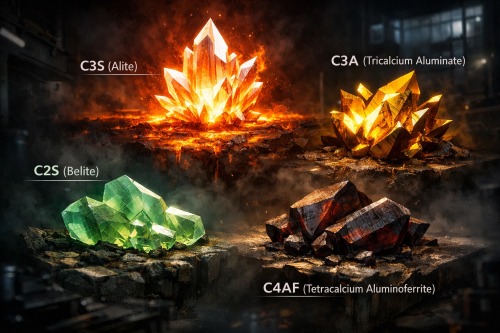
5. The Four Major Mineral Phases
C₃S — Alite
The high‑temperature phase responsible for early strength.
Forms at >1250°C and requires a liquid phase.
C₂S — Belite
Forms earlier at lower temperatures.
Slower reacting, contributes to long‑term strength.
C₃A — Tricalcium Aluminate
Fast, aggressive, and problematic.
Essential for cement behavior but hated by engineers.
C₄AF — Tetracalcium Aluminoferrite
Industrial stabilizer.
Does not influence cement strength much but affects melt viscosity.
6. Secondary and Minor Phases
These often reveal hidden problems:
- Periclase (MgO) → may cause expansion
- Free Lime (CaO) → underburning indicator
- Anhydrite/Sulfates → affects set time
7. Oxide Composition and Industrial Consequences
Small deviations cause large problems:
- Too much CaO → free lime, poor stability
- Too much SiO₂ → reduced burnability
- High Al₂O₃ → unstable melt
- High Fe₂O₃ → lower melt temperature but dark color
8. Raw Materials: Sources, Variability, Control
Limestone variability ruins raw mix stability.
Clay minerals behave unpredictably.
Iron sources disturb melt saturation.
Corrective materials fix one problem but create two more.
9. Chemical Modules (LSF, SM, AM)
These govern everything.
LSF: 92–98 ideal
SM: 2.0–3.0
AM: 1.0–2.5
Push any of them too far → kiln instability.
10. Raw Meal Preparation and Homogenization
Fineness influences burnability.
Homogenization affects phase formation.
Any fluctuation in raw meal chemistry shows up violently in the kiln.
11. Preheater Operation and Heat Exchange
Cyclone efficiency determines:
- fuel consumption
- calcination rate
- dust load
- pressure drop
12. Precalciner Chemistry
Up to 70% of calcination occurs here.
Alternative fuels complicate combustion.
NOx formation increases.
13. Rotary Kiln: Zones, Heat Transfer, Operation
Zones:
- Drying
- Preheating
- Calcination
- Transition
- Burning Zone
- Early Cooling
Everything depends on:
- flame shape
- burner design
- rotation speed
- feed rate
14. Thermochemical Transformation (Step-by-Step)
100–400°C: evaporation
700–900°C: calcination
900–1200°C: belite formation
1250–1450°C: alite formation (liquid phase)
Cooling: crystallization
15. Sintering and Liquid Phase
Too little liquid → poor clinker
Too much → rings, snowmen, unstable coating
16. Clinker Cooler: Principles and Efficiency
Types:
- grate coolers
- reciprocating coolers
- planetary coolers
Cooling affects:
- C₃S stability
- grindability
- thermal efficiency
17. Clinker Microstructure
SEM reveals:
- crystal size
- cracks
- porosity
- growth defects
Healthy clinker has well‑formed alite and compact belite.
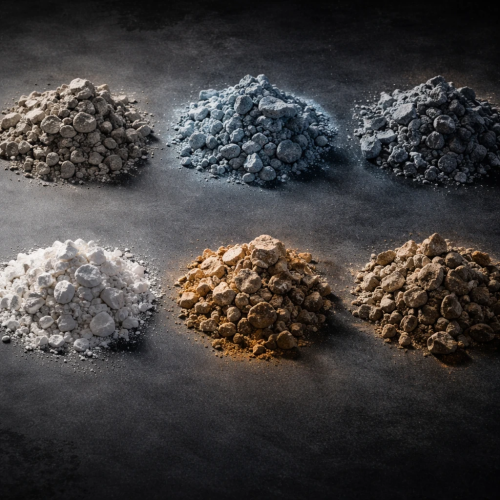
18. Types of Clinker
- OPC
- low‑heat
- sulfate‑resistant
- white clinker
- high‑early‑strength
- alternative fuel clinker
19. Clinker Storage and Aging
Moisture is the enemy.
Aged clinker grinds poorly and loses reactivity.
20. Clinker Quality Indicators
- free lime
- liquid phase
- microscopy textures
- nodulization
- cooling curve
- XRD phase quantification
21. Analytical Techniques
XRF: oxide composition
XRD: mineral phases
SEM: microstructure
Microscopy: defects, maturation
22. Combustion Systems and Flame Engineering
Flame temperature and shape define the entire burn.
Poor flame → poor clinker.
23. Kiln Modeling
CFD modeling provides:
- gas flow
- heat transfer
- flame simulation
Digital twins are becoming standard.
24. Common Operational Problems
- rings
- snowmen
- red spots
- dust cycles
- coating collapse
Every plant faces them—even if they deny it.
25. Coating Behavior
Healthy coating protects refractory.
Overcoating or undercoating = trouble.
26. Volatile Cycles
Cl, S, K, Na create cycles that destabilize everything.
27. Energy Consumption
Clinker production consumes 3,200–3,800 MJ/ton.
Optimization saves millions annually.
28. Alternative Fuels
Impact on:
- chemistry
- flame
- emissions
- residues
Often marketed as green, rarely that simple.
29. Environmental Impact
Clinker = 8% of global CO₂ emissions
Plus NOx, SOx, dust, and heavy metals.
30. Global Economics
Pricing depends on:
- fuel cost
- electricity
- transport
- export regulations
31. Comparison Table: Clinker vs Cement
| Feature | Clinker | Cement |
|---|---|---|
| Form | Nodules | Powder |
| Temperature | 1450°C | <150°C |
| Composition | Four phases | Clinker + gypsum |
| Reactivity | Low | High |
32. FAQ
Is clinker the same as cement?
No. Cement = Clinker + Gypsum.
Can clinker absorb moisture?
Yes — and it ruins grindability.
Is high C₃S always good?
No. It increases energy cost and instability.
33. Final Thoughts
Clinker is complicated.
Expensive.
Chemically unstable.
Operation‑dependent.
Factories that treat clinker as “simple” always suffer.
Factories that respect it — thrive.