
Iran Gypsum Stone Export: Price, HS Code & Shipping 2026
Iran Gypsum Stone Export is an important sourcing option for international buyers looking for natural gypsum for cement, plaster, construction, agriculture, and other industrial applications. Iran has significant gypsum resources, established mining capacity, and access to major shipping routes through the Persian Gulf.
However, purchasing gypsum stone from Iran is not simply a matter of finding the lowest price per ton. International buyers should also consider gypsum purity, chemical composition, particle size, moisture, packaging, shipping costs, documentation, and supplier reliability.
This comprehensive Iran Gypsum Stone Export guide explains what buyers should know before purchasing Iranian gypsum stone. It covers quality specifications, HS codes, prices, shipping options, export documentation, major markets, and supplier verification.
What Is Gypsum Stone in Iran?
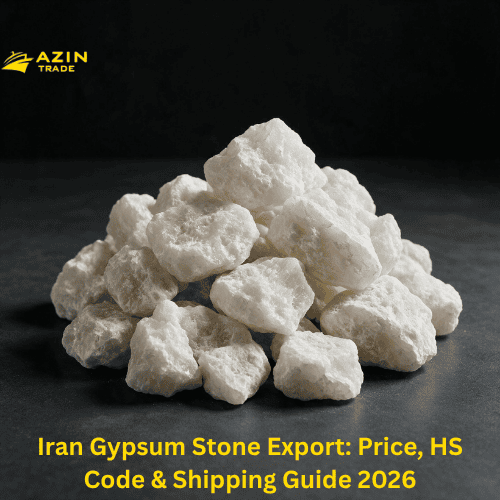
Gypsum stone, also called raw gypsum or gypsum rock, is a naturally occurring mineral extracted from gypsum deposits.
Its primary chemical composition is calcium sulfate dihydrate:
CaSO₄·2H₂O
Natural gypsum is widely used in several industries, including:
- Cement manufacturing
- Plaster production
- Gypsum board manufacturing
- Construction materials
- Agriculture
- Industrial applications
For international buyers, understanding the difference between raw gypsum and processed gypsum is essential.
Raw gypsum is normally extracted from the mine and then crushed, screened, and sized. By contrast, calcined gypsum is produced by heating natural gypsum and removing part of its chemically combined water.
Therefore, buyers should clearly define whether they require raw gypsum stone, ground gypsum, or calcined gypsum before requesting an export quotation.
Iran Gypsum Stone Export: Why Is Iranian Gypsum Important?
Iran is one of the significant gypsum-producing countries in the region.
According to the U.S. Geological Survey Mineral Commodity Summaries 2026, Iran’s gypsum production was estimated at approximately 16 million metric tons in 2025. Global gypsum production was estimated at approximately 160 million metric tons during the same year.
This production capacity gives international buyers access to a substantial raw material market.
Furthermore, Iran’s geographical position provides access to the Persian Gulf and important maritime trade routes.
As a result, Iranian gypsum can be considered for markets such as:
- India
- UAE
- Oman
- Kuwait
- Qatar
- Iraq
- Pakistan
- China
- Southeast Asia
Nevertheless, production volume alone does not guarantee product suitability.
Different mines can produce gypsum with different chemical and physical characteristics. Consequently, buyers should request a current Certificate of Analysis before approving a large shipment.
Benefits of Iran Gypsum Stone Export for International Buyers
Iranian gypsum offers several potential advantages for international buyers.
Large Gypsum Resources in Iran
Iran has extensive gypsum deposits and a well-established mining industry.
Consequently, international buyers can evaluate multiple potential sources when they need substantial industrial volumes.
Competitive Regional Logistics
Iran’s access to southern ports can provide potential logistics advantages for buyers in the Persian Gulf, South Asia, and nearby Asian markets.
Of course, actual freight costs depend on the destination, vessel availability, fuel prices, port charges, and shipment size.
Different Gypsum Grades
Iranian suppliers can provide gypsum with different chemical compositions and particle sizes.
Therefore, buyers can select material according to their intended application rather than purchasing a single standardized product.
Bulk Export Opportunities
For large industrial buyers, Iran Gypsum Stone Export can be arranged through bulk or containerized shipments, depending on the destination and logistics requirements.
Moreover, the appropriate shipping method should be selected according to the complete delivered cost rather than the product price alone.
Iran Gypsum Stone Quality Specifications
Quality is one of the most important factors in gypsum trading.
Many suppliers advertise their products using a single number, such as “95% high-purity gypsum.”
However, purity alone does not determine whether gypsum is suitable for a particular factory.
Instead, buyers should review the complete technical specification before approving a shipment.
Important parameters can include:
| Parameter | Importance |
|---|---|
| CaSO₄·2H₂O | Indicates gypsum content |
| SO₃ | Important for cement applications |
| CaO | Helps determine chemical composition |
| SiO₂ | Indicates siliceous impurities |
| MgO | Relevant to mineral composition |
| Fe₂O₃ | Can affect color and certain applications |
| Moisture | Important during transport and storage |
| Particle Size | Determines processing suitability |
| Insoluble Matter | Indicates non-gypsum material |
| Whiteness | Important for some plaster applications |
For this reason, a professional buyer should never approve a large shipment based solely on a supplier’s marketing statement.
What Gypsum Purity Is Suitable for Cement?
The correct gypsum purity depends on the cement plant’s formulation and production process.
For cement applications, buyers may evaluate:
- SO₃
- Moisture
- Insoluble matter
- Chlorides
- Particle size
- Purity
- Consistency
For example, a gypsum product with slightly lower purity can sometimes be more economical when it consistently meets the cement plant’s technical requirements.
On the other hand, a product with higher advertised purity may not necessarily perform better if its chemical composition varies significantly between shipments.
Therefore, cement manufacturers should evaluate both quality and consistency.
Gypsum Stone vs. Gypsum Powder
One of the most important distinctions in Iran Gypsum Stone Export is the difference between natural gypsum stone and processed gypsum powder.
Raw Gypsum Stone
Raw gypsum stone is extracted from the mine and processed through crushing and screening.
It is commonly used as a raw material for cement and gypsum processing plants.
Gypsum Powder
Gypsum powder is a broader commercial term that can refer to finely ground gypsum.
Depending on the supplier and application, the term may also be used for processed gypsum products.
Calcined Gypsum
Calcined gypsum is produced by heating natural gypsum.
The basic production process can be summarized as:
Natural Gypsum → Crushing → Grinding → Calcination → Processed Gypsum
Consequently, importers should always specify the exact product form in their purchase contract.
Iran Gypsum Stone Export HS Code
The international six-digit HS code commonly used for gypsum and anhydrite is:
HS Code: 252010
The United Nations classification identifies HS 252010 as Gypsum; anhydrite.
Nevertheless, importers should not assume that 252010 is the complete tariff code in every country.
Many customs systems extend the six-digit international HS classification into eight- or ten-digit national tariff codes.
Therefore, the importer should confirm the final tariff classification with the customs authority or customs broker in the destination country.
Why Is the Gypsum HS Code Important?
Correct HS classification can affect:
- Import duties
- Customs clearance
- Import declarations
- Product statistics
- Documentation
- Regulatory requirements
Furthermore, the distinction between raw gypsum and calcined gypsum can be important for customs purposes.
As a result, buyers should provide customs authorities with an accurate technical description rather than relying only on a commercial product name.
Iran Gypsum Stone Export Price per Ton
One of the most common questions from international buyers is:
How much does Iranian gypsum stone cost per ton?
There is no universal fixed price.
Instead, the final price depends on several commercial and logistical factors.
These factors include:
- Gypsum purity
- Chemical composition
- Particle size
- Mine location
- Order volume
- Packaging
- Loading method
- Loading port
- Ocean freight
- Destination
- Incoterm
- Inspection requirements
- Payment terms
- Market conditions
For that reason, a price found in an old trade database should not automatically be presented as the current market price.
How Is Iranian Gypsum Stone Price Calculated?
A professional buyer should calculate the landed cost, rather than comparing supplier prices alone.
A simple formula is:
Landed Cost = Product Price + Inland Transport + Port Charges + Ocean Freight + Insurance + Destination Charges + Customs Costs + Other Applicable Fees
For example, one supplier may offer a lower FOB price while another supplier provides a slightly higher CIF quotation.
At first glance, the FOB offer may appear cheaper. However, freight, insurance, port charges, and other costs can change the final calculation.
Consequently, the second supplier could actually provide the lower delivered cost.
The correct comparison is therefore:
Total delivered cost per metric ton.
How to Request an Iran Gypsum Stone Export Quotation
Instead of sending a supplier a simple message such as:
“Please send me your gypsum price.”
A professional RFQ should include both technical and commercial requirements.
For example:
Product: Raw Gypsum Stone
Purity: 90%+ or buyer specification
Size: 0–50 mm
Quantity: 5,000 MT
Destination: Destination Port
Packaging: Bulk
Incoterm: FOB / CFR / CIF
Inspection: Third-party inspection
Payment: To be agreed
Providing these details allows the supplier to prepare a more accurate quotation.
Moreover, it makes offers from different suppliers easier to compare.
What Information Should a Gypsum Buyer Provide?
A buyer should ideally provide:
- Required product
- Intended application
- Required purity
- Required particle size
- Monthly or annual quantity
- Destination country
- Destination port
- Packaging requirements
- Preferred Incoterm
- Inspection requirements
- Delivery schedule
The more precise the RFQ is, the easier it becomes to compare suppliers accurately.
Iran Gypsum Stone Export Process
The export process can be divided into several practical stages.
Step 1: Define the Gypsum Application
First, determine how the material will be used.
Possible applications include:
- Cement manufacturing
- Plaster production
- Gypsum board
- Agriculture
- Industrial processing
The intended application determines the required specification.
Step 2: Find an Iranian Gypsum Supplier
Next, identify suppliers capable of meeting the required specification.
However, supplier selection should not be based solely on website claims or a low quotation.
Instead, ask for:
- Company information
- Mine source
- Current COA
- Product sample
- Export history
- Available quantity
- Loading port
- Packaging options
For buyers researching Iranian suppliers, the Trusted Gypsum Suppliers in Iran guide provides additional information.
Step 3: Request a Gypsum Sample
Before placing a large order, request a representative sample.
For high-volume transactions, independent laboratory testing can provide additional assurance.
This step is especially important because natural mineral composition can vary between deposits and production batches.
Step 4: Review the Certificate of Analysis
The COA should be compared with the specification agreed between the buyer and supplier.
Depending on the application, important parameters can include:
- Gypsum content
- SO₃
- CaO
- SiO₂
- Moisture
- Insoluble matter
- Other buyer-specific parameters
Therefore, the COA should be treated as a technical purchasing document rather than simply a formal attachment.
Step 5: Agree on Commercial Terms
The contract should clearly define:
- Product
- Quantity
- Quality
- Price
- Incoterm
- Packaging
- Loading port
- Delivery schedule
- Payment terms
- Inspection
- Documentation
Clear specifications reduce the risk of misunderstandings later.
Step 6: Arrange Independent Inspection
For larger transactions, the buyer may request independent inspection.
Depending on the agreement, inspection can cover:
- Quantity
- Quality
- Sampling</p>
- Loading
- Packaging
- Documentation
The inspection scope and responsibility for costs should be agreed before shipment.
Step 7: Load and Ship the Gypsum
Finally, the cargo can be prepared for shipment.
Depending on the order size and destination, gypsum may be shipped as:
- Bulk cargo
- Containerized cargo
- Jumbo bags
- Other agreed packaging
The most economical solution depends on the destination, available infrastructure, shipment volume, and freight market.
Bulk Gypsum Stone vs. Jumbo Bags
The right packaging and shipping method depends on order volume and destination.
Bulk Gypsum Shipment
Bulk shipment can be attractive for large industrial orders.
Potential advantages include:
- Lower packaging costs
- Efficient loading
- Suitable for cement plants
- Better economics at high volumes
However, buyers need suitable unloading and storage infrastructure.
For this reason, bulk shipment is generally more attractive when the receiving facility already has the necessary handling equipment.
Jumbo Bag Gypsum Shipment
Jumbo bags can be useful for:
- Smaller shipments
- Containerized transportation
- Buyers without bulk-handling equipment
- Warehouses requiring easier material handling
In contrast to bulk shipments, jumbo bags can provide greater flexibility for certain buyers.
Consequently, the final decision should be based on the complete logistics calculation.
Iran Gypsum Stone Export to India
India is an important market to consider when analyzing Iranian gypsum exports.
However, exporters need to distinguish carefully between different gypsum products.
For example, India’s Directorate General of Trade Remedies has been involved in a sunset review concerning Calcined Gypsum Powder originating in or exported from countries including Iran, Oman, Saudi Arabia, and the UAE.
This should not automatically be interpreted as a restriction on raw gypsum stone.
Instead, the importer should verify the exact:
- Product description
- HS classification
- Country-of-origin requirements
- Applicable duties
- Current trade regulations
For additional information about the Indian market, see our guide to Exporting Gypsum from Iran to India.
Other Major Markets for Iranian Gypsum
Iranian gypsum can potentially serve several regional and international markets.
Important destinations may include:
- India
- UAE
- Oman
- Kuwait
- Qatar
- Iraq
- Pakistan
- China
- Southeast Asia
Each market has its own commercial and regulatory characteristics.
UAE
The UAE is a major regional construction and trading market.
Furthermore, its geographical position makes it an important logistics hub for the wider Gulf region.
Oman
Oman has significant construction and industrial activity and is geographically close to Iranian ports.
As a result, freight economics can make Oman an interesting destination for certain gypsum shipments.
Kuwait and Qatar
Both markets have construction and infrastructure demand.
Nevertheless, import regulations, port charges, and freight costs should be evaluated for each transaction.
Pakistan
Pakistan is another nearby market where logistics and transportation routes can influence the final landed cost.
Southeast Asia
Southeast Asian markets may also be considered when freight rates and product specifications remain competitive against alternative suppliers.
Ultimately, market selection should be based on delivered cost, demand, regulations, and competition.
Gypsum Stone for Cement Manufacturing
Natural gypsum is widely used in cement manufacturing.
It is added during cement production primarily to help regulate setting behavior.
However, cement producers should not assume that maximum purity automatically means maximum value.
A cement plant should evaluate:
- SO₃
- Moisture
- Insoluble matter
- Chlorides
- Particle size
- Purity
- Consistency
- Delivered cost
For large cement plants, consistency between shipments can be especially important.
Therefore, a supplier who repeatedly delivers the agreed specification may be more valuable than one offering a higher specification only on paper.
Gypsum Stone for Plaster Production
Gypsum used for plaster production may require a different specification from cement-grade gypsum.
Depending on the production process, buyers may evaluate:
- Purity
- Whiteness
- Moisture
- Insoluble matter</p>
- Chemical composition
- Particle size
- Calcination behavior
For that reason, plaster manufacturers should provide the supplier with their actual technical requirements before requesting a quotation.
Gypsum Stone for Agriculture
Gypsum is also used in agriculture as a source of calcium and sulfur and in certain soil-management applications.
Nevertheless, agricultural buyers should evaluate the product according to their specific soil and agronomic requirements.
Relevant factors may include:
- Calcium content
- Sulfur content
- Solubility
- Particle size
- Moisture
- Impurity levels
- Local regulations
In other words, a high-purity product is not automatically the best agricultural product for every application.
Documents Required for Iran Gypsum Stone Export
International gypsum buyers should confirm documentation requirements with their customs broker and local authorities.
Common documents can include:
Commercial Invoice
The commercial invoice normally contains:
- Seller
- Buyer
- Product description
- Quantity
- Unit price
- Total value
- Incoterm
Packing List
The packing list may include:
- Package count
- Package type
- Net weight
- Gross weight
- Dimensions where applicable
Certificate of Origin
This document identifies the origin of the exported goods.
Certificate of Analysis
The COA provides technical information about the gypsum shipment.
It is one of the most useful documents for industrial buyers because it allows them to compare the shipment against the agreed specification.
Bill of Lading
For maritime transportation, the Bill of Lading is a key shipping document.
The buyer should review the required details before the document is finalized.
Inspection Certificate
If third-party inspection is included in the contract, the relevant inspection certificate should also be prepared.
How to Choose a Reliable Iranian Gypsum Supplier
Supplier selection is one of the most important parts of the buying process.
A reliable supplier should be able to provide clear answers about:
Mine Source
Ask where the gypsum is extracted.
Current COA
Always request a recent laboratory analysis.
Sample
Test the material before placing a large order.
Production Capacity
Confirm whether the supplier can meet the required volume.
Export Experience
Ask about previous international shipments where appropriate.
Loading Port
Confirm the actual loading location.
Packaging
Discuss bulk, jumbo bags, or containerized shipment.
Inspection
Determine whether independent inspection is possible.
Documentation
Confirm which export documents will be provided.
Product Consistency
Ask whether the same specification can be maintained across shipments.
Red Flags When Buying Gypsum from Iran
International buyers should be cautious if a supplier:
- Refuses to provide a sample
- Cannot provide a recent COA
- Makes unsupported purity claims
- Offers an unusually low price
- Cannot identify the mine
- Cannot explain the loading process
- Avoids third-party inspection
- Provides unclear product descriptions
- Confuses raw gypsum with calcined gypsum
- Cannot provide proper commercial documentation
A low price can be attractive. Nevertheless, it should never replace proper due diligence.
Iran Gypsum Stone Export Shipping Options
Shipping terms have a major impact on the final cost.
Common Incoterms used in international mineral trading include:
- FOB
- CFR
- CIF
FOB Gypsum Export
Under FOB, the seller’s responsibilities and the point at which risk transfers are determined by the applicable Incoterms rules and the named place.
The buyer generally arranges the main international transportation.
CFR Gypsum Export
Under CFR, the seller arranges the cost and freight to the named destination port.
However, risk allocation follows the applicable Incoterms rules.
CIF Gypsum Export
CIF includes cost, insurance, and freight to the named destination port, subject to the applicable Incoterms rules.
Therefore, buyers should confirm the exact Incoterm version and named place in the contract.
How to Calculate Gypsum Shipping Cost
Shipping cost depends on:
- Destination
- Cargo volume
- Vessel availability
- Container availability
- Fuel costs
- Port charges
- Loading method
- Packaging
- Seasonal market conditions
For this reason, a supplier should provide a shipment-specific quotation.
A generic shipping price per ton may not accurately reflect the final cost.
Iran Gypsum Stone Export Buyer Checklist
Before signing a gypsum purchase contract, confirm the following:
☐ Product type confirmed
☐ Raw or calcined status confirmed<br />☐ Intended application confirmed
☐ Gypsum purity specified
☐ SO₃ specified
☐ Moisture specified
☐ Particle size specified
☐ Insoluble matter specified
☐ Current COA received
☐ Sample approved
☐ Mine origin confirmed
☐ Quantity confirmed
☐ Packaging confirmed
☐ Loading port confirmed
☐ Incoterm confirmed
☐ Delivery schedule confirmed
☐ Inspection requirements confirmed
☐ Certificate of Origin confirmed
☐ Commercial Invoice confirmed
☐ Packing List confirmed
☐ Bill of Lading requirements confirmed
☐ Destination-country regulations checked
☐ Landed cost calculated
Completing this checklist before signing the contract can significantly reduce the risk of misunderstandings.
Frequently Asked Questions About Iran Gypsum Stone Export
What is the HS code for Iran gypsum stone export?
The six-digit international HS code for gypsum and anhydrite is 252010.
However, the final tariff code can contain additional digits depending on the importing country’s customs system.
What is the chemical formula of Iranian gypsum stone?</h2>
Natural gypsum is primarily calciu
m sulfate dihydrate:
CaSO₄·2H₂O
What is the difference between raw gypsum stone and gypsum powder?
Raw gypsum stone is naturally extracted gypsum rock that is generally crushed and screened.
Gypsum powder is a processed form that may be ground or calcined depending on the product specification.
Therefore, buyers should specify the exact product form before purchasing.
What is the price of gypsum stone from Iran?
There is no universal price.
The final price depends on quality, size, quantity, mine location, packaging, loading port, freight, destination, Incoterm, and market conditions.
For an accurate quotation, buyers should provide their required specification, quantity, and destination.
Can I import gypsum stone from Iran in bulk?
Yes.
Bulk shipment can be suitable for large industrial buyers, especially cement manufacturers and other high-volume consumers.
However, suitable unloading and storage infrastructure is required at the destination.
Can Iranian gypsum stone be exported to India?
Yes, Iranian gypsum products can be traded with India.
Nevertheless, importers should verify current regulations and distinguish raw gypsum stone from calcined gypsum products.
What quality of gypsum is suitable for cement?
The appropriate specification depends on the cement plant’s formulation.
Purity, SO₃, moisture, insoluble matter, chlorides, particle size, and consistency should all be considered.
What documents are needed to import gypsum from Iran?
Common documents include:
- Commercial Invoice
- Packing List
- Certificate of Origin
- Certificate of Analysis
- Bill of Lading
- Inspection Certificate where applicable
Additional documents may be required depending on the destination country.
Can Iranian gypsum be used for plaster production?</h2>
Yes, depending on its chemical a
nd physical properties and the buyer’s processing system.
Plaster manufacturers should evaluate purity, whiteness, moisture, impurities, particle size, and calcination behavior.
Is Iranian gypsum better than Omani gypsum?
There is no universal answer.
The best product should be selected based on:
Quality + Consistency + Delivered Cost + Logistics + Documentation + Supplier Reliability
Country of origin alone is not enough to determine which gypsum is better.
Is bulk gypsum cheaper than bagged gypsum?
For large industrial shipments, bulk gypsum can reduce packaging costs.
However, the most economical option depends on order size, destination, handling infrastructure, and freight rates.
How can I verify Iranian gypsum quality?
Request a representative sample and a recent Certificate of Analysis.
For large transactions, independent laboratory testing and third-party inspection can provide additional assurance.
How can I get an Iranian gypsum stone quotation?
Provide the supplier with:
- Required purity
- Particle size
- Quantity
- Destination port
- Packaging
- Incoterm
- Intended application
With this information, the supplier can prepare a more accurate quotation.
Author’s Opinion on Iran Gypsum Stone Export
From a buyer’s perspective, the most important lesson is simple:
The cheapest gypsum is not always the cheapest solution.
A small saving in the purchase price can quickly disappear if the material has inconsistent quality, excessive moisture, unsuitable particle size, or unexpected logistics costs.
For that reason, I recommend the following purchasing sequence:
Application → Specification → Sample → COA → Inspection → Logistics → Price
This approach is more reliable than starting with price alone.
Furthermore, a professional gypsum supplier should demonstrate the quality of the product instead of simply claiming that it is “the best.”
The strongest suppliers are usually those that can provide:
- Transparent specifications
- Consistent quality
- Reliable documentation
- Realistic delivery schedules
- Clear commercial terms
- Professional communication
- Export capability
Ultimately, successful Iran Gypsum Stone Export is not about selling the cheapest material.
Instead, it is about delivering the right gypsum, with the right specification, at the right destination, at a competitive total cost.
Conclusion: Is Iran Gypsum Stone a Good Choice?
Iran is an important source of natural gypsum and offers international buyers access to significant production capacity and regional shipping routes.
However, buyers should evaluate each supplier and shipment individually.
The best sourcing strategy is to:
- Define the application.
- Specify the required quality.
- Confirm the HS classification.
- Request a sample.
- Review a current COA.
- Verify the supplier.
- Confirm packaging.
- Compare shipping terms.
- Calculate the complete landed cost.
- Check destination-country regulations.
In short, successful Iran Gypsum Stone Export depends on more than a competitive price.
It requires a combination of:
Quality + Consistency + Documentation + Logistics + Supplier Reliability
For international buyers, the smartest approach is therefore to compare the complete delivered solution rather than focusing exclusively on the price per metric ton.
About Azintrade
Azintrade provides sourcing and export solutions for international buyers interested in Iranian minerals and construction materials.
Buyers researching Iranian gypsum can also explore:
- Exporting Gypsum from Iran to India
- Trusted Gypsum Suppliers in Iran
- Industrial Gypsum Powder Supplier & Bulk Exporter
- Gypsum Export
- Gypsum Imports and Exports in the UAE
For a quotation, international buyers should provide their required gypsum specification, quantity, destination port, and preferred Incoterm.