
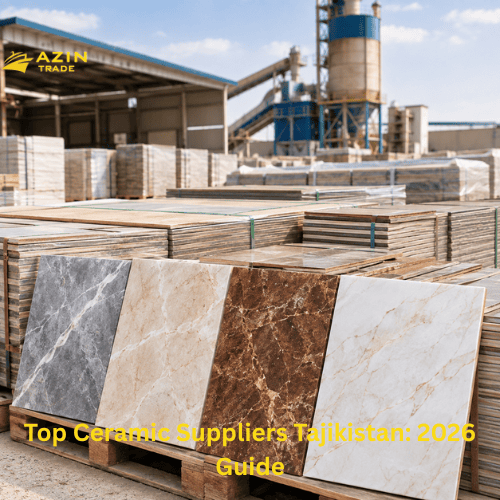
Top 10 Ceramic Suppliers in Tajikistan (2026)
Tajikistan has quietly become one of Central Asia’s most important ceramic tile markets. Import volumes have grown steadily, and as a result, the country now ranks as the region’s second-largest ceramic tile importer, behind only Kazakhstan, according to IndexBox’s Central Asia Ceramic Tile Market Report. In fact, Tajikistan is also the fastest-growing importer in the entire region. Therefore, understanding who actually supplies this market matters for buyers, distributors, and exporters alike. For Iranian producers weighing where to expand next, Tajikistan’s growth trajectory makes it a market worth watching closely, alongside better-established corridors like Iraq and Afghanistan.
A quick note on methodology before the list. However, Tajikistan does not publish a single definitive ranking of named suppliers. Instead, this guide ranks the ten countries most likely to supply Tajikistan’s ceramic tile market, based on regional trade patterns, production capacity, and documented export relationships. Where specific companies are verifiably active in the market, we name them directly.
Tajikistan’s Ceramic Tile Market at a Glance
Tajikistan is landlocked, bordered by Uzbekistan, Kyrgyzstan, China, and Afghanistan. In fact, it has no direct border with Iran, Turkey, or Russia, so nearly every imported tile travels through at least one transit country before arriving. This geography shapes almost every supplier relationship discussed below, and it explains why transit routing gets its own dedicated section later in this guide.
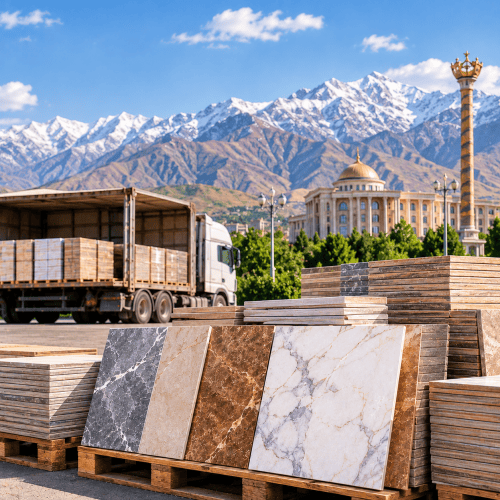
- Construction activity has driven steady tile demand growth. Specifically, urban housing and infrastructure projects across Dushanbe and other regional centers continue to expand.
- Price sensitivity remains high across the market. Because average incomes are lower than in neighboring Kazakhstan, mid-range and budget tile segments still dominate overall demand.
- Design preferences increasingly follow broader regional trends. Neutral tones, stone-look finishes, and wood-effect tiles have all gained popularity in recent years.
- Construction activity in Tajikistan also follows a fairly predictable seasonal pattern. Most major building projects concentrate work during the warmer months, which means tile orders often peak in spring and early summer as contractors plan ahead for these windows.
1. Uzbekistan
Uzbekistan tops this list of ceramic suppliers for a simple reason: production scale. Indeed, Uzbek ceramic tile output exceeds that of Turkmenistan, the region’s second-largest producer, by more than tenfold, according to the same IndexBox regional report.
- Direct land access keeps logistics costs low. As a result, trucks can move tile shipments from Uzbek factories into Tajikistan without crossing a third country.
- Uzbekistan has invested heavily in modern tile production lines in recent years. Consequently, this has improved both output volume and finish quality, narrowing the gap with more established exporters.
- Price competitiveness remains Uzbekistan’s strongest advantage. Therefore, for budget and mid-range projects, Uzbek tile often undercuts imports arriving from farther away.
2. Iran
Iran holds a distinctive position among ceramic suppliers to Tajikistan, and not just for commercial reasons. Trade between the two countries has quadrupled in recent years, reaching hundreds of millions of dollars, according to OilPrice.com’s coverage of Iran’s regional trade routes.
- Persian and Tajik are closely related languages. This genuinely eases business communication. In fact, Tajik is essentially a Persian dialect written in Cyrillic script, so many commercial terms translate almost directly.
- CERAMPAKHSH, one of Iran’s largest ceramic tile exporters, explicitly lists Tajikistan among its regular buyer markets. The company has said that Iranian tile now reaches 52 countries despite ongoing sanctions pressure.
- Araz Tile is another established Iranian exporter active in regional markets. Over time, it has built over a decade of experience shipping ceramic and porcelain tile across Central Asia and neighboring regions.
- Iran also benefits from improving transit infrastructure. The Mashhad-Bafq-Bandar Abbas railway, completed with ECO assistance, cut around 500 miles off the route connecting Central Asian markets to Persian Gulf shipping lanes.
3. China
China remains a dominant force in almost every ceramic tile market worldwide, and Tajikistan is no exception. Indeed, its manufacturing scale and export infrastructure give it reach few competitors can match.
- Chinese factories offer an unusually wide design range. As a result, buyers sourcing large, uniform orders often turn to Chinese suppliers for consistency at scale.
- Rail links through Kazakhstan and Uzbekistan increasingly support Chinese tile shipments into Central Asia. Consequently, this has shortened delivery times compared with older sea-and-road routing.
- Price remains China’s core advantage, particularly for large commercial and infrastructure projects where budget outweighs brand preference. This makes Chinese suppliers a common default choice for government-backed construction programs across the region.
4. Russia
Russia has supplied Central Asian ceramic tile markets for decades, building on Soviet-era trade infrastructure that still shapes regional buying habits today.
- Established distributor networks give Russian suppliers an operational edge. In fact, many Tajik importers already have long-standing relationships with Russian trading houses.
- Russian tile is generally positioned in the mid-range segment. As a result, this overlaps directly with the price bracket most in demand across Tajikistan’s construction sector.
- Regional data on nearby Kazakhstan shows Russia among the top three suppliers of ceramic tile imports, alongside China and Uzbekistan. Similar patterns likely apply across the wider Central Asian market.
5. Turkey
Turkey has built a strong global reputation in ceramic tile manufacturing, and that reputation increasingly extends into Central Asia.
- Turkish tile is often positioned as a step above budget options. Consequently, buyers looking for a quality upgrade without paying full European prices frequently choose Turkish brands.
- Design innovation is a genuine strength. Turkish manufacturers regularly introduce new finishes and formats that influence broader regional taste.
- Growing trade ties across the CIS region support Turkish export logistics into Central Asia, even without a direct land border with Tajikistan.
6. Kazakhstan
Kazakhstan plays a dual role in this market, since it is both Central Asia’s largest ceramic tile importer and a growing regional producer in its own right.
- Some Kazakh production is re-exported. It is then distributed onward into neighboring Tajikistan. This is especially true, for example, for northern Tajik regions with strong Kazakh trade links.
- Kazakhstan’s role as a regional transit hub also matters. Tiles imported into Kazakhstan from Russia or China sometimes continue onward into Tajik markets through established distributor chains.
7. Turkmenistan
Turkmenistan’s importance comes less from its own tile production and more from its role as a transit corridor.
- Turkmenistan shares an 1,100-kilometer border with Iran, making it the principal overland link between Iran and the rest of Central Asia. Specifically, the Sarakhs border crossing handles much of this traffic.
- Tajikistan has directly invested in this corridor. In October 2022, the country launched its own multimodal freight route from Kulob to China via Uzbekistan, Turkmenistan, and Iran, which also supports incoming Iranian goods.
8. India
India has expanded its footprint in ceramic tile export markets worldwide, and Central Asia is increasingly part of that expansion.
- Indian manufacturers offer competitive pricing on mid-range porcelain and ceramic tile lines. As a result, this makes Indian product attractive for large residential developments.
- Regional trade reports covering Central Asian ceramic tile imports list India among the countries supplying the market, alongside Iran and Kyrgyzstan.
9. Belarus
Belarus is a less obvious name on this list, but it appears consistently in regional ceramic tile trade data for Central Asia.
- Belarusian tile typically arrives through established Russia-linked distribution networks. Even so, this keeps logistics relatively simple despite the distance involved.
- Product positioning tends toward practical, mid-range finishes rather than premium design lines. This makes Belarusian tile a reasonable fit for standard residential projects where budget matters more than design differentiation.
10. Spain and Italy (Premium Segment)
No global ceramic tile discussion is complete without Spain and Italy, the traditional leaders of the premium design segment.
- Spanish and Italian tile typically enters Tajikistan in smaller volumes, aimed at high-end residential and commercial projects. Even so, price points sit well above regional alternatives.
- These brands remain influential even at low volume. In short, design trends set in Europe often filter down into what regional manufacturers, including those in Iran, Turkey, and China, choose to copy or adapt.
Common Tile Formats and Sizes in Demand
Beyond country of origin, format and size preferences shape which suppliers win business in Tajikistan. These preferences have shifted noticeably over the past few years.
- Large-format floor tiles have grown in popularity for both residential and commercial projects. Sizes in the 60×60 centimeter and 80×80 centimeter range are increasingly common in newer developments.
- Wood-look and stone-look porcelain remain strong sellers. These finishes let builders achieve a premium appearance without the cost or maintenance burden of natural materials.
- Smaller mosaic and decorative tiles still hold a steady niche. Bathrooms and accent walls continue to drive demand for these smaller formats, regardless of which country supplies the base product.
- Suppliers who can offer both large-format and decorative lines in a single order often win repeat business. Consequently, exporters willing to diversify their catalog have an edge over single-format competitors.
How Ceramic Tiles Actually Reach Tajikistan
Because Tajikistan has no coastline and no direct border with several major suppliers, logistics planning shapes almost every sourcing decision buyers make.
- Land routes dominate trade with Uzbekistan, Kyrgyzstan, and China. Generally, trucking remains the fastest and most flexible option for these neighboring markets.
- Iranian goods typically transit through Turkmenistan and Uzbekistan before reaching Tajik territory. Specifically, the Sarakhs crossing and connecting rail lines carry a significant share of this traffic.
- New multimodal corridors are reshaping regional logistics. The Turkmenistan-Uzbekistan-Tajikistan corridor, along with Tajikistan’s own China-to-Iran freight route launched in 2022, are both actively expanding capacity.
- Buyers should always confirm current transit conditions before committing to large orders. After all, regional corridors can shift quickly based on infrastructure investment, political developments, or seasonal border conditions.
- Seasonal weather adds another layer of planning. Mountain passes connecting Tajikistan to neighboring countries can face winter closures, so timing large shipments around this risk matters.
- Freight consolidation helps smaller buyers manage cost. Because full container loads are not always practical for smaller distributors, many importers work with trading intermediaries who consolidate shipments from multiple suppliers.
Why Iran Deserves Special Consideration
Among all ten suppliers on this list, Iran offers a combination of advantages that few competitors can fully replicate.
- Linguistic and cultural affinity genuinely reduces friction in business communication. Indeed, shared Persian heritage between Iran and Tajikistan shows up in everything from contract negotiations to marketing materials.
- Trade volume growth backs this up. Meanwhile, Iran-Tajikistan trade has quadrupled in recent years, signaling growing commercial confidence between the two countries.
- Competitive Iranian pricing, driven partly by currency dynamics, keeps Iranian tile attractive even after transit costs through Turkmenistan and Uzbekistan are factored in. For buyers comparing options more broadly, our guide to ceramic tile export to Armenia shows how Iranian exporters approach other regional markets with similar transit challenges.
- Diplomatic and economic ties between Iran and Tajikistan continue to strengthen at the government level. This broader relationship often translates into smoother customs processes and fewer bureaucratic delays for legitimate trade shipments.
How Pricing Typically Compares Across These Ten Suppliers
Price is often the deciding factor for Tajik buyers, given the market’s overall price sensitivity. Even so, pricing patterns differ meaningfully depending on where the tile originates and how it travels.
- Uzbekistan and China generally anchor the budget end of the market. Their combination of production scale and relatively short or well-established transit routes keeps landed costs low.
- Iran and Russia typically sit in the low-to-mid range. Currency dynamics in both countries can shift pricing from one order to the next, so buyers should confirm current rates rather than relying on older quotes.
- Turkey and India generally occupy the mid-range tier. Their pricing reflects a step up in design variety or brand recognition compared with the more budget-focused suppliers on this list.
- Spain and Italy remain the premium tier by a wide margin. Buyers choosing these suppliers are typically paying for design exclusivity and brand prestige rather than raw material cost.
- Kazakhstan, Turkmenistan, and Belarus tend to fall closer to the budget-to-mid range, depending on the specific product line and how much of the shipment passes through paid transit corridors along the way. Buyers comparing quotes across all ten suppliers should always ask for landed cost estimates rather than factory-gate pricing, since transit fees can meaningfully change the final ranking.
Quality Standards and Certifications Buyers Should Expect
Quality expectations vary noticeably across the ten suppliers on this list, and buyers should not assume every exporter meets the same baseline. Understanding these differences helps prevent costly disputes after delivery.
- European suppliers, including Spain and Italy, typically carry the most rigorous certification standards. As a result, their documentation is usually the most straightforward to verify.
- Chinese and Turkish manufacturers increasingly offer internationally recognized certifications as well. However, quality can still vary significantly between individual factories, so buyers should request specific factory documentation rather than relying on country-level reputation alone.
- Iranian exporters serving established markets, such as CERAMPAKHSH and Araz Tile, generally provide standard export documentation, including quality certificates and packing lists. Even so, first-time buyers should request references from existing regional clients before placing large orders.
- Regional producers such as Uzbekistan and Kazakhstan have improved certification practices considerably in recent years. That said, buyers working with newer or smaller factories should still verify current certification status directly, since standards can vary by facility age and investment level.
A Buyer’s Checklist for Sourcing Ceramic Tile Into Tajikistan
Choosing a supplier from this list is only the first step. The following checklist helps buyers avoid the most common mistakes when sourcing ceramic tile for the Tajik market.
- First, confirm the supplier’s actual export history to Tajikistan or the wider Central Asian region, rather than relying on general claims of international reach.
- Second, clarify transit routing in advance. Shipments from Iran, Turkey, or Europe typically require at least one transit country, which affects both cost and delivery time.
- Third, request samples before committing to volume. Regional climate and installation practices can affect how certain finishes perform in practice.
- Fourth, verify documentation standards. Certificates of origin, quality certifications, and packing lists should match the requirements of Tajik customs authorities.
- Finally, compare total landed cost, not just factory price. Transit fees, currency conversion, and insurance can shift the real cost ranking between suppliers significantly.
Conclusion
Sourcing ceramic tile for Tajikistan is not a one-size-fits-all decision. It depends on budget, timeline, and how much design flexibility a given project actually needs.
The ceramic suppliers shaping Tajikistan’s market span the region and beyond, from neighboring Uzbekistan’s production scale to Iran’s cultural and commercial ties, and from China’s manufacturing reach to Europe’s design influence. Therefore, buyers who understand both the supply landscape and the logistics behind it are far better positioned to source reliably. Given Tajikistan’s status as the region’s fastest-growing ceramic tile importer, this market is only going to matter more in the years ahead. Suppliers who invest now in reliable logistics and genuine local relationships will likely hold a meaningful advantage as demand continues to climb. For now, Uzbekistan and Iran appear best positioned among the group, combining proximity, pricing, and, in Iran’s case, a cultural connection that few other suppliers can offer.
Interested in sourcing ceramic tile or related building materials directly from Iranian producers? Explore our clinker export from Iran guide or our Top Grey Cement Suppliers 2026 guide for a broader look at Iran’s regional export capabilities.