
Tile and Ceramic Export Obstacles in the Afghanistan Trade
Iranian manufacturers face a growing set of tile and ceramic Export Obstacles when shipping products to Afghanistan. This is one of their most important regional markets. In fact, Afghanistan ranks just behind Iraq among the neighboring countries that absorb most of Iran’s ceramic exports. However, the trade route between Iran and Afghanistan is far from problem-free. Industry estimates suggest that around 85% of Iran’s total tile and ceramic exports go to just three countries: Iraq, Afghanistan, and Pakistan. This shows how central this corridor is to the industry’s health. Even so, exporters continue to navigate real obstacles along the way.

Provinces like Yazd have invested heavily in this trade. Yazd alone accounts for roughly half of Iran’s national tile and ceramic production. It also hosts more than 3,000 active manufacturing units and employs around 100,000 people. As a result, the province has built direct trade routes into Afghanistan, including new rail links designed to move tens of thousands of tons of product per year. For a broader look at how this market works, see our complete market guide to Iran tile exports to Afghanistan. Despite this scale and proximity, exporters still face structural, financial, logistical, and political obstacles. Below is a detailed breakdown of the main tile and ceramic Export Obstacles. It also covers what they mean in practice for producers, traders, and buyers on both sides of the border.
1. Sanctions: A Root Cause of Tile and Ceramic Export Obstacles
Sanctions on Iran remain the single biggest constraint on the industry’s long-term competitiveness. This holds true even in markets like Afghanistan, where direct trade continues relatively unimpeded.
- Limited access to modern machinery and technology. Kilns, glazing lines, and digital printing equipment used by competitors in Spain, Italy, and Turkey are hard for Iranian manufacturers to import. As a result, innovation in design and finish quality slows down.
- Restricted access to raw materials and chemical inputs. Some glazes, frits, and specialty additives come from international suppliers. Because of sanctions, manufacturers often rely on costlier substitutes or lower-grade alternatives instead.
- Reduced capacity utilization. Weak domestic demand, combined with constrained export markets, has left much of the industry running at around half of its installed capacity. Consequently, per-unit production costs rise and squeeze margins on every shipment.
- Reputational friction with shipping and insurance providers. Even for legal, non-sanctioned routes like the one to Afghanistan, banks and freight companies often apply blanket caution to any Iran-linked transaction.
2. Currency Volatility Adds to Export Obstacles
One advantage of the Iran–Afghanistan corridor is that trade is often settled in Iranian rial. Many Afghan banks maintain branches or correspondent relationships inside Iran, which avoids some hard-currency conversion problems. Still, this doesn’t eliminate financial risk.
- Rial volatility makes long-term pricing difficult. A price agreed today may no longer be profitable once a shipment clears customs weeks later, especially during rapid inflation or exchange-rate swings.
- Short payment cycles dominate as a result. Because of this unpredictability, most trade happens through smaller, faster-turnaround deals rather than large, multi-month supply contracts.
- Formal credit or trade-finance instruments remain limited. Therefore, many transactions rely on personal trust rather than bank-backed guarantees, which raises risk for new entrants especially.
3. Transportation Bottlenecks: A Persistent Tile and Ceramic Export Challenge
Moving heavy, fragile ceramic products across the border is never simple. It remains one of the sector’s most persistent operational challenges. Our 2026 guide to exporting ceramic tiles from Iran to Afghanistan covers current shipping routes and lead times in more detail.
- Road-dependent routes face congestion. Even with newer rail options linking hubs like Yazd to Afghan destinations, most trade still moves by truck. Border crossings often bring long queues and unpredictable processing times.
- Rail capacity is still limited relative to demand. Initial rail contracts move only a fraction of what the industry could supply. Scaling up therefore requires further infrastructure investment on both sides of the border.
- Seasonal disruptions add further delay. Mountain routes and border regions can be affected by winter weather or security-related closures, creating supply gaps that are hard to plan around.
- Fuel costs and vehicle availability fluctuate too. This adds another layer of cost unpredictability to each shipment.
4. Product Fragility and Packaging Standards
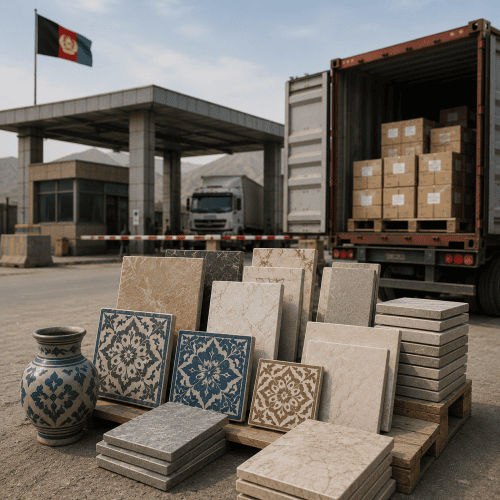
Tile and ceramic products are uniquely vulnerable during long overland transport. This is one of the most underappreciated cost centers in the trade.
- Breakage rates rise sharply with weak packaging. Products wrapped to standards suited for short domestic delivery often don’t survive multi-day overland journeys.
- Disputes over damaged goods happen often. These disputes are a recurring source of friction between exporters and importers, sometimes leading to refunds or damaged relationships.
- Better packaging adds real cost. Improved crating, corner protection, and moisture-resistant wrapping all raise the landed cost of each shipment, which cuts into thin margins.
- Handling practices vary at both ends. As a result, inconsistent loading and unloading at transfer points can undo even well-executed packaging.
5. Competition Intensifies Regional Export Obstacles
Iranian producers do not have Afghanistan’s market to themselves. Instead, they compete on several fronts.
- Chinese ceramics compete aggressively on price. They also offer a wide range of designs, even if quality is sometimes perceived as lower.
- Turkish producers compete on design and technology. In some cases, their finishing quality outpaces Iranian alternatives.
- Afghan buyers perceive clear quality tiers. Because of this, Iranian exporters must continually differentiate on design, durability, and price rather than proximity alone.
- Sanctions limit investment in design and R&D. Consequently, it becomes harder for Iranian manufacturers to keep pace with global design trends and glazing technology.
6. Security Conditions and Political Unpredictability in Afghanistan
Afghanistan’s internal situation directly affects how reliable this trade corridor is.
- Security incidents can disrupt routes quickly. They may delay deliveries or raise insurance costs for shipments already in transit.
- Regulatory changes often arrive with little notice. Afghan customs rules, tariffs, and documentation requirements can shift suddenly, forcing exporters to adapt fast.
- Enforcement varies across border crossings. Consequently, the same paperwork might clear smoothly at one crossing yet stall at another.
- Insurance costs rise in less stable regions. This ultimately affects how competitively exporters can price their goods.
7. Informal Trade Networks Compound Tile and Ceramic Export Obstacles
Much of this trade still runs on personal relationships rather than standardized, government-backed frameworks.
- Established traders benefit from long-standing ties. They also draw on informal credit arrangements and deep knowledge of customs processes.
- New entrants face a steep learning curve instead. Smaller producers often struggle to break in without existing contacts or documented trade infrastructure.
- Dispute resolution remains largely informal. As a result, disagreements over quality or payment terms often favor whichever party has more local leverage.
- Government-to-government agreements remain limited. So the industry largely self-organizes, which works at current volumes but limits future scalability.
8. Quality Control and Standardization Gaps
- Grading and labeling standards are inconsistent. This can confuse buyers comparing products from different manufacturers.
- Third-party certification is limited. Therefore, premium Iranian producers struggle to distinguish themselves from lower-cost competitors.
- Manufacturing quality varies across producers. With over 3,000 active units in Yazd alone, Afghan importers sometimes face inconsistent quality even within one country of origin.
tile and ceramic export obstaclesOpportunities Despite the Export Obstacles
Even so, none of this changes the fundamental appeal of the Afghan market for Iranian producers.
- Geographic proximity keeps costs lower than for more distant competitors.
- Cultural and linguistic similarity simplifies communication and relationship-building.
- Rial-based settlement removes a major barrier that complicates trade with most other destinations.
- Demand for construction materials stays strong, driven by ongoing rebuilding and housing needs. This same demand also supports related building materials, such as white cement exports from Iran to Afghanistan.
- New rail infrastructure signals room for growth, especially as capacity keeps expanding.
tile and ceramic export obstaclesHow to Overcome Tile and Ceramic Export Obstacles
- Expand rail capacity to reduce dependence on road transport
- Establish formal, government-backed trade agreements for construction materials
- Invest in standardized packaging protocols suited to overland transport
- Develop third-party quality certification systems for premium producers
- Encourage trade-finance instruments that reduce reliance on informal payments
Conclusion
Iran’s tile and ceramic trade with Afghanistan is a resilient, high-volume relationship. It is built on proximity, currency practicality, and genuine market need. However, ongoing tile and ceramic Export Obstacles still limit how quickly the sector can scale. These include sanctions-driven technology gaps, currency instability, fragile infrastructure, and an informal trading culture. Therefore, producers who invest in better packaging, formal contracts, and consistent quality standards are best positioned to turn Afghanistan’s steady demand into lasting export growth.
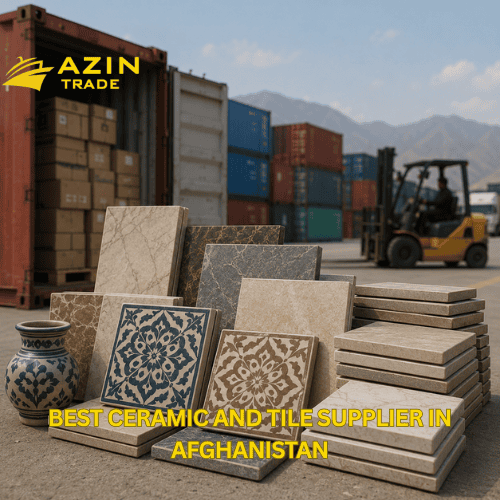
Interested in exporting tile and ceramic products to Afghanistan or other regional markets? Understanding these Export Obstacles is the first step toward a more resilient strategy. If you’re looking for a reliable partner, see our guide to the best ceramic and tile supplier in Afghanistan.
Related posts